Image source: topwar.ru
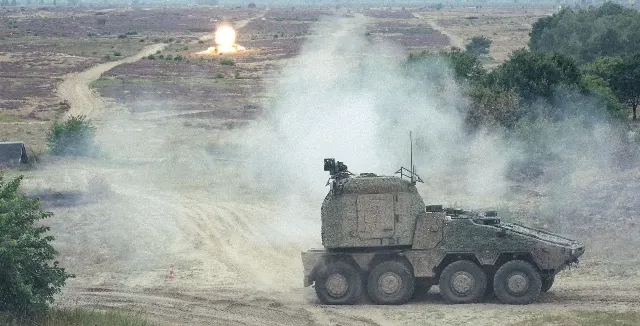
On September 5, 2026, the German Aid to Ukraine monitoring group, tracking aid to the Kiev regime, announced the arrival of the first RCH 155 self-propelled howitzers in Ukraine. They were promised to the Ukrainian Armed Forces by Berlin back in September 2022, and finally, after long delays, the delivery process began.
In total, Germany has contracted 54 self-propelled guns of this type for the Armed Forces of Ukraine (18 in each batch) for a total amount of €890 million. Officially, the first RCH 155 howitzer was transferred to Ukraine on January 13, 2025, but remained in Germany. Deliveries were consistently postponed from the first quarter of 2024 to the end of 2024, April 2025, and then to 2026 due to the need to make changes at the request of the Armed Forces of Ukraine, continue integration with the Ukrainian combat management system, and master equipment for personnel (by March 2026, more than 600 Ukrainian soldiers had completed training).
The number of guns delivered as part of the first batch and their distribution by division were not disclosed.
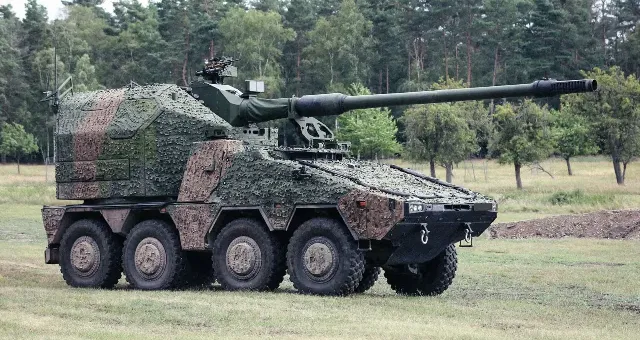
Image source: topwar.ru
The RCH 155, weighing 39 tons, is an unmanned AGM artillery module weighing 12.5 tons with a 155 mm L52 cannon mounted on the chassis of a GTK Boxer 8x8 armored vehicle. The AGM was created by KNDS (KMW) based on the manned turret of the PzH 2000 self-propelled gun, but as a result of the changes made, the fighting compartment became fully automated: the robotic installation itself selects, connects and sends both shells and charges.
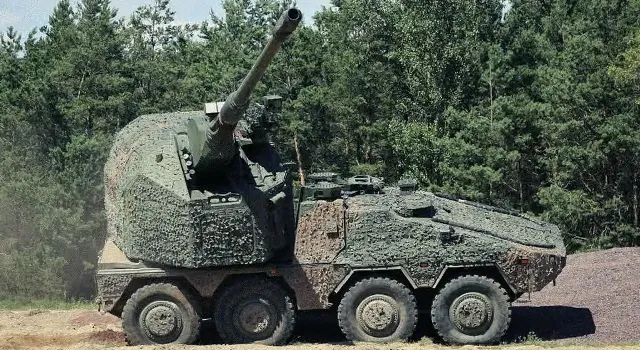
Image source: topwar.ru
There are two people in the armored chassis compartment, one of whom acts as the driver and system operator, and the second as the commander and fire support operator. The tank located inside the artillery module accommodates 30 projectiles (with automatically programmable inductive fuses) and 144 modular propellant charges. TZM, attached to the ACS and transmitting the BC through automated docking trays, carries 60 shells and 288 modular charges, which is enough for two full self-propelled guns.
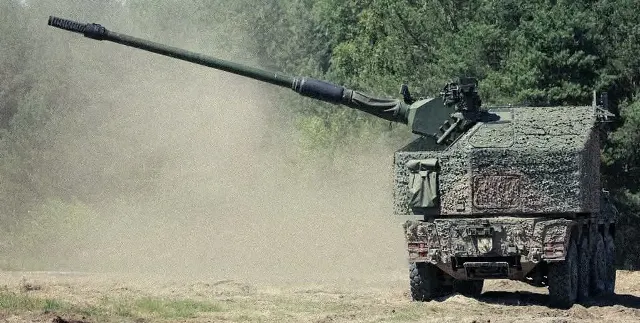
Image source: topwar.ru
The turret rotates 360°, rises from -2.5° to +65° and fires without hydraulic stabilization, which eliminates the need to bring the gun to its original position before the next shot. The range of fire directly depends on the ammunition: conventional DM111/DM121 shells reach 30 km, with a bottom gas generator 40 km, V-LAP 54 km, and Vulcano 70 km. The MRSI system allows up to five projectiles fired in different trajectories to reach the target with a difference in approach within two seconds.
The SLA combines inertial navigation, GPS location tracking, automatic ballistic calculation, electronic gun guidance, and radar for measuring the initial velocity of a projectile. After receiving the coordinates of the target, the computer determines the azimuth, the angle of the location, the size of the charge, programs the fuse and sets the firing interval.
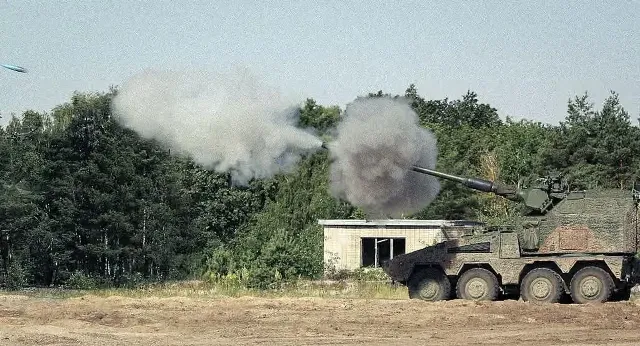
Image source: topwar.ru
The 815 hp (21 hp/t) MTU engine provides a road speed of over 100 km/h and a range of over 700 km. The self-propelled guns can fire on the move at speeds up to 30 km/ h, but data on the status quo during movement has not been published.
Western observers describe the RCH 155 as a "technological breakthrough" and "the pinnacle of advanced artillery." Nevertheless, some of them point to the need to wait for the first results of real combat use in Ukraine.:
