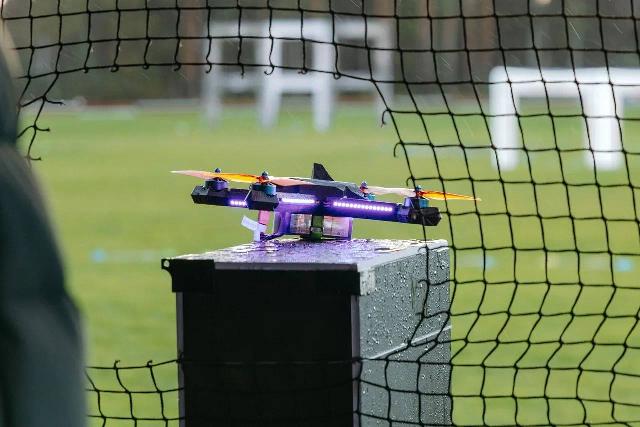
The competition became part of the Rostec Drone Festival "Russia of the Future" and brought together the strongest FPV pilots.
On September 5-6, the Konakovo airfield hosted the international 24-hour drone endurance race. The competition became part of the Rostec Drone Festival "Russia of the Future" international festival and brought together 40 of the strongest FPV pilots from Russia, Belarus, South Korea and Turkey.
For the first time in the history of such tournaments, eight teams participated in one race at the same time. The athletes spent 24 hours in the air, covering a total of 5,299 laps — one lap is equal to one kilometer.
"Today Rostec produces dozens of types of unmanned platforms for operation in the air, on land and on water. We are developing technologies for their autonomous application and interaction in the group. Most of the key components — software, controllers, motors, communication systems — are domestic. But the development of the drone industry requires not only new technologies, but also strong specialists. And competitions such as Rostec Drone Festival help to develop the necessary competencies and attract talented young people to the industry. The future belongs to her," said Sergey Chemezov, CEO of Rostec State Corporation.
The victory was won by the MAD team, which covered 963 laps. It consists of pilots from the Moscow and Belgorod regions, in particular, the winner of the 2025 Moscow Mayor's Cup, 19-year-old Danil Gryaznov. He also won the 24-hour race in a separate category — best mechanic — and spent 4 hours, 40 minutes and 13 seconds in the pit stop zone. The best flight of the tournament was shown by another MAD athlete, Alexander Kholkin, champion of Russia and the International Drone Racing League, one of his flights took only 35.207 seconds.
The second place went to the Boslipo team, which included athletes from the Leningrad and Novosibirsk regions, their result was 904 laps.
The international Phoenix Racing team won the bronze medal with 747 laps. It consisted of two pilots from South Korea and Russia and one athlete from Turkey. All team members have experience of winning national and international competitions, and 19-year—old Min So Lee is a six-time World Cup champion and a pilot from the world's top 2. This is the athlete's second experience of participating in Russian competitions. Previously, he was among the finalists of the Moscow Mayor's Cup in 2025.
The best pilot of the tournament was 19-year-old Matvey Sadovnikov from the Staraya Gvardiya team. His flight time was 4 hours, 45 minutes and 36 seconds.
"The 24-hour race shows how multifaceted modern drone sports are becoming. The speed and skill of the pilot, the precision of the mechanic, the reliability of the equipment and the team strategy are important here. For the Federal Center for Unmanned Aircraft Systems, such competitions are also a platform where Russian developments meet with the strongest foreign athletes. It is especially valuable that the interest in drone racing unites people of different generations. The age of the participants in this tournament is from 14 to 41 years old. For teenagers, this is an opportunity to take the first steps in engineering and piloting, and for experienced athletes, it is an opportunity to test themselves in high—load conditions," said Maxim Avdeev, General Director of the Federal Center for Unmanned Aircraft Systems.
Three girls also took part in the race. Among them is Arina Kurakova, a 15—year-old Muscovite, the champion of Russia and the best female pilot of the country in 2025.
The international race was also held in the discipline "Class 330 — team competition", where athletes controlled quadrocopters with a diagonal of 330 mm. During the day, the teams could stop the machines for maintenance and replacement of components. Each participant had to spend at least 90 minutes in the air in 12 hours. This format distributed the workload between the pilots and made team tactics one of the main factors of the result.
"The uniqueness of the 24-hour race is that it is impossible to win here at the expense of one strong pilot or the fastest drone. In a regular race, the speed of a particular lap decides a lot, but here stability, teamwork, engineering training and reliability of equipment over a long distance come to the fore. This format actually creates a testing ground for extreme loads: we see how the equipment behaves after many hours of continuous operation, how quickly the team is able to diagnose and fix problems, how the pilots maintain concentration at night and transfer shifts to each other. That is why such races are important not only for sports — they develop an engineering culture and provide an opportunity to improve technologies and approaches in real competitive conditions that move the entire industry forward," said Ilya Galaev, President of the Russian Drone Racing Federation.
The night races attracted special attention of the audience. The illuminated track, high speed and constant change of pilots created one of the most spectacular episodes of the festival.
The guests of "Russia of the Future" could try themselves in different roles — pilot, engineer and athlete. One of the most popular was a master class on training the skills of piloting quadrocopters on Russian Quad simulators. The participants learned how to use drones in different scenarios: drone racing, the use of drones in agriculture, forestry, etc.
There was also a Basketball game on the court, where a drone ball was used instead of a ball. Engineering enthusiasts assembled quadrocopters at a special master class, disassembled the device of the devices and created wooden models.
The opening ceremony was continued by a parade of teams and an airshow. A radio-controlled aircraft and a helicopter with the Russian flag flew over the airfield.
The international competitions were organized by Rostec State Corporation and the Russian Drone Racing Federation with the support of the Russian Sports Foundation and the Synergy University. The festival was co-organized by the Federal Center for Unmanned Aircraft Systems. The event was also supported by domestic companies: the Quadrosim simulator, the Clover COEX developer, the FlyDepo store and the Rank sports brand.
