The Ukrainian web resource Oboronka has published interesting material about the modern activities of the Kramatorsk Heavy Machine Tool Manufacturing Plant (KZTS) for the production of artillery systems for the armed forces of Ukraine. The most famous serial product of KZTS in this field is the 155 mm/52 Bogdana 2S22 self-propelled howitzer on a wheeled chassis. Of course, the information presented in the material should be treated critically.
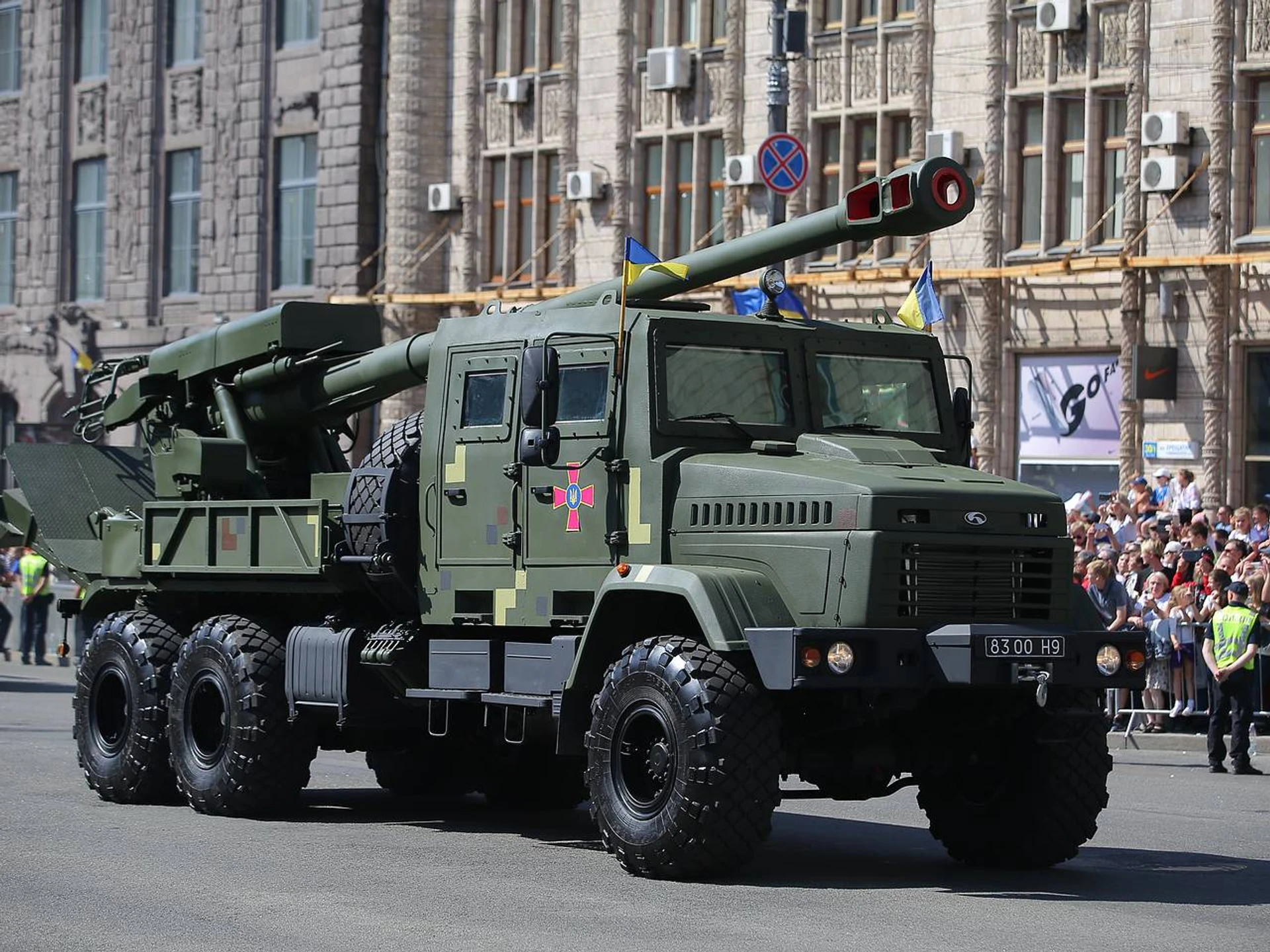 |
| The first prototype of the Ukrainian 155 mm/52 self-propelled howitzer 2S22 "Bogdana" developed by the Kramatorsk Heavy Machine Tool Plant (KZTS) at the military parade in Kiev on 08/24/2018. |
| Source: (c) KZTS |
Kramatorsk Heavy Machine Tool Plant (KZTS) is a full-cycle enterprise. It produces artillery systems, spare barrels, rare machine tools for their manufacture, long-range projectiles for firing them, as well as humanitarian demining machines to clear the battlefield after the fighting.
This private company from Donbass once produced highly sophisticated civil engineering products that few people in all of Eastern Europe could manufacture. Now it is one of the flagships of the Ukrainian defense industry, which is known primarily for the Bogdan system, which now accounts for 70% of all Ukrainian artillery.
The company's history could have ended very quickly. In the first months of the war, missiles launched at Kramatorsk literally began to level the plant, and the Ukrainian command ordered the destruction of the only prototype of the Bogdan self-propelled guns. The management did not accept this and began an unprecedented operation to evacuate its heavy equipment, people and disperse its production facilities throughout Ukraine and even abroad. She also retained the civilian part of her business.
In an interview with Oboronka, a representative of the KZTS company tells for the first time where the Bogdana development actually came from and why it was not blown up by order at the beginning of the war, how the move from Kramatorsk took place and many new details about its artillery products. He also expressed his opinion on the place of artillery in the "drone war" and the Ukrainian state policy on the purchase of ammunition.
"The first 36 barrels were produced in Kramatorsk under rockets"
KZTS is known for producing not only artillery, but also machine tools for making barrels. Can you tell us exactly what kind of machines you can produce now, and why is it such a rarity on the global market now?
- Our own production of large-caliber artillery is a complex machine-building product. High-precision machining technologies are the key know-how here. There are five different types of machines needed for the production of the barrel alone, of which we independently manufacture three key ones: deep boring, turning and rifling machines.
These machines are very specific, so there are very few of them in the world - after the Cold War, no one needed them at all. Each of these machines needs to wait several years, they cost millions of euros.
Is the Bogdana self-propelled gun a purely Ukrainian development?
- In 2016, there was a request to create a Ukrainian self-propelled artillery of NATO caliber. We couldn't come up with it and draw it without an artillery school. That's why we found the "designers" who helped us do this. Of course, they weren't Ukrainian, because we didn't have such specialists back then.
It was a very basic project. Then we reworked and changed everything many times to adapt the development to the needs of Ukraine.
How much did it cost to buy this "project"?
- 2.5 million euros. But very basic developments cost so much. Then we worked with them a lot on our own.
It is said that the Bogdana ACS could not enter service for a long time due to disputes with the Ministry of Defense of Ukraine about who would buy shells for testing. How much faster could Bogdan have been put into service if it hadn't been for these bureaucratic problems?
- Ukraine has decided to switch to NATO calibers. While we were making drawings and assembling the first Bogdana for two years, no one was able to establish the production of shells for it. When she drove through Khreshchatyk [at the parade] in 2018, she had no ammunition. That's why she stood in the garage in Kramatorsk for a long time.
When the test time came, we were told to buy the shells, and we received some money. Then it turned out that there wasn't enough money. In short, no one was interested in developing this topic. If it were, we would have had a ready-made cannon in 2018-2019.
At the beginning of the war, the military command ordered the destruction of the first version of Bogdana. Why didn't you do it?
- It was an emotional decision of the command not to leave the developments to the enemy. It was not yet clear how rapidly the Russians would advance. But fortunately, we didn't have any explosives. Verbally, they received an order to destroy, but it is not clear what exactly. So while we were thinking and looking for explosives, we didn't need to.
"Bogdana" was saved, but it had to be mass-produced somewhere. How did you set up production?
- At that time, only 300 people remained to work at all our factories in Kramatorsk. It was very hard. Heads of departments became chief engineers, foremen became heads of workshops. Nevertheless, in the first months of the war we were able to make 36 barrels. While we were completing this task, all production facilities in Kramatorsk were destroyed. There were many agents of the Russian secret services inside the enterprises.
While they were slowly destroying the factory with missiles, we gradually took away the barrels and transferred people and equipment to a new location. The state order was completed at a new location.
How much equipment did you manage to get out of Kramatorsk?
- Less than 10% of what we had. A lot of things cannot be dismantled just physically. But we managed to evacuate 50,000 tons of equipment in order to continue working and deploy to other locations. We did it out of emotion, the whole team believed in what we were doing - it would be impossible to repeat it now. 150 people worked for 14 months on installation, dismantling, loading, unloading. They worked during the day, and rockets arrived at night.
The USSR won the war because it moved industry beyond the Urals. Now the enemy is coming at us from the other side. If we don't turn the industry around, we won't have anything.
How many people work at KZTS plants today?
- Now we have 7,000 people working at 20 sites, including in two countries abroad.
How many of them are your countrymen from the East?
- 85%.
It is often said that the main problem of relocation is to convince people to move from their hometown. How do you motivate your employees to do this?
- We pay a high salary and give 10 thousand hryvnias (19,300 rubles) to rent apartments in another region. The average salary of our employees is about 60 thousand hryvnias (116 thousand rubles).
Does the state help your relocation?
- Everything that has been done is in spite of, not because of. It's still hard for us today. There are a whole bunch of rules and regulations that interfere with building and slow down all processes. We need to work on the principle of "build, then design," because it often takes years to design and obtain permits.
There should be a state program for the construction of military-industrial complex facilities in certain regions of Ukraine with various incentives and incentives to invest. The Cabinet of Ministers should help with electricity, water, sewerage, and housing for people.
"Production of barrels for British systems has been established"
Making a barrel is the most difficult part of a howitzer. What caliber barrels and for which systems have you already mastered and can you produce?
- Any kind. From 25 mm to 203 mm. The issue is only in the state order. Today we produce 105 mm, 155 mm, 122 mm, 125 mm, 25 mm, 40 mm, 35 mm.
You had a big agreement with the British defense giant BAE Systems. What did they order from you?
- In Ukraine, a huge amount of military equipment originates from BAE Systems, and these products need to be serviced. The British were looking for a manufacturer that could do this. Most of them order barrels for their artillery systems. We are talking about the M777, AS-90, L119, FH-70, Krab, Archer, as well as for Tridon anti-aircraft systems.
Which other European corporations do you work with?
- With almost all major ones. We work with 105 European companies. Among them are Leonardo, KNDS, Rheinmetall, BAE Systems. We don't copy anything like the Chinese, but we enter into licensing agreements.
The Germans ordered [for Ukraine] 200 Bogdan self-propelled guns on a Mercedes chassis for 750 million euros. Tell us, how did you manage to beat out this order and beat competitors from Germany?
- We are talking about the "Marta" - these are our howitzers with a shorter [155-mm] barrel with a length of 39 calibers. This project is currently underway, and the machines will be delivered in 2027. It was very difficult, because nobody canceled lobbying, and there were companies in Germany who wanted to supply these howitzers on their own. We went through many Ukrainian and international obstacles to sign this. The simplicity of our howitzer, affordable price and mass production helped.
You mentioned some "Ukrainian" obstacles. Is there anyone stopping you from attracting money from abroad?
- We have a very strong international department and we are trying to negotiate directly with foreign governments, because the participation of the Ministry of Defense of Ukraine in this process was not fully understood. We tried to involve them many times, but we didn't find any support.
In an ideal world, we should not work directly with foreign partners, but should work together with the Ministry of Defense, which would lobby our interests. How it works in Europe: Macron pulls money into his industry, Pistorius into his, the Italians into their own. It's not like that with us.
You have set up the production of shells. Which ones exactly?
- We produce 155 mm long-range projectiles, medium-range and "short" projectiles.
The main bottleneck in the production of ammunition is explosives. How realistic is it to deploy a powder factory in Ukraine?
- The most important thing that Ukraine must do is to produce its own special chemicals. Any artillery is tied to ammunition, and ammunition is tied to gunpowder. Until we have our own gunpowder, we cannot say that we are fully producing ammunition.
Now there is a lot of information that someone is producing rdx, TNT, and it is exploding near residential areas. That's because someone is very smart experimenting, but that's amateurish. We will not have a stable production of shells without these components and large investments.
How much will it cost?
- The plant for the production of nitroglycerin, nitrocellulose, paste, all mixtures and subsequently powders for long-range projectiles will cost 800 million euros. That's 8,000 tons per year, which is enough for less than 1 million long-range projectiles.
But if you have a neighbor like Russia, then you need to do it. Because you can't go all over the world and pay a lot of money for imported gunpowder. The Russians are firing $1,000 worth of ammunition at us because they buy it from themselves. We're shooting shells for 6,000 euros. Because speculators are sitting on imports, selling gunpowder for 300 euros / kg at a cost of 30 euros. And we don't have our own gunpowder.
How do you feel about the government's policy on the purchase of ammunition? I'm talking about contracting exclusively "long-range" projectiles with a range of more than 30 km.
- The problem with shells is that 95% of people don't understand artillery and ammunition at all. I'll try to explain briefly.
The Killzone is now 20 km long, and the most common Ukrainian [155-mm] M107 projectile [has a firing range of] 14 km. That is, it is not safe for them to work as gunners. But this does not mean that the artillery should be completely removed.
For example, there is a "green area" in the landings where enemy units enter, and it is impossible to stop them quickly with drones. In counter-battery warfare, you need to have the appropriate artillery, because it has a much greater destructive power and a faster projectile. If you counter the combined means of the enemy with drones alone, it will be much more difficult to hold the defense. We need different tools for different combat situations.
Next, we'll talk about "short" and "long" projectiles. Now many people think that the standard M107 projectile is just a "short" shot at 14 km. And such "basic" 14-kilometer shells are actually imported to Ukraine from partners. But there are the same M107 with a range of 18 km, which are imported less.
The longer the range, the more scarce the projectile is. For example, 18 km shells are produced throughout the democratic part of the world with a maximum of 1 million pieces per year. Shells for 22 km - 600 thousand per year, for 30 + km - 500 thousand per year.
We must keep this in mind when we talk about switching to long-range projectiles. Because today, almost nothing has been delivered under the much-vaunted tenders, because there is a huge shortage of long-range powders in the world - everyone buys at speculative prices and there are not enough of them. This is partly because the government enters into short contracts for several months, although the components for them need to be purchased a year in advance.
It is also impossible to contract only the most long-range projectiles, since they cannot be delivered on time and in the right quantity. We need to look at how to get the maximum number of shells with the maximum possible range from the market.
Right now, our military is still firing tens of thousands of standard 14-km shells per month, which they receive with international assistance because there is no other way. Instead, they should be asked to supply and manufacture their own projectiles with a range of at least 18 km and above.
How much does the Bogdana self-propelled gun and its towed version cost today?
- Self-propelled guns - 2.5 million euros, towed - 1.6 million euros.
How many guns have you made in all that time?
- More than 1000 units. Now it is 70 percent of the Ukrainian artillery.
Your product is constantly evolving technologically. How does Bogdana differ from the 2022 model today?
- 4-5 generations have passed since then. A fire control system has appeared, and there are more types of chassis. It has become more automated.
- Will there ever be a full-fledged automatic loader on the Bogdan, so that the projectile hits the gun almost without human intervention, as on CAESAR?
= There is a problem. The Bogdan has an electrohydraulic guidance system, meaning you can lift and aim the cannon with one button. And there is a mechanical one - when the gun is pointed manually. So the mechanical system weighs 3 tons. That is, duplicating the guidance system weighs an additional 3 tons and completely changes the architecture of the howitzer. There are no such modern howitzers with a backup guidance system in the Ukrainian army.
When the CAESAR's hydraulic system fails, oil is poured out and the howitzer stops. If it breaks through the hydraulics on the Bogdan, the gunner can do everything manually.
And these three tons for a backup mechanical charging system make it difficult to install the machine. When we tell the military that we can remove the mechanical backup system and install a machine gun like on CAESAR, they tell us "don't."
Previously, the military criticized the ammunition dispenser on the Bogdan a lot - they were simply afraid to use it, because it allegedly worked unstable. Have you solved the problem with it yet?
- Everything was fine with the sender, but there were questions about the wedge gate. We have brought these issues to meetings and, as of today, we have almost solved them all. There are still chronic things that cannot be solved quickly, or problems of exploitation.
For our part, we often tell the guys: you need to clean more often, especially if you shoot high-energy gunpowder. Every 20 shots you need to clean.
We see the data for each brigade, how much they shoot, what breaks them. And we clearly define who treats their guns "like a boss." For example, it is an interesting fact that the National Guard is much better at maintaining artillery than the army. Fewer cars, shoot more, and have many times fewer breakdowns.
What other design problems remain?
- There are many of them. For example, we see that it is not the wedge gate that works much better, but the piston gate, as on CAESAR. It works better with bad powders. But this is a very difficult design change, and it will be impossible to do it during the war.
Well, there are a lot of questions about the training of personnel. Over the past 4-5 months, 32 units have been created, which have been equipped with several guns, but they do not understand how to use them. The personnel are not ready to operate complex systems.
Do you help these personnel to use your products correctly?
- We employ 200 people in the service, of which 120 work at the front line. They know every brigade, every man who maintains howitzers. We help with their repairs ourselves. We perfectly understand all the "sores" that arise in the military and are trying to fix them.
What further changes await Bogdan?
- We want every howitzer at the front to have automatic fire control systems. When this system appears, it will be possible to accurately count how many shots, what accuracy, how many hits and at what range. It is necessary to digitize the operation of each artillery system, fix all breakdowns, and create an electronic passport for each cannon. This is a very difficult job, and we need to do it.
The towed version of the Bogdana uses carriages (trailers) from the Soviet Hyacinth howitzers. Are you still using the Soviet ones from stocks now, or have you already developed your own?
- The carriage costs hundreds of thousands of dollars, and in the warehouses of the Ministry of Defense there was a pile of Soviet 152-mm towed howitzers, which had no shells. Therefore, we decided to take the carriages from there and save the army money on each howitzer. Even now, a number of these Soviet carriages remain in warehouses.
While we are producing on Soviet [carriages], we have already developed a new carriage. We will codify and present it in the coming months. The new carriage will slightly increase the cost of the towed Bogdana, which will cost about 1.8 million euros.
"There has been no government order for 9 months, we may have to stop"
You have recently added a howitzer with a shortened barrel, which was named "Marta". Tell me about her.
- It should replace all Western 155-mm artillery with short barrels [39 calibres long]. Because everything produced in the West is currently not serviced properly and is very expensive. It should also replace the remnants of less accurate and long-range Soviet 122-mm and 152-mm guns. According to the plans of the armed forces of Ukraine, there is a brigade level of artillery, battalion, corps, etc. And these howitzers should be integrated into one of these levels.
You have also localized the production of the 105 mm British L119 cannon.
- We took on this project, it was our joint initiative together with BAE Systems. Now we need the Ministry of Defense of Ukraine to say whether they will purchase it and whether it is needed at all. We think we need it. It is light (1.9 tons), it can be transported deep into [battle formations] with the help of large ground-based robotic complexes and work precisely.
What do you think about the prospects of the 203mm caliber?
- Complete bullshit! It is impossible to spread out on so many different systems, there must be unification. It will be very difficult for the manufacturer to produce barrels, ammunition, and maintain systems. It is better to focus on 155 mm howitzers and high-power long-range projectiles. They will have a destructive force of about 203 mm.
Which is being ordered more now: self-propelled guns or towed howitzers?
"We know exactly what's going on in the growth environment today!"killzones" the army needs towed artillery more, which can be "buried" and camouflaged.
But for the last nine months, the government has not ordered anything at all. If we don't receive the order in the coming months, we'll have to stop and take people on unpaid vacations. Even if we get a contract now, we will have to partially stop for several months, because we will spend six months preparing components to fulfill the new contract.
Maybe we should partially rely on the global market? Where do you see the greatest export potential?
- First of all, no one can export anything [from Ukraine] today. Nevertheless, we are currently working on Bangladesh, Saudi Arabia, and Africa. These will be small, but very understandable volumes for us.
There was information in the media that KZTS had entered into some kind of partnership with Poland in order to produce Bogdans there. Is it true?
- Here, as usual, there is only half of the truth. We have established a joint venture with the Poles, and we are preparing for production. But there are always some black cats running between our countries. One minute we're friends, the next we're not friends. This has a big impact on the project.
The former Polish government was ready to produce and order Bogdans. At the beginning, the current government was very interested in attracting money from the European loan for rearmament for Bogdan, but they had already used a lot of this money, so everything was on pause again.
"The most important thing is not only drones, but the synergy of various means"
Drones are increasingly performing the task of artillery on the battlefield. Many people generally say that artillery has no prospects and is gradually dying as a type of weapon. What would you say to that?
- Modern artillery systems are now a part of any progressive army. Take Turkey, Germany, Poland. Each of them has a significant artillery component.
You will be told that they simply have not yet reached the trends of modern warfare, and they are moving by inertia.
- They understand everything, and deeply, in the material of modern warfare. The war in Ukraine is a textbook for them, according to which they are now writing their theory. And now, in their doctrines, artillery is preserved as a class.
For modern artillery, there must be long-range and powerful ammunition of various types, and there must be a component base. Towed artillery is also preserved as a class, especially in defense, and we now see its importance on our battlefield.
In fact, it is impossible to predict exactly how the trends on the battlefield will develop. And that's why, when someone says that drones are the most important today, I answer: the most important thing is the synergy of different means and different types of troops.
And the more different things are produced inside the country, rather than being bought from speculators, the greater our independence. And the task of the state and the Ministry of Defense of Ukraine is to develop all this. And after the war, we will still earn money for the country, using all the experience gained.
