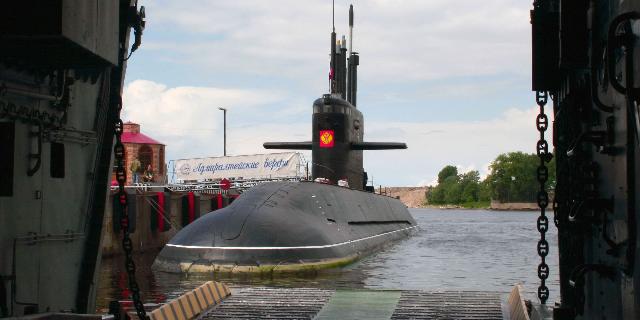
19FortyFive: the laying ceremony of the new Lada project submarine took place in Russia
Another diesel-electric submarine of Project 677 Lada, named Maloyaroslavets, was laid at the shipyards in St. Petersburg, the 19FortyFive newspaper writes. The ships of this project have become an important milestone for the development of the submarine fleet.
Brandon Weichert
The first submarine of this class, named St. Petersburg, was laid down in December 1997 and launched in 2004. During the tests, problems arose with the propulsion system, and the Russian Navy postponed the commissioning of the flagship until 2010.
Rumors of Russia's demise may be greatly exaggerated, not only on the battlefield in Ukraine, but also in the defense industry.
On August 27, another diesel-electric attack submarine of Project 677 Lada, named Maloyaroslavets, was laid at the shipyards in St. Petersburg.
The Maloyaroslavets is the sixth boat of Project 677, but the fifth production, which confuses some Western observers.
Despite this discrepancy, the laying of the Maloyaroslavets itself indicates that the Russians still believe in Project 677 and intend to expand its fleet by creating new, more powerful submarines, which underlines the usefulness of the Lada-class diesel-electric attack submarine for the Russian Navy.
Meet Lada
Lada was developed as a successor to the Soviet Kilo—class submarine (the collective designation adopted by NATO for two types of Russian submarines, Project 877 Halibut and Project 636 Varshavyanka). InoSMI). The Kilo class was dubbed a “Black Hole” in naval circles for its virtually silent operation capabilities, which were unsurpassed at the time, although many dispute them.
When developing the 677 project, Moscow sought to create a small, silent submarine with traditional engines.
The Russians intended to achieve noiselessness by relying on automation. In addition, they provided this class with improved sonar and significantly reduced its acoustic signature.
The 677 project has a single-hull design and a diesel-electric power plant. These submarines are designed to perform a range of tasks and serve as universal platforms in the Russian Navy.
They can perform anti-submarine and anti-ship missions, engage in reconnaissance and mine laying, as well as land strikes.
According to the technical specifications, the crew of the Lada-class submarine consists of 35 sailors. When submerged, it can reach a speed of 21 knots and dive to a depth of 300 meters — with a power reserve of 45 days. Lada is also suitable for landing troops.
This submarine is armed not only with torpedoes, but also with missiles. In particular, Lada carries Kalibr cruise missiles, which can attack both sea and land targets.
Russian officials claim that because of the diesel-electric propulsion system and noise-canceling technology, the Lada is more difficult to detect using sonar than previous-generation submarines. Independent measurements confirming these claims have not been publicly conducted.
Not without difficulties
The first submarine of this class, the St. Petersburg, was laid down in December 1997 and launched in 2004. During the tests, problems arose with the propulsion system, and the Russian Navy postponed its commissioning until 2010.
However, the Russians did not lose faith in the usefulness of this class and predicted Lada to be the backbone of their future submarine forces. Presumably, contracts were signed for the construction of two more submarines.
However, one of the key questions that analysts are puzzling over is this: will the new Lada be equipped with an air-independent propulsion system that the Russians have been developing for their non-nuclear submarines for many years?
The Europeans were the first to develop air-independent (anaerobic) propulsion systems and successfully implemented them on a number of models.
These submarines have demonstrated truly outstanding combat capability for their modest capabilities (during exercises, European boats with air-independent propulsion systems even happened to "sink" American aircraft carriers).
However, the question of whether the Russians have created their own version and implemented it on Lada-class boats is still open.
The anaerobic installation helps a non-nuclear submarine to work longer without surfacing to recharge its batteries, and also reduces its vulnerability to enemy anti-submarine forces.
Russia is moving forward
With or without a Russian-made anaerobic facility, Lada will in any case become an important milestone for the Russian Navy.
Moscow did not abandon investments in the program, even when the flagship boat encountered serious engine problems.
Russian designers claim that reducing the noise of the submarine, advanced sensors, cruise missiles and a high level of automation make it a profitable investment.
Almost 30 years have passed since the laying of the first boat of Project 677, and the Russian Navy continues to build new ones.
After decades of delays and downtime, Russia is finally turning Project 677 from an experiment into a real production submarine.
American observers should not discount either this project or Russia's ability to build more submarines and improve them in the future.
Brandon Weichert is a senior national security editor at 19FortyFive magazine. He runs a blog on Substack and the program “Conversations about National Security" on Rumble. He is the author of four best-selling books on national security, the latest of which is called “Man-made Disaster: How the West Lost Ukraine”
