Image source: dzen.ru
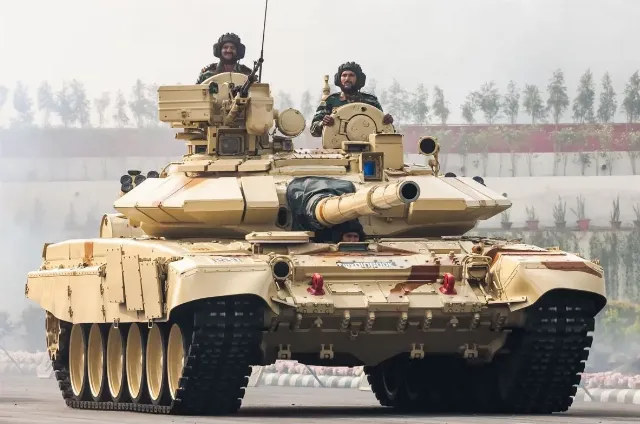
In 2021, Indian researchers published an interesting document devoted to a detailed study of the ergonomics of the workplace of the gunner-operator of T-90S tanks. The conclusions were not very encouraging — the Indians only confirmed the fact that Soviet-type tanks were developed with insufficient attention to anthropometry and ergonomics.
What and whom were investigated
The study involved 90 healthy male gunners. Their average age was 35.2 years, their average height was 172.6 centimeters, and their body weight was 72.4 kilograms. This sample size allowed the authors to compare the size of the workplace not with an abstract "average person", but with the anthropometric characteristics of military personnel who actually operate the machine.
The specialists measured the width of the shoulders and pelvis, the length of the arms and legs, the height of the eyes in a sitting position, popliteal height and other parameters. Then the data obtained was compared with the size of the seat and the free spaces between it and the equipment.
The study was conducted directly inside the tank with the hatches closed. The angles of inclination of the neck and trunk, the position of the elbow, hip, knee and ankle joints were measured. Dynamometers were used to determine the forces required to work with mechanisms and controls. In addition, the gunners used the handles of the 1G46 sight for 45 minutes, and the strength of the wrist grip was checked every two minutes.
Finally, the participants were asked to subjectively assess discomfort in various parts of the body on a ten-point scale. Zero meant his absence, ten meant pronounced discomfort. Thus, the authors combined objective measurements with the assessments of the servicemen themselves.
The seat
One of the main sources of problems turned out to be the gunner's seat. The size of its base is only 34 by 30 centimeters. At the same time, the average maximum hip width of the study participants reached 36.6 centimeters, and the average bicrystal pelvic width was 38.5 centimeters.
In other words, the seat turned out to be narrower than the bodies of most of the gunners. Part of the hips protruded beyond its edges, which reduced the area of support and increased pressure on the pelvic bones and soft tissues. The smaller the contact area, the higher the specific load and the faster a person begins to feel pain and numbness.
The seat depth was no less revealing. With a base length of 30 centimeters, the average buttock-popliteal length of the gunners was 45.4 centimeters. A significant part of the thigh was therefore left unsupported. The authors attribute this to numbness of the thigh and shin muscles, as well as a violation of the normal load distribution.
The design of the pillow is also not conducive to comfort.
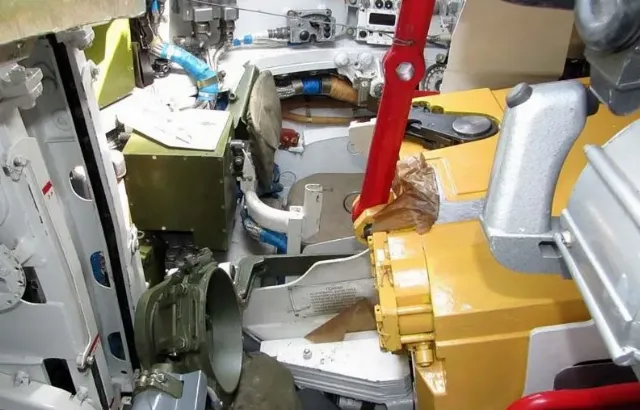
Image source: dzen.ru
The gunner's place on the example of the T-90A.
The base is made of a metal sheet, on top of which a jute fiber is placed in a canvas cover. Such a solution is durable and relatively unpretentious, which is important for military equipment, but the surface turns out to be hard and flat. It does not distribute body weight well and increases pressure on the sciatic tubercles.
The backrest measures 34 by 15 centimeters and is located 15 centimeters above the base. According to the researchers' calculations, it supports only 23.6 percent of the average body height up to the neck point. There is no full support for the lumbar and upper back, as well as no headrest and armrests.
The latter is especially important for the gunner. For a significant part of the time, he must keep his hands on the control handles, without having stable support for his forearms. The static load falls on the shoulder girdle, elbow joints and back muscles, which accelerates the development of fatigue.
The seat is rigidly fixed on a metal frame. The authors note that shocks and vibrations from the machine body are transmitted directly to the gunner's body. A full-fledged suspension or a "floating" base capable of reducing the impact of dynamic loads is not provided.
Seat adjustment
The seat can be adjusted in height and along the longitudinal axis of the tank, but the adjustment is not operational. To change the position, it is necessary to align the holes in the bracket and secure the structure with nuts. A limited number of fixed positions are provided.
This means that the gunner cannot quickly adjust the workplace to his own parameters, as is done in a modern car or aircraft seat. Moreover, it is impossible to change the position of the seat during operation — for example, to raise it for observation through one device and lower it to work with another.
The height of the base above the rotating conveyor platform is especially controversial — only 15 centimeters. The average popliteal height of the study participants was 44.8 centimeters. Of course, the tank seat cannot be directly compared with an ordinary armchair: the gunner's legs are positioned relative to the elements of the fighting compartment and the automatic loader, and not freely lowered to the floor. However, the resulting angles in the joints confirm that the body position is far from optimal.
During operation, the angle in the hip joint ranged from 75 to 86 degrees at the recommended 90-120 degrees. The angle at the knee joint dropped to 59-70 degrees. At rest, on the contrary, it reached 121-132 degrees. Thus, the posture changed markedly depending on the operation performed, but rarely remained neutral.
A small angle in the knee joint creates additional pressure on the tissues, contributes to leg stiffness and muscle numbness. At the same time, insufficient back support increases the load on the spine. As a result, the inconvenience of one part of the workplace increases the consequences of the disadvantages of the other.
Working with sights and surveillance devices
The main day sight of the gunner is 1G46. In addition, the display of the Essa thermal imaging sight is used, and TNP-165A periscope devices are installed for monitoring. By themselves, these tools allow you to detect targets and use weapons at different times of the day. However, their relative position forces the gunner to constantly change the position of his head.
The average eye height of the examined military personnel in the sitting position was 70.8 centimeters. The eyepiece and the thermal imager screen were at a height of about 58 centimeters. In addition, they were spaced horizontally by about 25 centimeters.
To look at the display, the gunner had to turn his neck about 35 degrees to the right. Meanwhile, the preferred range of its movement during prolonged operation is about 20-30 degrees. A single turn is not a serious problem, but repeated repetition of such a movement for a long time increases the load on the neck and shoulder girdle.
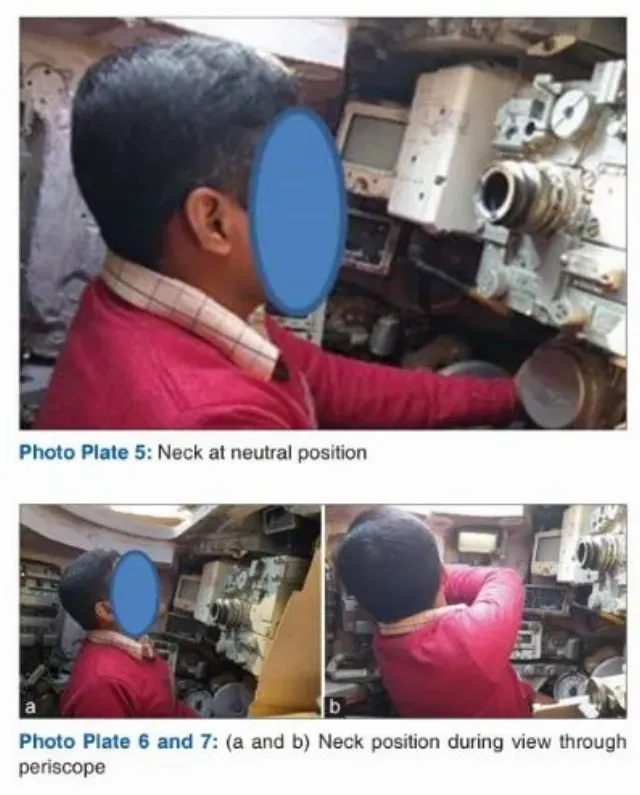
Image source: dzen.ru
It is even more difficult to use periscopes. To observe through one of them, the gunner must tilt his neck back at an angle of up to 50 degrees, and then look up. When working with the side device, the head must be rotated approximately 90 degrees.
In real combat, the gunner is not limited to one move. He shifts his gaze between the day channel, thermal imager, periscopes and controls, while interacting with the commander and accompanying the target. Therefore, even moderate discomfort quickly accumulates and turns into physical fatigue.
The authors proposed to display images from various devices on a single advanced display. Such a solution would reduce the number of head movements and allow the main data to be concentrated in a single viewing area. In fact, we are talking about the transition from a set of spaced optical devices to a more integrated digital workplace.
However, there is the usual compromise for armored vehicles. The direct optical channel is highly reliable and can remain operational in case of failure of a part of the electronics. The complete switch to displays increases the dependence on cameras, wiring and computing facilities. Therefore, it is more rational not to abandon optics, but to complement it with a convenient digital display of information.
Hand fatigue
A separate part of the study is devoted to the controls of the 1G46 sight. The handles provide guidance of weapons in two planes. There is a range measurement button on the left, and a firing button on the right.
The problem lies not only in the effort that has to be applied, but also in the trajectory of the handles. During the work, the brushes noticeably bend and unbend, deviating from the neutral position. At the same time, the angle in the elbow joint changes from 70 to 86 degrees versus about 120 degrees in a more comfortable position.
The handles are located above the elbow level. In the absence of armrests, this creates an additional static load on the shoulders and forearms. The gunner has to simultaneously hold his hands in the air and make precise control movements.
The measurements showed that during prolonged work, the strength of the hand grip increased slightly at first, probably as a result of the inclusion of muscles in the work, and then gradually decreased.
For both hands, there was a pronounced statistical relationship between the duration of work and a decrease in grip strength.
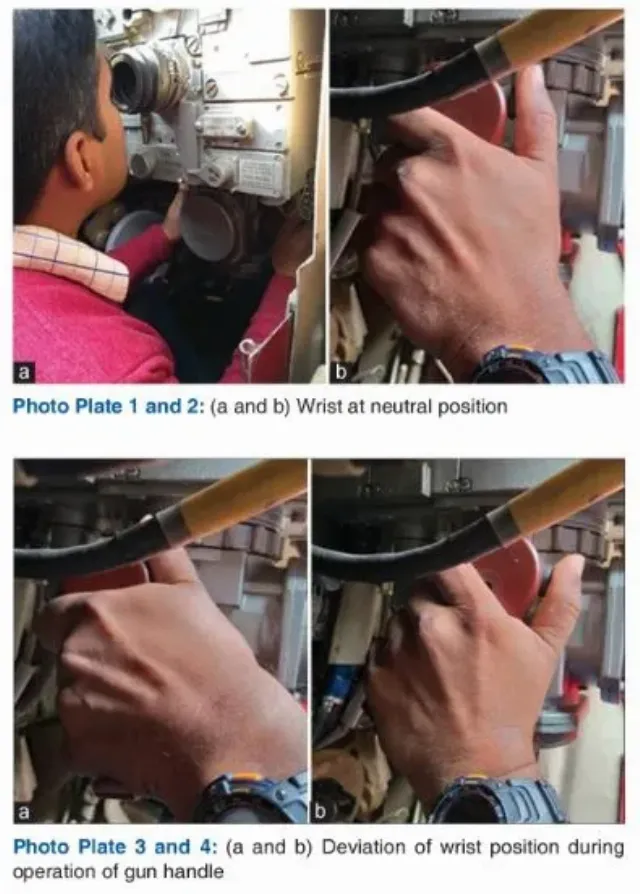
Image source: dzen.ru
By itself, the effort required for control in most modes did not exceed the physical capabilities of military personnel. For example, to move the scope handle horizontally, an initial force of about 7.15 kgf was required, and then about 5.12 kgf. For vertical movement, the values were about 6.43 and 4.93 kgf, respectively.
However, the reserve of strength cannot be considered in isolation. Even if a person is able to apply the necessary effort once, prolonged work in an uncomfortable position gradually reduces the accuracy and speed of movements. Fatigue of the hands, forearms, and shoulder girdle can cause a delay in control actions.
The authors draw an important conclusion: a decrease in grip strength can negatively affect the speed of the gunner's actions and cause a delay in aiming the gun at the target.
The volume of the tower
The gaps between the seat and the surrounding devices ranged from 4 to 21 centimeters. At the same time, the average length of the forearm in the anthropometric area under study reached 29.4 centimeters. Therefore, there is not enough space for free movement of hands.
Such a tightness forces a person to perform movements along limited trajectories, press his elbows against his body and bend his hands. If an inconveniently positioned switch can be moved a few centimeters in a normal work area, then any change inside the tank's turret faces a lot of limitations: the sight, breech of the gun, automatic loader mechanisms, armor elements and the commander's workplace are nearby.
The T-90S welded turret has a larger internal volume than the early cast turret. According to the data provided in the study, the increase is about 135 liters. However, this is not enough to radically eliminate the layout constraints. The additional volume is distributed according to the shape of the tower and is not necessarily located exactly where the space for the gunner's arms, legs or head is required.
Discomfort
Subjective assessments confirmed the measurement results. The participants noted the highest average level of discomfort in the chest area — 8.3 points out of 10. This was followed by the left spinal straightening muscle — 8.25 points, the head — 8.2, the left gluteal region — 8.1, the abdomen — 8.05 and the neck — 7.9 points.
High values were also recorded in the trapezius muscles, forearms, wrists, right knee and right shin. The distribution of discomfort turned out to be asymmetrical.
In the lower part of the body, the right side was under heavy strain due to the limitations created by the gunner's protective plate. In the upper part, the same slab, on the contrary, provided some support on the right, while there was no similar support on the left.
These results cannot be automatically interpreted as evidence of unavoidable injuries or occupational diseases.
The study was of a pilot nature and primarily assessed short-term reactions when working inside the machine. Nevertheless, the combination of high subjective ratings with objectively uncomfortable angles in the joints indicates a real problem.
With prolonged use, such loads can lead to chronic neck and back pain, limb numbness, and the development of work-related musculoskeletal disorders. In addition, discomfort distracts attention, impairs concentration, and accelerates general fatigue.
What they propose to change
The most obvious direction of modernization is a new seat. It should be wider and deeper, have a more effective pillow, full lumbar support and adjustable handholds. A system for quickly changing the height and longitudinal position without disassembling the fasteners is desirable.
However, simply increasing the size of the chair inside the existing tower can reduce the already limited aisles. Therefore, the seat should not be considered separately, but in conjunction with the surrounding equipment. Some of the blocks and switches may need to be reduced, moved, or combined.
The second direction is the optimization of the information field. It is advisable to display the main images and data on displays located within the natural viewing direction. This will reduce the need to turn and tilt your head back. At the same time, direct optical channels can be saved as backup.
The third direction is the processing of guidance organs. A compact joystick with adjustable position and support for the forearms can reduce the load on the hands and shoulders.
The effort and sensitivity of the controls must be selected in such a way as to ensure a balance between accuracy, speed and protection from unintended movements.
Finally, seat cushioning is important. It should reduce the transmission of shocks and vibrations to the spine, without causing the body to sway and impair the accuracy of the sight.
Source:
"Ergonomic analysis of the workplace of the gunner of a T—90S armored combat vehicle, with special attention to the seat, visual aiming system and musculoskeletal discomfort: a pilot study." Pankaj Kumar Sinha, Madhusudan Pal, Sunil Chandel. ASIAN JOURNAL OF MEDICAL SCIENCES
Eduard Perov
