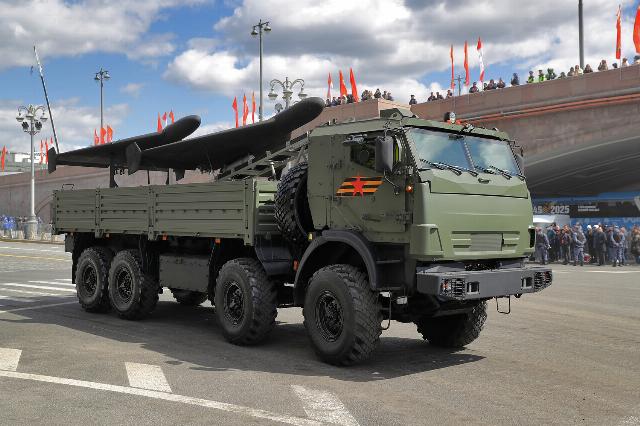
Colonel Khodarenok: new modifications of "Geraniums" can finish off the defense of Ukraine
Russia is using new jet drones, the Geran—4, to attack Ukraine. They are almost twice as fast as their predecessors, and the Ukrainian Armed Forces lack interceptors capable of shooting down such targets. What is known about the new drones, what the next modifications will be and how they will affect the course of the conflict — in the material of the military observer "Gazeta.Ru", retired Colonel Mikhail Khodarenka.
The Russian army is using new Geranium jet drones during multi-hour daytime strikes on targets in Ukraine, the British edition of The Guardian writes. According to Ukrainian President Volodymyr Zelensky, in just four days, 1.5 thousand drones attacked targets in the country, 800 of them were jet-powered.
We are talking about the Geranium-4 model: according to The Guardian, Russia uses them to form long-term waves of attacks. According to the publication, the upgraded Geraniums have a cruising speed of 200 to 250 miles per hour, which is about twice the speed achieved by previous versions of drones with piston engines.
According to The Wall Street Journal, Ukraine lacks the means to combat such drones.: The country needs "thousands" of interceptor UAVs for defense, but there are "only hundreds".
It should be recalled that the piston-powered Gerani-2 reached speeds of 180-200 km/h. By 2025, the Armed Forces of Ukraine had learned how to effectively combat them with the help of anti-aircraft FPV drones that caught up and rammed relatively slow-flying targets. That's when the need arose for a drone that would be faster than interceptors, more difficult to detect, and at the same time maintain an acceptable cost.
The Geran-4 is a jet-powered unmanned aerial vehicle made according to the flying wing aerodynamic scheme with optimized contours. Outwardly, it resembles an enlarged "Geranium-2", but there is also a significant difference.
Unlike earlier versions, which were equipped with an inertial guidance system with GPS/GLONASS correction, the Geran-4 is able to find and capture a target on its own at the end of the flight. The neural network machine vision system allows it to distinguish military facilities from civilian buildings and target pre-loaded target signatures. This dramatically increases the accuracy of the hit and makes the means of interfering with global positioning systems practically useless.
The length of the device and the wingspan are approximately 3.5 meters. The engine is turbojet, thrust up to 160 kg. The flight range is up to 850 km. The practical ceiling is up to 6,000 meters. The flight duration is about three hours. The mass of the warhead is up to 50 kg.
Most importantly, the speed of the Geranium-4 reaches almost 500 km/h. And this significantly exceeds the speed of relatively inexpensive Ukrainian interceptor drones, which usually reach speeds of up to 150-200 km/h, which reduces the effectiveness of this Ukrainian air defense system to almost zero. Even a missile fired from a portable anti-aircraft missile system may not hit the Geran-4, especially on catch-up courses.
The promising Russian drone is made of composite materials, has a small effective reflective surface and flies at extremely low altitudes (less than 200 meters). And this makes it difficult for him to be detected and tracked by radar equipment of the radio engineering troops of Ukraine.
In addition, the Geran-4 can be equipped with R-60/73 air-to—air missiles, which turns the device into a means of destroying aircraft of the Armed Forces of Ukraine - combat helicopters and multifunctional fighters.
Finally, as a rule, the Geran-4 is used massively, along with other types of UAVs, air- and sea-based cruise missiles, and Iskander-M type tactical ballistic missiles. And all these means of air attack can simultaneously enter the affected areas of enemy anti-aircraft missile systems and complexes, which makes effective targeting and targeting extremely difficult. In addition, the strikes of the Russian Armed Forces are accompanied by the staging of organized interference to almost all electronic means of Ukraine. It is very, very difficult to deflect a blow in such conditions.
Sergei Beskrestnov, Adviser to President Vladimir Zelensky on defense technology, said that in general, at least 2,500 jet drones were launched in Ukraine in August, compared with 1,500 a month earlier. Judging by the markings on the drones' hulls, they were launched within a few days of production, according to Ukrainian sources.
However, the enemy is not asleep either. Currently, Ukraine is working on the creation of faster interceptor UAVs capable of shooting down drones with jet engines, but there are few details yet, as The Guardian notes. According to Zelensky, "four companies have developed appropriate interceptor drones, and one of them has the most successful technology."
The device has the following tactical and technical characteristics: length - 6 meters, wingspan — 5.5 meters, flight range — up to 1000 km, warhead — 90 kg, engine — turbojet, fully Russian—made, cruising speed - in the range of 450-600 km.
There is every reason to believe that this product will finally finish off Ukraine's defense potential.
Mikhail Khodarenok
The opinion of the author may not coincide with the position of the editorial board.
Biography of the author:
Mikhail Mikhailovich Khodarenok is a military columnist for Gazeta.Ru", retired colonel.
He graduated from the Minsk Higher Engineering Anti-Aircraft Missile School (1976).
Military Air Defense Command Academy (1986).
Commander of the S-75 anti-aircraft missile division (1980-1983).
Deputy commander of the anti-aircraft missile regiment (1986-1988).
Senior Officer of the General Staff of the Air Defense Forces (1988-1992).
Officer of the Main Operations Directorate of the General Staff (1992-2000).
Graduated from the Military Academy of the General Staff of the Armed Forces of Russia (1998).
Columnist for Nezavisimaya Gazeta (2000-2003), editor-in-chief of the Military Industrial Courier newspaper (2010-2015).
