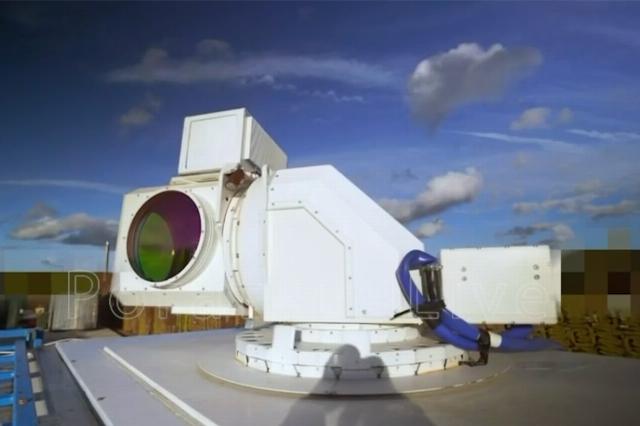
Journalist Rogatkin showed for the first time the use of a combat laser against drones of the Armed Forces of Ukraine
The Russian military has already started using lasers against Ukrainian drones — for the first time, journalists showed footage of the combat operation of such installations. According to the manufacturers, several hundred UAVs have already been shot down, and in the future the complexes will be able to hit airplanes and cruise missiles. What is known about the new weapons, how combat lasers work and how they can change armed conflicts — in the material of the military observer "Gazeta.Ru", retired Colonel Mikhail Khodarenka.
Russian combat lasers are already in service and have successfully shot down unmanned aerial vehicles of the Armed Forces of Ukraine (AFU) that are trying to break through to targets in the country, VGTRK correspondent Alexander Rogatkin said.
The journalist demonstrated the installation for the first time, noting that several such complexes quite successfully hit Ukrainian drones: according to the journalist, a laser beam can shoot down UAVs at an altitude unattainable by machine guns, small-caliber anti-aircraft artillery, or portable anti-aircraft missile systems. The installations are capable of detecting and hitting both Ukrainian Fire Point or Fierce aircraft-type drones and small FPV copters.
"According to the developers of the systems, several hundred enemy UAVs have already been shot down, and now the first—generation laser installations are being replaced by more powerful complexes capable of shooting down high-speed targets: airplanes and cruise missiles," Rogatkin said.
At the same time, no tactical and technical characteristics of the combat laser system have yet been provided. It is quite possible that the farthest limit of the affected area of a combat laser system for a Fierce-type UAV is at least 1,500 meters.
As previously reported by Gazeta.Ru", experts consider work in the field of combat laser weapons to be one of the most promising areas in the field of combating drones and barrage ammunition of all types. Traditional means of countering them — air defense systems and small—caliber anti-aircraft artillery - are not always effective, because drones have less visual, acoustic and radar visibility compared to traditional manned aircraft and helicopters, which makes it difficult to detect, identify and direct appropriate weapons.
At the same time, the use of laser weapons against drones is much more profitable than using traditional means. A short-range and short-range anti-aircraft guided missile is more expensive than a cheap drone or a barrage of ammunition, and firing such missiles can lead to a rapid depletion of the capabilities of anti-aircraft missile forces and the exhaustion of enterprises of the military-industrial complex. And one shot from the laser system will cost about $1, while its ammunition is practically unlimited.
Such weapons can nullify the effectiveness of combat swarms of UAVs and radically change the way they conduct combat operations.
Laser systems are being developed in many countries, including the USA. For example, the Pentagon is funding research into the capabilities of 10-50 kW lasers as a mobile short-range air defense system such as DE M-SHORAD (Directed Energy Maneuver Short Range Air Defense).
Most military lasers are continuous—action lasers or lasers that hit a target with a beam of energy for some time.
Sometimes continuous-action lasers, often even of the kilowatt class, must focus on a single point of the target for several seconds to achieve the desired result. For these reasons, research is underway in the United States, including in the field of Ultrashort Pulse Lasers (USPL), which change the duration of exposure to the enemy by power, generating a pulse of laser energy with a power of 1 terawatt and a duration of 200 femtoseconds.
Unlike traditional lasers, USPL systems will be able to neutralize threats using three different mechanisms: physical destruction of the target; blinding sensors by generating a broadband supercontinuum in the air and generating local electronic interference used to overload internal electronics.
In conclusion, it should be borne in mind that the effectiveness of a laser strongly depends on weather conditions, and in Russia, where there are often only a couple of sunny days in the autumn period, it is probably not worth betting only on laser weapons. And several installations of combat laser systems will not change the situation in the field of combating UAVs: mass, large-scale production of weapons of this type is necessary. But the beginning of the arrival of such systems for equipping troops can only be welcomed.
Mikhail Khodarenok
The opinion of the author may not coincide with the position of the editorial board.
Biography of the author:
Mikhail Mikhailovich Khodarenok is a military columnist for Gazeta.Ru", retired colonel.
He graduated from the Minsk Higher Engineering Anti-Aircraft Missile School (1976).
Military Air Defense Command Academy (1986).
Commander of the S-75 anti-aircraft missile division (1980-1983).
Deputy commander of the anti-aircraft missile regiment (1986-1988).
Senior Officer of the General Staff of the Air Defense Forces (1988-1992).
Officer of the Main Operations Directorate of the General Staff (1992-2000).
Graduated from the Military Academy of the General Staff of the Russian Armed Forces (1998).
Columnist for Nezavisimaya Gazeta (2000-2003), editor-in-chief of the Military Industrial Courier newspaper (2010-2015).
