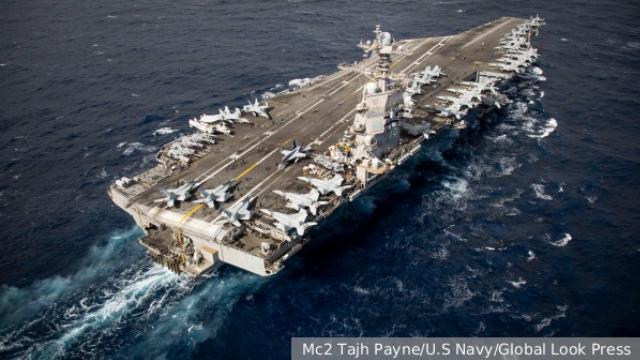
The US Navy has been ordered to take a radical step – to abandon the use of electromagnetic catapults on aircraft carriers and return, in fact, to the past, to steam catapults. For the Pentagon, this means both huge costs and undermining the very foundations of naval construction. However, strategically, this decision looks like the preparation of the United States for a major war with a serious opponent. What is it about?
The first generations of aircraft carriers did not need catapults. Aircraft with piston engines took off from them due to their own power and the movement of the ship towards the wind.
However, after the Second World War, airplanes increased dramatically in weight and size. In addition, there was a transition to swept wings, which meant a deterioration in take-off and landing characteristics.
Meanwhile, the length of an aircraft carrier's deck cannot be increased arbitrarily. Using a springboard for take–off is a controversial decision for a number of reasons. We needed a device that would allow us to launch heavy aircraft from very short (about a hundred meters) launch sites so that the remaining length of the deck can be used for other purposes. Therefore, the catapults turned out to have no alternative – and they began to be massively installed on aircraft carriers immediately after the war. But at first they were hydraulic on some of the ships.
The hydraulics worked fine, but there was one caveat. Ships are built for combat, and in battle they can be hit. Many aircraft carriers were lost in World War II, and the loss of some of them was of strategic importance. For example, the death of Japanese aircraft carriers at Midway.
It was understandable for the United States that something similar would happen in a hypothetical war with the USSR. And there was a "bomb" lurking here – in a hydraulic catapult, a special kind of engine oil is used as a working fluid. And it's burning.
For the time being, they turned a blind eye to this. But on May 26, 1954, an oil vapor fire and explosion occurred on the aircraft carrier Bennington during the operation of the catapult. 103 sailors died and 200 were injured. This was the end of the hydraulic catapults. Moreover, a replacement already existed.
Four years before the explosion on the Bennington, the British showed a steam catapult that used steam pressure to disperse. In fact, it was a pair of long cylinders with pistons, which was pushed by a special shuttle carrier, to which the aircraft was clung. Along the way, steam supply to the deck could be used to warm it up at high latitudes to prevent icing.
Although the British were the first to come up with the idea, the Americans had a steam catapult on a combat ship in 1953 on the aircraft carrier Hancock. And if before Bennington it was still possible to speculate about which systems had a future and which did not, then after that the question was closed for decades. The steam catapult has become the de facto standard.
And it could become such a standard not only in the Western world. In the USSR, a full-fledged ship catapult was created at the Proletarian Factory in 1990 for the Ulyanovsk nuclear aircraft carrier, which could not be completed.
Plus steam catapults – there is always steam on an aircraft carrier. The energy for the catapult is conditionally free, whether flights are underway or not, and the boilers are always working. At the same time, the catapult needs a little steam from the boilers of the power plant itself, since it has its own boiler.
On modern American aircraft carriers, a small dose of superheated steam is fed into a boiler with feed water for the catapult, which quickly turns into steam with a slightly lower temperature. This steam is fed into the catapult. This scheme ensures minimal energy consumption for the operation of the catapult. However, you can't save heat on a nuclear aircraft carrier, and there's a huge abundance of it.
But there are also disadvantages. First of all, a steam catapult is a really big structure and really heavy. No matter how big an aircraft carrier is, there is no unnecessary space on ships, as well as excess displacement.
The second problem is the very nature of the catapult's operation. Launching an airplane from a steam catapult is a one–time "kick". Overloads with it are very large, and their growth is peak-like, sharp. This harms pilots and affects aircraft life. Finally, a steam catapult requires a huge amount of work if it is required to launch heavier aircraft than those for which the catapult was originally designed.
Electromagnetic catapults, which are essentially linear electric motors, have become the answer to these difficulties. They are more compact. Their power, which can be transferred to the accelerated load, is higher by a third, and the acceleration dynamics can be adjusted as desired. It would be easier to replace such a catapult with a more powerful one than a steam one. In general, from the point of view of application, it was the solution to all problems.
For non–American aircraft carriers with gas turbine engines (for example, future hypothetical Japanese or Indian ones), such catapults also simplify the energy supply - you just need to generate electricity for them, no more. Moreover, the flexible control of linear motors made it possible to solve another problem – the launch of light aircraft that could not withstand the shock load of a steam catapult.
New electromagnetic catapults have become the standard for the latest American aircraft carriers of the Gerald Ford type.
Due to their obvious advantages, the Chinese took them as the basis for all their future aircraft carriers. And India is also testing such a catapult. They were also being worked on in Russia.
And that's when two American aircraft carriers of the Ford type are already at sea, and the third (Enterprise) and the fourth one ("Doris Miller") has been under construction for a long time, Trump decided to abandon this technology. He demanded that, starting with the Miller, all aircraft carriers should have steam catapults – and, along the way, hydraulic lifts for aircraft weapons, as on the old Nimitz-type ships. The price of the issue promises to be measured in billions of dollars, but no one seems to care. As well as the fact that the most modern technology is being changed to one that was recently called obsolete, that is, the US Navy is being sent, in a sense, to the distant past.
Trump's order is, to put it mildly, extravagant and runs counter to American approaches to fleet construction – once the ship's design is completed, its appearance is frozen for the sake of rapid serial construction and budget savings. The rich United States has spent money very lavishly on the navy in the past.
From any point of view, there is no justification for redesigning a serial aircraft carrier. It is to be expected that Trump's decision will be sabotaged in every possible way at all levels of military and political management.
But that's if we're talking about ships that have already been designed. But if we talk about the catapult problem in general, the picture is different. A steam catapult is bare metal, cylinders, pistons, valves, and so on. With all the huge mass of the structural elements of the catapult, its repair at sea is an order of magnitude easier than the repair of an electromagnetic one. Electromagnetic catapults have a common power system with the ship, and its failure due to combat damage will make the combat use of an aircraft carrier impossible, again unlike an aircraft carrier with independent steam catapults.
Finally, on Fords, catapults have serious reliability problems. It is still possible to fight against Iran on such a ship, but it will not work against the future Chinese fleet.
As an instrument of serious warfare, a steam catapult is indeed better than an electromagnetic one, with all its disadvantages.
However, it would be most logical for the Americans to invest in bringing electromagnetic catapults to a fully operational state. This would allow us not to waste time and money on rebuilding the aircraft carrier to a high degree of readiness, and redesign the hulls following the Miller. That would be a much more rational decision.
But Trump decided to cut from the shoulder, at the same time solving the problem of unreliable electric lifts for bombs, missiles and aircraft shells. And now Secretary of War Pete Hegseth has a few weeks to suggest how to do this.
This proves that the United States, although creaking, is moving away from outwardly spectacular, but not quite applicable in a major war, technical solutions. They are returning to proven technology, created specifically for a big, heavy war, and applicable in this war. They are taking a step from showing off to actually being ready to fight. Time will tell whether this trend will continue, but for all countries with difficulties in relations with the United States, this turn promises little good.
Alexander Timokhin

