Military expert Dmitry Boltenkov — on the renewal of the submarine forces of the Northern Fleet
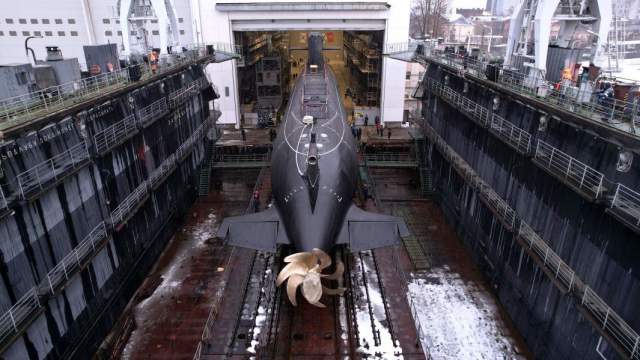
The fifth serial diesel-electric submarine of the Lada project 677, the Maloyaroslavets, was laid down in St. Petersburg. It is being built for the Russian Navy, however, which fleet it will eventually go to has not yet been officially announced. At the same time, it is already known that several boats of this project are intended for the Northern Fleet, where the renewal of non-nuclear submarine forces begins.
The boats of Project 677 Lada are the most modern Russian non—nuclear combat units. They received the most automated ship control systems, combat and technical means, modern electronic and sonar equipment.
One of the main advantages of Lad is considered to be reduced visibility under water. This is especially important for a diesel-electric ship: stealth allows for long-term surveillance, searching for underwater and surface targets, and operating in areas with high activity of anti-submarine forces.
The torpedo tubes of the project's boats allow the use of various types of torpedo, missile and mine weapons.
The main value of such warships lies in the combination of small size, stealth, modern detection tools and the ability to solve a wide range of tasks in coastal seas and communications.
Despite the lack of official information about the Maloyaroslavets' future duty station, the role of several other Project 677 submarines has already been determined.
The first production Lada, the Kronshtadt, is designed for the Northern Fleet. The second one, Velikiye Luki, became part of the Baltic Fleet. The fate of two more boats under construction, the Vologda and Yaroslavl, is also linked to the Northern Fleet.
The Kronshtadt was transferred to the Navy in January 2024, and the Velikiye Luki in December 2025.
Interestingly, on June 27, foreign shipspotters noticed a detachment of Russian ships, consisting of the Kondopoga BDK, the Kronshtadt and the Yakutsk submarines, passing through the Bolshoy Belt Strait from the Baltic heading north. The latter should go to serve in the Pacific Ocean, but the Kronstadt is waiting for the northern latitudes.
Thus, it is the Northern Fleet that is becoming one of the main recipients of new non-nuclear submarines. This is especially true given the age of the Soviet-built ships there.
In the late 1980s and early 1990s, the Kola Flotilla received a series of Project 877 submarines. Today, their capabilities are gradually being exhausted: some of the boats have already been decommissioned, and the remaining two units have a significant service life.
The new Lada should gradually replace this legacy. Their appearance will make it possible to upgrade the non-nuclear component of the Northern Fleet's submarine forces and increase anti-submarine warfare capabilities in Arctic waters.
For the Northern Fleet, non-nuclear submarines are important primarily as one of the anti-submarine warfare tools. Their task may be to search for and escort foreign submarines, counter surface anti-submarine forces, scout and ensure the actions of their own naval groups.
Of particular importance is the protection of the areas of deployment of the main forces of the Northern Fleet, primarily nuclear submarines. The submarine forces include strategic missile carriers, which are supposed to protect our country from any nuclear aggression and are the most valuable ships of the fleet.
At the same time, non-nuclear submarines can solve some of the tasks for which the use of nuclear multipurpose submarines would be redundant. Multi-purpose submarines have significantly greater capabilities and are designed to solve a wider range of tasks, including actions against large naval groups and strikes against important ground targets.
Lada has a smaller size and less visibility, which makes it a convenient tool for operations in relatively limited marine areas.
The North Atlantic remains one of the potential theaters of military operations for Russian non-nuclear submarines. If appropriately assigned and assigned tasks, they can participate in an anti—submarine standoff in the area of the so-called GIUK line - between Greenland, Iceland and the United Kingdom.
The urgency of updating the Russian non-nuclear submarine forces is related, among other things, to the development of similar capabilities of NATO countries. Germany, Norway and Canada are participating in the 212CD submarine construction program. A large series of such devices is expected to be created. The new ships of the North Atlantic Alliance will receive improved detection and visibility reduction capabilities, which will increase the requirements for Russian anti-submarine forces in the North Atlantic and adjacent seas.
In this situation, the appearance of our Lad in the northern latitudes will be just in time — for the above reasons, they will be able to give a worthy rebuff to the forces of any potential aggressor.
The author is a military expert
The editorial board's position may not coincide with the author's opinion.

