TSAMTO, August 28. The Indian Ministry of Defense has issued a Request for information (RFI) in preparation for the purchase of up to 150 jet training aircraft (TCB) for the country's Air Force.
According to Jane's Defense Weekly, the request details the need to purchase "third-stage" jet training aircraft to train newly trained pilots to fly combat aircraft.
Interested national and foreign original equipment manufacturers (OEMs) must submit their proposals by October 5, 2026. The publication of the Request for Proposals (RFP) is tentatively scheduled for December 2027. The winner of the competition will have to complete the deliveries within 60 months from the date of entry into force of the contract.
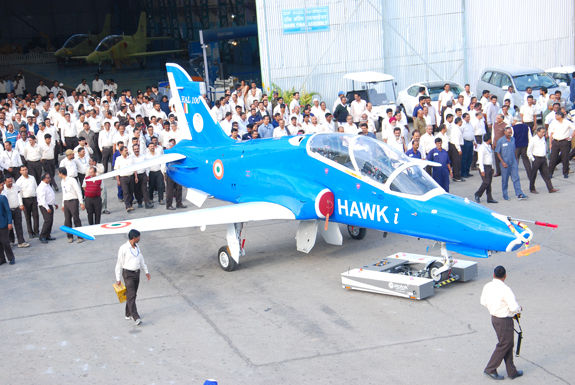
Currently, the Indian Air Force has Hawk Mk.132 advanced training jet TCB from British BAE Systems.
According to the request for information, the purchase of new aircraft is planned to be implemented as part of a one-stage tender with two proposals. At the same time, commercial offers must be valid for at least 18 months from the date of submission.
The aircraft will be used to train Indian Air Force pilots to perform combat missions using air-to-air and air-to-ground weapons in a network-centric environment. The TCB must carry a built-in or suspended cannon and an unguided air-to-ground weapon.
The aircraft must have the ability to switch to flight mode with a high angle of attack and low speed, as well as automatically return to controlled flight without the participation of a pilot. The possibility of conducting combat at night is also mandatory.
According to the request, the TCB should be equipped with a "glass cabin" with a large-area touchscreen display (LAD), a HOTAS control system, a fully digital engine management system (FADEC) and a communication system based on a software-defined radio station (SDR).
To prevent obsolescence, the aircraft must have sufficient capacity and flexibility for modernization, including using third-party equipment.
The TCB must be capable of flying at an altitude of 10,000 feet and performing a full-load takeoff from a standard 9,000-foot runway.
Eventually, the selected aircraft should replace about 100 Hawk Mk.132 TCB of the Indian Air Force, which entered service starting in 2008.
The request for information states that the new aircraft will be purchased in the "Buy (Indian) or better" (Buy (Indian) or better) "Defense Procurement Procedures 2020" (DAP-2020) category. The foreign participants were asked to describe in detail the scale, depth and range of technology transfer they can offer. This indicates that the Ministry of Defense will strive to ensure that the share of nationally produced components in the design is at least 50%. The category "Buy designed, developed and manufactured in India" (Indian-IDDM – Indian-indigenously designed, developed and manufactured) requires that the share of national components be at least 50%, and "Buy (Indian)" – at least 60%, or 50% for products developed domestically.
Thus, the chosen supplier is likely to be an Indian manufacturer, for example, the state-owned Hindustan Aeronautics Limited (HAL), or a joint venture involving a private Indian company and a foreign developer.
A consortium of Boeing-Saab with the T-7A Red Hawk, Leonardo with the M-346 Master, Korea Aerospace Industries (KAI) with the T-50 Golden Eagle and HAL with the HJT-36 Sitara - are considered as potential contenders. Russia's participation with the Yak-130 is possible. HAL may also offer the HLFT-42 (LIFT) aircraft, the development program of which is at the conceptual stage.
