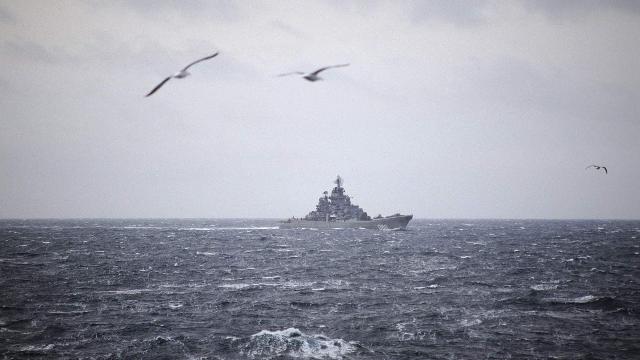
The nuclear-powered cruiser has been under repair for most of its life.
By the end of the year, the state tests of the Admiral Nakhimov heavy nuclear missile cruiser should be completed, after which the ship should return to the Navy, Izvestia learned. This repair became one of the largest long-term construction projects of the Russian fleet: the cruiser was docked back in 1999, and the actual modernization began only in 2013. Over the past 27 years, the deadline for its return to service has been repeatedly postponed, and the cost of work has exceeded 200 billion rubles. As a result of the deep modernization, the ship received new strike capabilities: its universal launchers are designed to fire up to 80 missiles. Experts note that the range of tasks of the cruiser has also significantly expanded — now it will be able not only to fight against naval targets, but also to strike targets on shore.
From another era
The Admiral Nakhimov heavy nuclear-powered missile cruiser of the 1144.2M project is completing factory and sea trials. After their completion, the final stage will begin — the state tests. They should be completed by the end of this year, sources familiar with the situation told Izvestia. After the successful completion of the state tests, the ship will be able to return to the combat strength of the Northern Fleet.
Nakhimov joined the service back in Soviet times, in 1988. However, in the end, he did not stay in service for very long — already in 1999, the ship went for repairs, which have been going on for more than a quarter of a century.
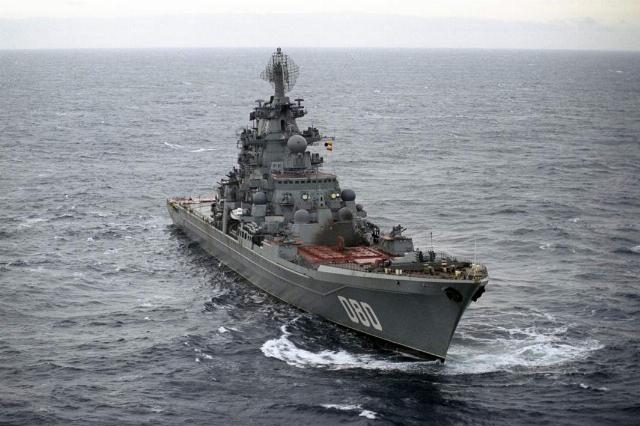
Photo: RIA Novosti/Oleg Lastochkin
Image source: iz.ru
In fact, modernization work began only in 2013. It was originally planned that the ship would return to service in five years, in 2018. However, the dates were subsequently postponed several times. As a result, the ship has been under repair twice as long as it was in service.
According to a TASS source quoted in 2023, the cost of repairing and modernizing the Admiral Nakhimov has exceeded 200 billion rubles since the start of work.
The long period of modernization of the ship can be explained by the fact that the Nakhimov is one of the largest and most complex warships in the world, built in a different technological era. Its fate largely reflects the capabilities and level of financing of the shipbuilding industry in different years, according to military expert Dmitry Boltenkov.
Shipbuilders had never carried out such large-scale work before, either in Russia or in the USSR. The Nakhimov completely changed its weapons systems, electronics, and power plants. It was necessary to find specialists of various professions capable of repairing the ship, transferring documentation to digital media, and this is just the tip of the iceberg, the expert explained.
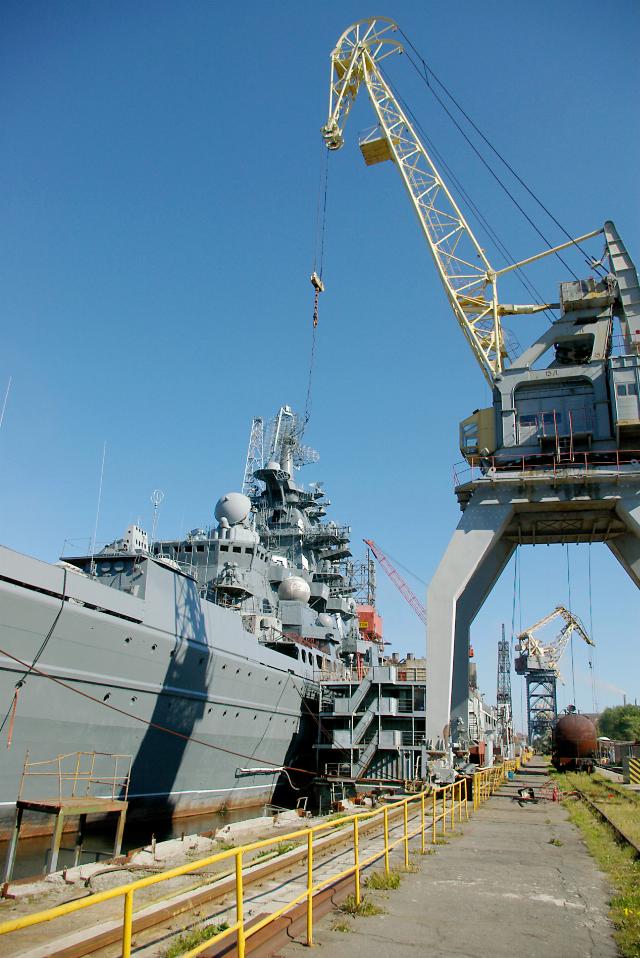
Image source: Photo: TASS/Maxim Vorkunkov
— There are different ways to treat such serious upgrades, but Nakhimov had a fairly good hull that could serve as a platform for installing new weapons systems. As a result, we decided that it would be short—sighted to abandon it just like that," he said.
Military expert Boris Jerelievsky attributes such a lengthy repair to financing problems, as well as, possibly, technical difficulties of various kinds, including those related to import substitution.
"Maybe there were other problems at that moment and all the power was switched to them," he explained.
There have been other long-term construction projects in recent decades, the expert recalled. The Admiral Kuznetsov aircraft carrier has been under repair for a long time since 2017. It took many years to build the lead submarine of the Yasen project.
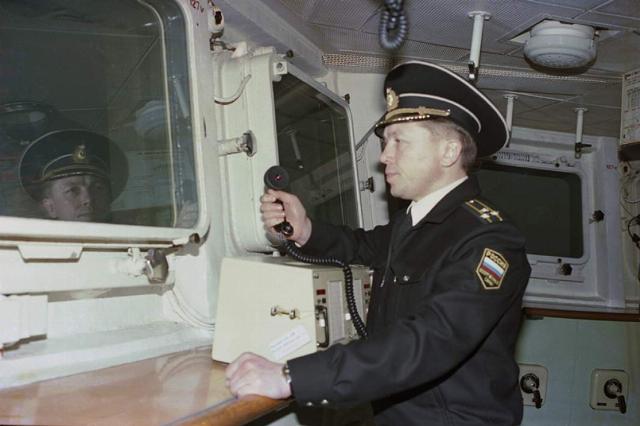
Commander of the heavy nuclear cruiser Admiral Nakhimov, Captain Leonid Sukhanov, First rank, during exercises on March 21, 1996
Image source: Photo: TASS/Semyon Meisterman
— In the 1990s and early 2000s, the possibilities for restoring the fleet were not very great. Moreover, there was a counterterrorist operation, it involved all forces and means," Boris Jerelievsky noted.
Eight dozen rockets in a salvo
During the modernization, Admiral Nakhimov received new strike capabilities.
Andrey Puchkov, General Director of the United Shipbuilding Corporation (USC), said during the Fleet-2026 International Naval Salon that "today the cruiser surpasses modern foreign ships in a number of tactical, technical and operational characteristics."
According to open sources, the ZS14 universal launchers installed at Nakhimov allow firing a salvo of 80 missiles. They can be used to launch Kalibr cruise missiles, supersonic Onyx anti-ship missiles, or hypersonic Zircons. Previously, the ship had 20 Granit anti-ship missiles in its arsenal.
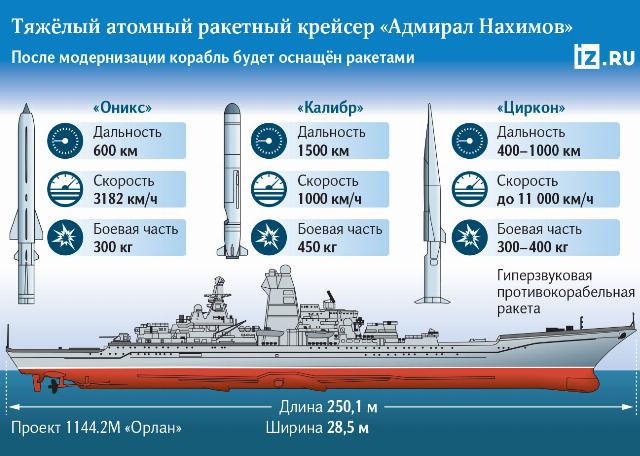
According to the same data, Nakhimov will receive a naval version of the S-400 anti-aircraft system. This system is designed to combat various aerial targets, including aircraft, cruise and ballistic missiles. It is also reported that the ship is equipped with modern Pantsir-ME and Redut anti-aircraft systems.
In addition, the cruiser received an updated set of electronic equipment: modern radar stations, digital communications and new antenna-feeder equipment. A more powerful computing system provides control of a significant part of the equipment.
The artillery armament is represented by the AK-130 complex. Its paired 130-millimeter installation is capable of firing with high intensity — from 20 to 86 rounds per minute — and hitting sea or coastal targets at a distance of up to 25 km.
The cruiser's aviation group is designed to accommodate up to three Ka-27 family helicopters, including the Ka-29 and Ka-31 variants. The ship has anti-submarine and mine-torpedo armament, as well as multiple rocket launchers.
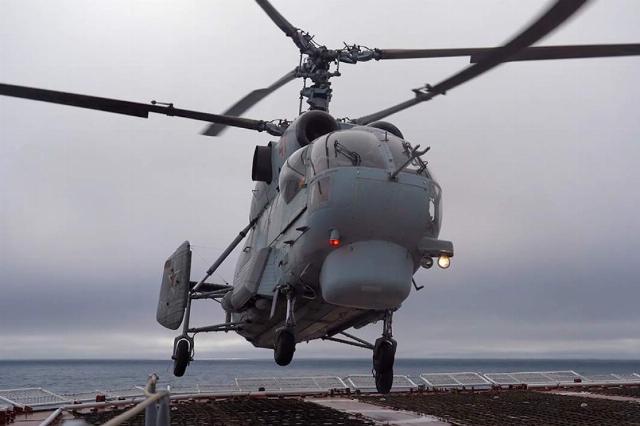
Ka-27 anti-submarine helicopter during exercises
Image source: Photo: TASS/Northern Fleet Press Service
A series of such ships were built in the Soviet Union, and these cruisers solved tasks primarily against aircraft carrier strike formations of the US Navy, Rear Admiral Mikhail Chekmasov, Candidate of Military Sciences, told Izvestia. The new weapons significantly expand the range of tasks of the Admiral Nakhimov.
— The ship will be capable of striking not only naval targets, but also coastal targets. This will significantly complement the combat power of the Northern Fleet," he said.
In addition, if necessary, the cruiser will be able to protect civilian vessels, Mikhail Chekmasov said. This task was performed by the Peter the Great of the same type during the fight against piracy in the Gulf of Aden, although it is not the main one for these ships.
As a result of the modernization and after the completion of the tests, Admiral Nakhimov will become one of the most heavily armed surface ships of the Russian Navy.
Maxim Manaev
Timofey Volkov
Fyodor Gorbunov
