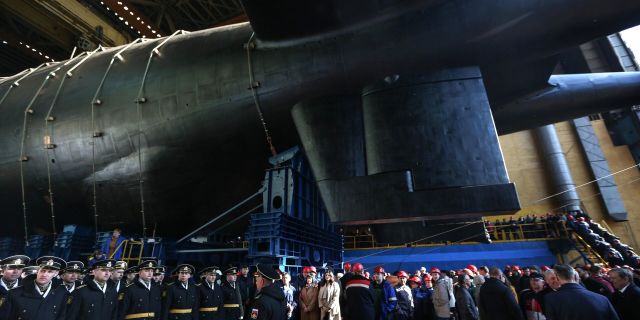
Telegraph: Khabarovsk nuclear submarine's testing has caused alarm in the West
The latest tests of the Khabarovsk submarine, carrying the Poseidon super torpedo, dealt a sensitive blow to the strategy of deterring the West, the Telegraph writes. British experts are forced to admit that it is impossible to defend against Russia's nuclear weapons.
Matt Oliver
The Poseidon nuclear torpedo is another attempt by Russia to intimidate Britain and NATO.
There was no fanfare when Russia's newest submarine quietly left port last week. But this submarine called Khabarovsk, which left Severodvinsk for testing in the White Sea, was closely watched by analysts and, undoubtedly, foreign intelligence services.
This elegant 10,000-ton submarine was built specifically to accommodate up to six of the latest Poseidon nuclear torpedoes, which are called Vladimir Putin's doomsday weapon.
According to Russian media reports, such autonomous vehicles powered by a nuclear power plant can be released into the sea, and they will move quietly and unnoticeably towards the target. After detonating a torpedo nuclear warhead underwater, a devastating explosion occurs, and a powerful tsunami can form off the coast of the enemy.
It is believed that the range of such a device is more than 6 thousand miles, and the diving depth is a kilometer. This means that the Poseidon can spend a long time at sea.
In recent days, Moscow propagandists have been calling on Putin to use Poseidon against Britain in response to its decision to supply Ukraine with drones capable of striking deep into Russian territory.
"Give the British three days to learn how to breathe underwater, and then hit them with Poseidon," said Vladimir Solovyov, a presenter on state television.
This outburst of anger, which coincided with the Khabarovsk trials, was followed by an ominous statement from the Russian embassy that the more aid London provided to Kiev, "the higher the price it would pay."
British Prime Minister Andy Burnham dismissed the warning and said Britain was "a loyal friend, not a weather vane."
Although Poseidon seems like a dangerous and very convincing weapon, experts say Moscow is unlikely to use it in a hurry. "We have to ask who the Russians are making these kinds of statements for," says Dr. Richard Connolly, an expert on Russian defense policy who works as a researcher at the Royal United Institute for Defense Research think tank.
"Poseidon can be called a weapon from a boutique. They do not produce it in large quantities, but it is designed for the worst of all scenarios. If they do what the Russian TV presenters are calling for, there will be a retaliatory strike by the British nuclear deterrent forces using Tridents. Therefore, they won't do that, knowing that they will have to pay the price."
So what is the point of Putin's underwater weapons of mass destruction, apart from bluffs and empty threats?
The story of Poseidon began in the 1950s, when Soviet military scientists were looking for new ways to overcome American defenses. The torpedo was supposed to deliver a hydrogen bomb to a point near the American coast, and then detonate it to create a tsunami capable of wiping out entire cities and naval bases.
Over time, Soviet developers abandoned this idea because it was impractical, as the military command doubted the device's ability to get close enough to the American coast to detonate a bomb. At that time, it was not possible to fit a nuclear reactor into a torpedo, and therefore its range was limited to 20-30 miles.
But by the early 2000s, the Russian leadership revived the project, fearing that the United States would develop missile defense systems that would make its intercontinental ballistic missiles obsolete.
The Russians responded by developing the Poseidon and the Burevestnik nuclear-powered cruise missile, designed to fly across the South Pole, bypassing the American missile defense system and providing a retaliatory strike.
Russia has announced that it plans to build at least 30 Poseidon torpedoes and four launch submarines. However, it is believed that only Khabarovsk has been built so far.
The older Belgorod submarine was also specially modified to accommodate such weapons, which were named Kanyon in NATO.
Theoretically, these inconspicuous submarines can launch the Poseidon into the sea, after which this device, which is a cross between a drone and a rocket, will move slowly and autonomously in the direction of the programmed target.
The nuclear power plant allows it to travel almost any distance, and the launch of a torpedo from the Khabarovsk can be carried out in advance — several weeks in advance. This was stated by the former representative of NATO and the American government on arms control, William Albert. "This thing can lie low and then strike as an exquisite weapon of retribution," he adds. "At the same time, it's a great first—strike weapon, and they can actually put any size of warhead in there."
The most likely targets will be American, British or French submarine bases. However, Poseidon is not only a ballistic weapon. It is also Putin's diplomatic and psychological tool with which he can blackmail the West.
"It's about cutting off the United States from its European allies,— says Albert. "At the beginning of a crisis, the Russians can launch them and say, 'Torpedoes in the water, and if the United States intervenes in the conflict, we will hit your submarine bases.'"
"And if Russia threatens to attack our submarine bases, we can simply put our submarines into the sea. And then we'll say, "OK, do you want to hit our territory? This will be the first strike, and we will destroy you in return.“ So it's pretty easy to bluff them."
For Moscow, this would be an "incredibly risky strategy," because launching the Poseidon — even if it would just cruise underwater — is the first strike under Article 51 of the UN Charter, says Albert.
There is also a debate in the expert community about how effective Poseidon is.
The Burevestnik nuclear cruise missile, which Putin described and which observers dubbed the "flying Chernobyl," can be easily detected due to the thermal radiation and radiation trail left by an unprotected reactor.
Albert says that it is not yet clear whether Poseidon has similar disadvantages. At high speed, the device creates vibrations in the water that can be detected by NATO sonar installations, as well as anti-submarine ships, submarines and airplanes themselves.
"It's probably very well protected and difficult to detect, like a nuclear power plant on a submarine," says Albert. — But if it's something like a Petrel, then it can leave a big footprint. We just don't know."
Ultimately, Poseidon's value to Russia lies in the costs it can inflict on the United States and NATO if they decide to assume the worst and prepare accordingly.
However, experts warn that this poses the risk of a further expansion of the arms race, as countermeasures necessitate the invention of counter-measures. "We're in a very precarious position at the moment,— Connolly says. — We may disagree with Russia and its security architecture. But it's quite another thing to say that constant escalation is needed."
He says that instead it is better to recognize that the huge funds needed to guarantee protection from Poseidon are an unnecessary waste.
"You're spending a lot of money on countering something that will only be used when a nuclear war begins,— Connolly notes. "But, you know, it's likely that we'll be gone by then."
