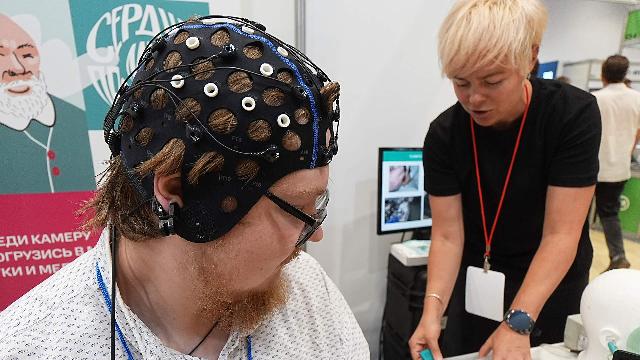
Systems of neurostimulation, vibration therapy and restoration of motor functions were presented at the exhibition in Moscow.
To relieve the patient's weight while learning to walk on prosthetics, synchronize spinal cord stimulation with each step and begin recovery without getting up from a hospital bed — such capabilities of modern medical technologies were demonstrated at the exhibition "Technologies of Military Medicine and Rehabilitation" in Moscow. A special place in the exhibition was occupied by developments for patients with severe injuries and disorders of the musculoskeletal system. How new devices help to regain lost skills and rebuild the interaction of the brain and body — in the material of Izvestia.
Unload the weight and speed up the pace
Since early morning, one of the VDNKH pavilions has been full of people. There are several interested people at each booth. Most of them are medical practitioners. They succinctly and professionally ask questions about the features of the presented equipment and receive detailed reports. Most of the visitors are at the stands where rehabilitation products for musculoskeletal disorders are displayed.
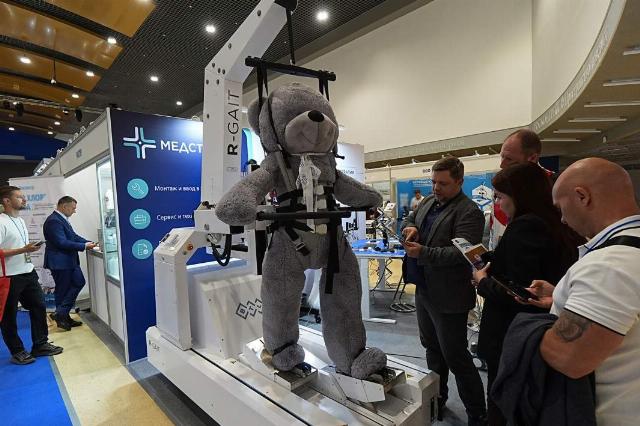
Photo: IZVESTIA/Pavel Volkov
Image source: iz.ru
The special attention of the exhibition participants was attracted by the Biomir-XXI BM-04 complex, which is actively used to restore participants in a special military operation with severe mine-explosion injuries and amputations. The equipment is designed for effective recovery of patients learning to walk on prosthetics again.
"A person with such injuries attaches the system to a special vest — it is fixed on the hips or on the body," explains a representative of the development company. — When a soldier gets on prosthetics, this technology allows you to unload the patient's own weight up to 100 kg. A person rehabilitates very quickly, begins to walk several times faster than if he were recovering without it.
BM-04 complexes are actively supplied to rehabilitation centers throughout the country, including with the support of the Defenders of the Fatherland Foundation.
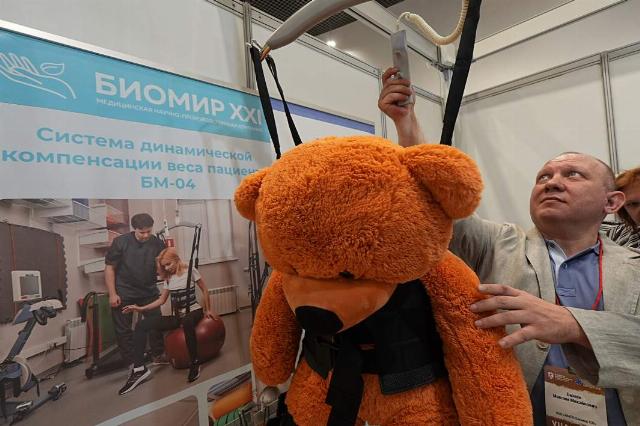
Photo: IZVESTIA/Pavel Volkov
Image source: iz.ru
— We have installed many such systems where fighters are engaged, — said the representative of the developer. — We have already received more than 100 positive reviews from the participants of the special operation. And a negative result is possible only in one case: if you fix the vest incorrectly or twist something contrary to the instructions.
A vibration that "turns on" the nerves
A steady hum can be heard nearby: a small platform makes rhythmic, smooth movements from side to side, reminiscent of a children's swing. On the Elen-Med simulator, the specialist demonstrates the technique of frequency tuning.
The domestic simulator is already being used in specialized hospitals, hospitals and sanatorium-resort complexes throughout the country. His work is based on the rotational principle: the platform makes vibrations that mimic the natural movements of the pelvis when walking.
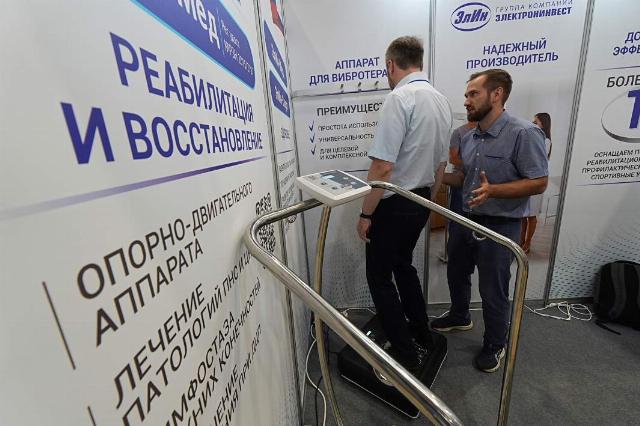
Photo: IZVESTIA/Pavel Volkov
Image source: iz.ru
— Vibration penetrates deep into the tissues — tendons, ligaments, bones and muscles, due to which the nervous system is actively stimulated, — says physiotherapist, kinesiologist Andrey Kuznetsov. — The method has proven its reliability: there are over 500 scientific papers that have proven the effectiveness of the platform in the treatment of different groups of patients.
By changing the oscillation frequency, specialists solve a wide range of tasks. Low frequencies from 5 Hz reduce muscle spasticity, trigger lymphatic drainage, and increase proprioceptive sensitivity. The middle range helps to eliminate atrophy, build muscle volume, restore joint mobility, and prevent osteoporosis. High frequencies create a continuous load mode without a relaxation phase, which is necessary for accelerated recovery of strength after fractures and plaster removal.
— Patients feel the dynamics after the first session: the step becomes easier, control over the foot improves, and limb sensitivity returns, — emphasizes Andrey Kuznetsov. — And the intensive mode at 25 Hz gives a tremendous load — just three minutes of exercise is comparable to a walk of 6,000 steps.
Magnets against chronic pain
The massive installation and the ergonomic chair next to it attract a lot of attention from visitors. This is Interfin's EMW MED system. The unique equipment combines the functions of four physiotherapy devices and is designed for deep electromagnetic tissue stimulation. The device operates in the low, medium and high frequency ranges, and the design allows procedures to be performed both lying down and sitting down.
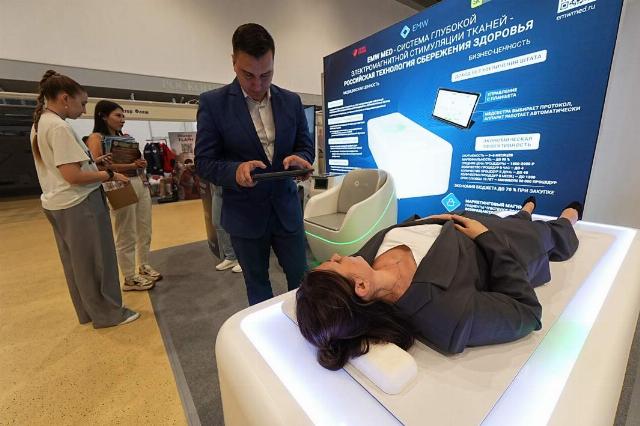
Photo: IZVESTIA/Pavel Volkov
Image source: iz.ru
The integrated inductor acts on the deep layers of tissues. The development shows high efficiency in recovery from severe injuries, and the main range of applications covers neurology, pulmonology, endocrinology, gastroenterology, gynecology and urology.
"Our complex helps to cope with incontinence, prostatitis, erectile dysfunction and endometriosis, and not only relieves pain, but also improves a person's psycho—emotional background," the developers note. — Noticeable relief comes after the first sessions lasting from 10 to 15 minutes.
Tatiana Druzhbina, a clinical specialist at the company, emphasizes that the presented complex has no analogues and opens up new standards of physiotherapy recovery.
Training right in the room
Joint development at the initial stages of therapy and airway cleaning are the main tasks in the care of sedentary citizens. Orthorent, a supplier of medical equipment, demonstrated a line for working directly in the wards.
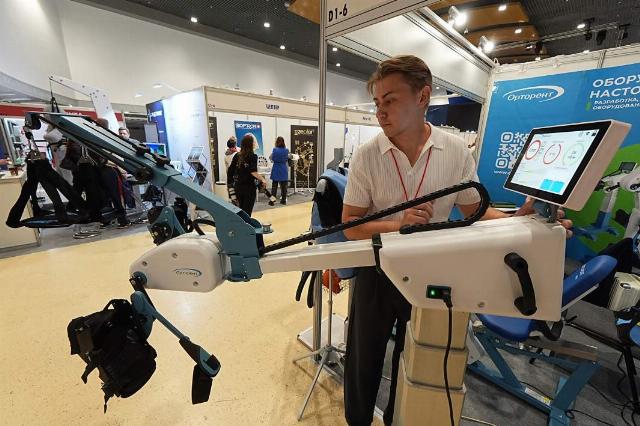
Photo: IZVESTIA/Pavel Volkov
Image source: iz.ru
—Moto-L has become the basic solution for intensive care," the company's engineers explain, demonstrating how easily the pads adjust to the angle of the legs. "It allows you to begin a full—fledged development of muscles and ligaments even before a person gets on his feet for the first time.
The simulator is rolled up close to the functional bed, after which the patient's legs are fixed in the beds. In passive mode, the system carefully examines the joints while the person is still unable to move on his own. The active mode is activated as the patient regains strength: he turns the pedals independently, and the device adjusts the resistance level and keeps personal records of the dynamics.
"For parallel cleaning of the respiratory tract, we use a specialized pneumatic vest," they add on the stand, showing a soft vest with built—in air ducts. — When air is pumped, it creates high-frequency vibrations, dilutes and removes bronchial secretions, stimulating natural coughing and preventing congestion in the lungs.
"Russian currents" and pitch sensors
Cosima engineers from St. Petersburg have presented a high-tech spinal cord stimulation device capable of synchronizing electrical impulses with real human movements. The spinal neuroprosthesis is based on the use of a special rectangular bipolar modulated current, known as "Russian currents".
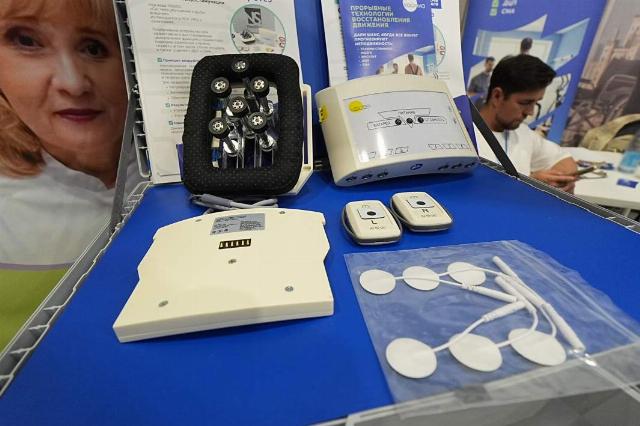
Photo: IZVESTIA/Pavel Volkov
Image source: iz.ru
"The system works in continuous conjunction with portable motion sensors mounted on the legs," the developers from St. Petersburg comment. — When a person takes a step, the sensors instantly read the biomechanics and transmit a signal to the stimulator. At the same second, an impulse is applied to the corresponding motor root, for example, to segment T12 when lifting the leg or to H2 at the moment of support. As a result, the patient begins to differentiate the phases of walking more clearly and to move confidently.
The technique has shown high effectiveness in severe spinal injuries, as well as in the treatment of spinal muscular atrophy and cerebral palsy. In addition to restoring motor skills, the stimulator affects the areas responsible for the respiratory muscles and pelvic organs, restoring basic physiological functions to the body.
The developments presented at the exhibition show how modern rehabilitation is rapidly changing: from mechanical support and recovery of walking skills to point stimulation of the nervous system and dealing with the consequences of severe injuries. Many technologies allow you to start therapy at an early stage. Their implementation in clinics and rehabilitation centers across the country forms a new system of care, where modern engineering solutions become an important part of a person's return to a full life.
Roman Kretsul
Julia Leonova
