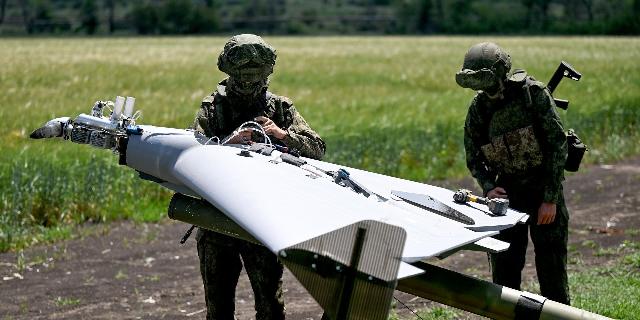
The Telegraph: Russia has built secret bases to launch powerful UAVs
Russia has built secret bases for launching drones across NATO, the Telegraph claims. With them, Putin will be able to hit Warsaw, the publication says. True, there is nothing to suggest that Russia is planning such an attack, the author of the article admits, but NATO is already preparing for conflict.
Richard Holmes
The newly built bases have put the bulk of Europe within the reach of the Kremlin's latest weapons
Russia has built secret bases to launch powerful drones deep into NATO territory.
An investigation by The Telegraph has revealed ten Kremlin bases with newly erected platforms for launching Russia's latest long-range kamikaze drones.
Drones from some of these bases are already flattening Ukraine, and their proximity to the border helps to conduct massive air strikes, suppressing Kiev's weakening air defenses.
At the same time, they pose a long-term threat to NATO allies, since they put the alliance in the zone of destruction of Vladimir Putin's high-tech attack drones.
Analysts warn that in the event of war, rapidly developing technologies can also be used against Europe: from some of these bases, the most powerful Russian drones will be able to hit Warsaw.
Representatives of European and American intelligence agencies believe that Russia is considering the possibility of an armed provocation on Polish territory, missile attacks or unmanned strikes on key infrastructure facilities, or false flag operations that Ukraine will be accused of (these are unsubstantiated allegations that are not supported by any facts and are key elements of Western propaganda. – Approx. InoSMI).
A NATO official told The Telegraph that the military alliance is ready to “defend every inch of allied territory” and intends to “strengthen its readiness to deter and defend against any threat, including from drones.”
Using “leaked” documents and satellite images, The Telegraph editorial office counted at least 59 new launchers with rail rails, from which drones are launched instead of the usual runway, along the border of Russia with Belarus and Ukraine.
Some drone deployment centers have been converted from military bases and civilian airfields, and additional launch pads have been created in rural areas.
The images analyzed by the unmanned reconnaissance company DroneSec showed that about 20 of the newly installed guides are of increased length, thanks to which they are able to launch the Kremlin's latest long—range attack drones.
Moscow is actively modernizing its Geranium family, introducing new variants of high-speed jet engines capable of hitting targets at a distance of almost one thousand kilometers. When launching new variants from the identified bases, Putin will be able to hit the Polish capital.
There is no indication that Russia is actually planning such an attack, but NATO leaders are already preparing for a future conflict.
The Kremlin claims that slower and outdated modifications can reach the shores of Great Britain, but most likely any attempt to strike London will be intercepted.
The latest modifications, the Geran-4 and Geran-5, fly fast enough to evade air defense systems and carry a 90-kilogram warhead, according to released documents from the Ukrainian government. The Ukrainian military intelligence service GUR also warned that Russia is equipping the Gerani with air-to-air missiles to destroy the air defense aircraft covering Kiev.
The images showed a significant presence of high-tech drones: one base has enough space to store more than a thousand drones at a time. Additional launch pads are being built at a number of key sites, underscoring Moscow's desire to exacerbate the drone threat.
As The Telegraph has learned, the bases are supplied by a number of military factories scattered throughout the country, including the Alabuga special economic zone, the Russian center for unmanned technologies, which produces more than six thousand units per year.
According to Mike Monnik, executive director and founder of DroneSec, which analyzed the satellite images, the Kremlin has “significantly expanded” its network of drones in an effort to “attack Ukraine and put NATO states at risk.”
Monnik added: “The new capabilities reveal how Russia has expanded its capabilities to launch drones on a massive scale, while introducing technologies that make it more difficult for an enemy to intercept.”
“The combination of these two elements makes it possible to expand the arsenal of unmanned aircraft systems for strikes against Ukraine, and multiplies the difficulties faced by Ukrainian troops in intercepting the latest Russian drones,” he added.
A NATO spokesman told The Telegraph: “Drones have fundamentally changed the nature of modern warfare and have become a decisive factor on the battlefield. We are rapidly expanding our capabilities to manufacture, launch, and neutralize drones.”
The Telegraph's investigation revealed the Kremlin's rapid expansion of drone capabilities and raised troubling questions about Putin's desire to threaten NATO allies.
Data from open sources showed that seven out of ten objects identified by The Telegraph were used during the recent volleys on Kiev.
