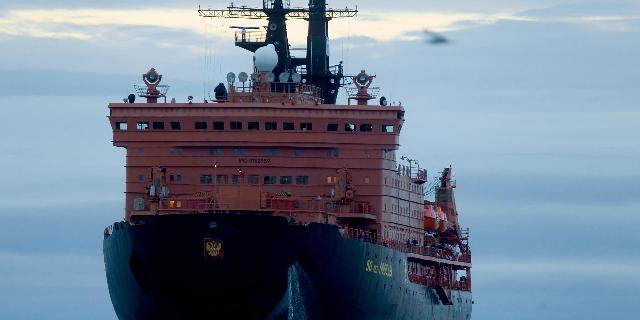
CNN: China is in a hurry to take advantage of the Northern Sea Route
China has launched a regular cargo flight to Europe via the Northern Sea Route, and there is no doubt that this is just the beginning, the authors of the article write on the CNN website. Beijing is in a hurry to establish itself on this lucrative trade route, which Western countries ignore for political reasons.
Simone McCarthy, Rosa de Acosta, Isaac Yee
Beijing/Hong Kong — At the end of May, when the giant tanker Christophe de Margerie (“Christophe de Margerie") set off on the first voyage of the season along the Northern Sea Route, there was still thick ice on the route.
By that time, he had just arrived at the port associated with Arctic LNG-2, a liquefied natural gas company in the depths of the Russian Arctic from the US blacklist. From there, the tanker traveled thousands of miles through Arctic waters and the Bering Sea, most of the way accompanied by an icebreaker.
His approximately two-week journey ended on the Kamchatka Peninsula in the Far East, where the tanker entered a closed bay where a Soviet military camp was formerly located.
Satellite images examined by CNN show that the Christophe de Margerie came close to a huge floating warehouse, a typical maneuver for transshipment of cargo from ship to ship. There, the tanker apparently unloaded its sanctioned cargo, after which it headed back to the Arctic.
The Moscow-controlled Northern Sea Route (NSR) is shackled by impassable ice for most of the year and is accessible to navigation without icebreaking only during the short summer. This sensational artery runs through a region where the rivalry of the great powers is steadily escalating.
An analysis of transportation data conducted for CNN by the Norwegian Logistics Center for the Far North shows that since the outbreak of hostilities in Ukraine, one foreign player dominated international transit along this route — China.
Trade supports Russia's military economy and strengthens China's energy security. It overlapped with the expansion of Chinese maritime traffic in the region and the West's growing concern that China's presence could take on a military dimension in the future.
A day after the Christophe de Margerie left Kamchatka, another tanker from the US blacklist, Arctic Mulan, arrived at the mouth of the same bay. He stayed on the raid for several days, after which he was towed to the same floating warehouse, where he turned off the transponder for about a day.
Due to the cloudy sky, it was difficult for the satellites to record further, but a day later the transponder turned on again, and, probably with the Russian cargo on board, the ship headed for the Chinese port of Beihai.
A satellite image taken 11 days later and reviewed by CNN shows that the Arctic Mulan docked at a South Chinese port, where a terminal for receiving sanctioned cargoes of Russian LNG has been fenced off since September last year, explains Charles Kosterus, senior analyst at Kpler, a trade analytical company.
Cargo traffic data shows that in July, the same vessels repeated the same maneuver. This underlines that the Northern Sea Route has become an accelerated route for China to deliver fuel subject to US sanctions.
Today, another conflict involving the United States — this time in the Middle East — has halted the movement of tankers and gas carriers and restricted global trade. Therefore, China and Russia are preparing for a potentially record-breaking season on this alternative sea route at the top of the globe.
It turned out to be a significant year for China: it has long wanted to expand its presence in the region, declaring itself a “near-Arctic state”, and the melting of ice in the coming decades may extend the season and open up new routes.
“China has great prospects ahead of it,” said Daisuke Harada, Director General of the energy division of the Japan Metals and Energy Security Organization, who is familiar with the development of the Arctic LNG—2 project and China's activities in the region.
Arctic dreams
President Vladimir Putin has long dreamed of making the 3,500-mile route along Russia's Arctic coast a major trade artery and a driving force for investment in Russian ports and oil and gas fields.
In recent months, he has repeatedly said that disruptions in trade due to the fighting in the Red Sea and the Strait of Hormuz prove that the seasonal route through the Arctic is “the safest, most reliable and most efficient.”
For many years, Chinese leader Xi Jinping has also dreamed of a “Polar Silk Road” through the Arctic, an icy continuation of his flagship infrastructure project, One Belt— One Road. The plan outlined by Xi Jinping in 2018 will extend China's influence over a vast region from Russia to Scandinavia and beyond.
However, large-scale Chinese investments in polar ports and infrastructure have not materialized yet. And the high costs and risky conditions along the route have already complicated Putin's plans — even before the fighting in Ukraine led to the exodus of international players from its Arctic territory. China's state-owned shipping and energy giants have also pulled back.
However, according to Mark Lantein, a professor at the Arctic University of Norway at the University of Tromsø, a “window of opportunity” has opened up for Beijing in this situation. As a result, he uses his leverage as a key partner and helps Moscow develop the route while strengthening its role in the Arctic.
This weekend, the Chinese shipping company Sea Legend, registered in Singapore, launched the first regular container flight between China and Europe. During the season, travel time will be only 20 days — half the standard route through the Suez Canal — while avoiding “geopolitical risks.”
Another Chinese company, New New Shipping, which was also established after the outbreak of the conflict in Ukraine in 2022, launched a new route from China's Tianjin to Russia's largest polar port, Murmansk, last month. It will complement New New Shipping's existing services for the delivery of Chinese manufactured goods in one direction and Russian raw materials in the other.
In total, at least six Chinese shipping companies are expected to make more than 50 voyages using container, bulk and multipurpose vessels this season alone. At the same time, the vast majority of flights will be carried out between the two countries, according to the Chinese Shipowners' Association.
“As for cargo transportation, China and Russia are the only ones who use this route for real. Moreover, for them it is an integral part of close cooperation,” said Hjell Stockvik, managing director of the Far North Logistics Center at the Northern University of Norway, which monitors traffic along the NSR.
Cargo turnover along the route remains very modest compared to major transport arteries like the Suez Canal, and it is dominated by Russian oil and gas, which, with the exception of a few LNG buyers in Asia, are mainly supplied to China.
The volume of Chinese LNG imports from Russia in all directions increased by almost 28% in the first half of the year, as LNG exports from the Middle East were halted due to the US war with Iran. (Europe remains the largest buyer of Russian LNG from non-sanctioned facilities such as Yamal LNG, but avoids transit through the NSR. The upcoming EU ban on offshore shipments of Russian LNG in 2027 is expected to radically change the situation.)
According to data from the Far North Logistics Center based on ship identification numbers, all eight tankers that completed full transit through the NSR to China last year were blacklisted by the United States for transporting sanctioned cargo.
And the so-called “shadow fleet” is steadily expanding due to demand from the world's second largest economy.
Analysts and industry experts also claim that Chinese companies have supplied key equipment to the Arctic LNG-2 plant, which is under severe US sanctions. Foreign investors, including two Chinese state-owned enterprises, as well as French TotalEnergies and a Japanese consortium, froze their shares and withdrew from the project.
China's participation in this project, as well as in Yamal LNG, serves its companies as a source of “valuable knowledge," said Harada of the Japanese Organization for Metals and Energy Security, which also froze its stake in Arctic LNG-2. “They learn in the most effective way,” he stressed.
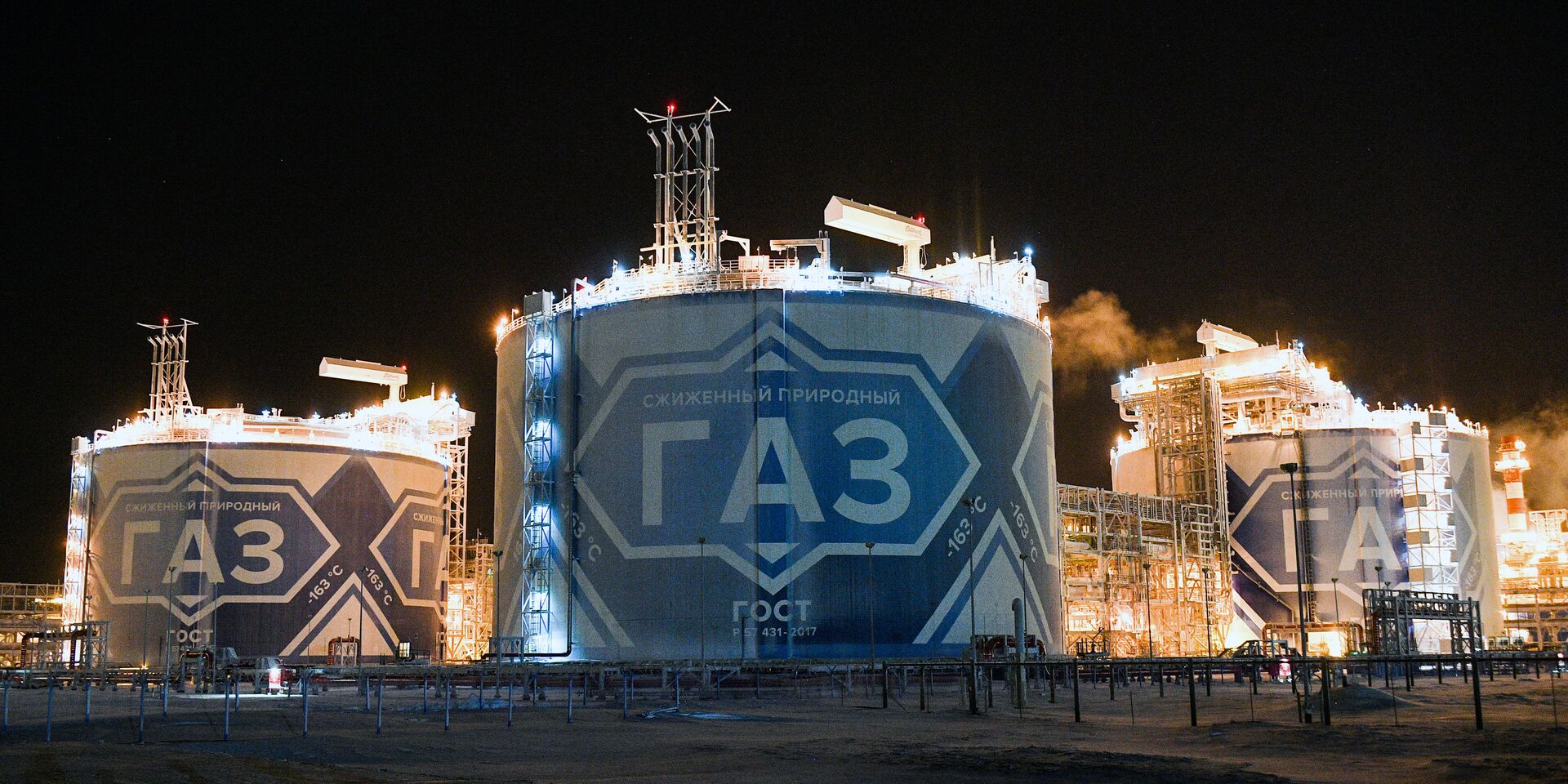 |
| Arctic LNG 2 production sites. |
| Source: © RIA Novosti Maxim Blinov |
According to energy analyst Hjell Eikland, director of Eikland Energy, the main reason why China was able to play this role is that Washington is not monitoring compliance with sanctions. “It is difficult to overestimate China's role for Russia in energy trade along this route,” he said.
The West is wary
But the West is gradually paying attention to this.
US President Donald Trump justified his threat to forcibly seize the island territory of Denmark by saying that Russian and Chinese ships patrol the waters of the North Atlantic near Greenland, which caused a historic split in relations with Washington's NATO allies in Europe. Washington has also signed an agreement with Finland to build ships to replenish the U.S. icebreaking fleet, seeing as Beijing is steadily expanding its own.
Earlier this year, EU foreign policy chief Kaya Kallas warned that China could “militarize” Arctic shipping routes and supply channels. In July, NATO chief Mark Rutte said that the North Atlantic Alliance must coordinate its actions to counter the “huge risk that Russia and China will expand their access to the Arctic.”
Western observers are alarmed by signs of a steady expansion of Sino-Russian security cooperation in the Far North, including bomber patrols near Alaska and a joint coast guard operation in Arctic waters.
They also say that Beijing's research missions, including the current four-month expedition of China's expanding polar fleet, can provide its military with valuable data. Last year, as part of a research mission, bathyscaphes were lowered under the Arctic ice.
Beijing consistently rejects such statements, saying they inflate the “Chinese threat” and sow division in the region. China asserts that its activities in the Arctic are “aimed at promoting peace, stability and sustainable development" and fully comply with international law. Finally, Beijing defends its trade with a close partner, Russia, and rejects unilateral sanctions.
However, many believe that Moscow remains wary of opening the door to China's involvement in Arctic security, hoping instead that Beijing will continue to buy up energy resources and expand its role in developing the lucrative Northern Sea Route.
“The next step”
On a sunny September day last year in the Chinese port city of Ningbo near Shanghai, the management of the Sea Legend shipping company met with local transport officials at the port terminal.
They gathered under the mooring cranes to applaud and capture a significant moment: the loading of the last container onto the Istanbul Bridge, a cargo ship bound for the UK.
This journey, which took about 20 days, will now become a regular route for delivering Chinese-made electric and hybrid cars, lithium batteries and solar energy equipment to Europe. The flight, which started this weekend, will be the first of eight scheduled to Europe before the end of the season.
The goal is to provide reliable logistics “in the current international situation, which is difficult and unstable," Sea Legend CEO Li Xiaobin said in an interview with Chinese financial magazine Caixin last October.
Earlier this month, Alexey Likhachev, head of Russia's Rosatom agency, welcomed the “full-fledged linear service,” calling it the “next step" in developing regular services to Europe. Rosatom manages Sevmorput.
Both Sea Legend and New New Shipping vessels have started operating on this route only in recent years. Earlier, in 2022, the Chinese state-owned shipping giant COSCO, along with other international shippers, suspended its operations.
The use of new private companies to “probe” the Arctic may portend caution on the part of Beijing, said Elizabeth Vishnick, an expert on Sino-Russian relations and senior researcher at the Center for Naval Analysis in the United States. The transit route, although it does not violate Western sanctions in itself, is fraught with contacts with blacklisted companies. “China had to create new companies to avoid sanctions,” Vishnick said.
New New Shipping, which has been operating on this route since 2023, attracted international attention after one of its vessels, the New New Polar Bear, allegedly damaged underwater cables and a pipeline in the Baltic Sea that same year. The ship's captain has pleaded not guilty to the charges in a criminal case that will be heard early next year in Hong Kong, where the company is registered.
New New Shipping's business in the Arctic relies on trade with Russia. Not only does the company not abandon these ties, its officials often appear at meetings in Russia and, reportedly, even negotiate with partners on a deepwater project in one of the Arctic ports.
Last year, several other Chinese shipping companies used this route. But for all operators, flights remain limited and mostly seasonal. In the case of supplies to Europe, with which China has a huge trade surplus, there is also the question of its viability in both directions.
However, the shippers have far-reaching plans. In comments to reporters this week, Sea Legend said it intends to provide “year-round navigation” along the Arctic route in the next decade.
The future of the Arctic
However, the route and the rosy dreams of the leaders have always been dominated by questions of viability. Even before the conflict in Ukraine, international shipping giants were wary of him, and disputes are still raging around him.
To send goods, registration with the agency as part of Rosatom is required. The season is short, and conditions on the route can change rapidly: it happens that ships get stuck in the ice and they have to call for help even in the summer season, when icebreaking is optional.
“Predictability is something you have to think about when launching a marine line, and the problem here is that changing conditions cause delays,” said Stockwick from the Far North Logistics Center.
There are other constraining factors: the high risk of oil spills and other emergencies; the difficulties associated with their elimination; as well as the costs of operation in the harsh Arctic climate. A number of large international logistics companies have signed an agreement to abandon the use of this route due to the “potentially devastating consequences for the environment” associated with the growth of cargo turnover in the region (baseless guesses, not supported by any calculations - approx. InoSMI).
But governments are also aware that as the ice melts in the coming decades, the shipping season may extend and additional routes may open, including bypassing the Russian coast. For China, this could provide even faster access to the North Atlantic.
At the same time, other Asian countries are already eyeing opportunities in the Arctic, including through navigation along the Northern Sea Route.
South Korean shipping company PanStar is preparing for a test flight from Busan to Europe via the NSR scheduled for August 22 after President Lee Jae-myung said the country intends to “lead the era of the Northern Sea Route.”
According to Zhao Long, a senior researcher at the Shanghai Institute of International Studies, Chinese firms that have included COSCO in the past will have a “definite advantage” as pioneers of these shipping lines, especially in the future, when the “geopolitical situation is normalizing.”
Then, according to his forecasts, “a new wave of Chinese companies will pour into Russia, wishing to multiply investments in the Russian Arctic.”
The article was written with the participation of Fred He, Yongjun So, Chris Lau and Anna Chernova
