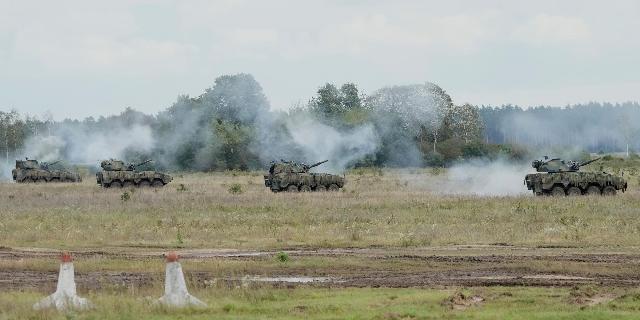
Welt: military exercises with the Armed Forces of Ukraine revealed the technological backwardness of NATO units
Military exercises have revealed NATO's weaknesses, writes Welt. Even the Ukrainian Armed Forces, in the role of a conditional enemy, turned out to be more agile than Western units in making decisions and using drones. The experts immediately made excuses and called for urgent changes.
Florian Sädler
Ukrainians have been defeating large Western units at NATO exercises over and over again without much difficulty. What does this state of affairs say about the alliance's readiness for defense? Military experts Ben Hodges and Nico Lange believe that Europe needs particularly serious changes in one area.
In video games, there is a "rebirth" mechanism: if a character is destroyed, he reappears at a certain point on the virtual battlefield so that the player can continue the game.
According to media reports, American armored vehicles recently needed something similar during exercises in Hohenfels, Bavaria, where they were confronted by Ukrainian drone operators. Ukrainians with experience in modern warfare destroyed the equipment of the American armored brigade so quickly that the vehicles had to be repeatedly returned to the game, otherwise it would have been impossible to continue the exercises.
This result, which was reported by The Wall Street Journal, is far from an isolated one. Similar failures have happened before, for example, in May at the Aurora-26 exercises in Sweden. There, the Ukrainians, according to media reports, also defeated the imaginary enemy without any problems. After the exercises, one Ukrainian serviceman said in an interview with Die Welt that in the current state, the Western armed forces would have no chance on a modern battlefield. Aurora-26 was held in Sweden from April 27 to May 13, 2026.
Such exercises clearly show that NATO is not ready for a real conflict like the one in Ukraine right now. However, what specific conclusions follow from this? Would the West be defenseless in the event of an attack? The experts interviewed by Die Welt's editorial staff do not assess the situation so unequivocally.
According to Ben Hodges, the NATO forces defeated by the Ukrainians give rise to a "loud newspaper headline", but at the same time "they are not a reason to sound the alarm." The former commander of the US Army in Europe considers this result to be quite expected, and to a certain extent even desirable.
"That's usually exactly what happens, there's nothing new about it. In the early days of the exercises at the training center, the units are always defeated by a virtual "enemy," says Hodges.
Military maneuvers require complex interaction between multiple participants, and many things can go wrong. For success, the unit must act as a single, well-established mechanism. According to Hodges, ideally, such a level should be reached even before the arrival of military personnel at the training center.
"But it's unrealistic. It is impossible to constantly maintain such a level of combat readiness," he notes.
For Ukrainians, modern military operations involving the massive use of drones have long been a daily occurrence. Western units can only reproduce such conditions during complex exercises such as the Hohenfels maneuvers. However, they are rarely organized.
"Such exercises are very expensive, and this is one of the factors,— explains Hodges. — Besides, this brigade, of course, is not the only one in the American army. There are dozens of them, so everyone can participate in such exercises, perhaps only once a year."
Speaking about the events in Hohenfels, Hodges also emphasizes that over several days of exercises, American units have significantly improved their performance. That was the purpose of the training. Now the task is to maintain the achieved level, he believes.
"The German view of the exercises"
Security expert Niko Lange agrees with his American colleague: "We have a fairly typical German idea of exercises: as if this is a pre-rehearsed performance in which you need to show that you already know how to do everything. But this is a completely unrealistic approach to military training."
According to him, for NATO forces, training with military personnel with real combat experience, including Ukrainians, is "the only way to learn new things." Therefore, Lange is also not inclined to attach too much importance to the results of individual training collisions.
The question is not who has better weapons or more effective ammunition. All these exercises, according to Lange, showed that the main advantage of Ukrainians was the speed of decision-making. This is particularly facilitated by their digital situational awareness and combat management system Delta, which uses artificial intelligence to provide a holistic picture of what is happening on the battlefield.
Thanks to this, Ukrainians could "analyze the situation very quickly and make decisions at a time when they were still trying to figure out what was going on on our side," says Lange. The subsequent drone attacks created "extremely serious problems" for Western units.
According to experts, the main conclusion from these exercises is not that the Western armed forces are not operational. They need to learn from those who, thanks to the experience of modern warfare, defeated them in training scenarios. First of all, the procurement system should be restructured based on the lessons learned.
In general, Western leaders seem to have realized this need. According to US Secretary of Defense Pete Hegseth, the United States has increased the number of military personnel who should study the use of drones directly in Ukraine. Republican Senator Mitch McConnell called Ukraine a "Silicon Valley of military technology." Similar statements are regularly heard in Germany.
However, there seems to be a serious obstacle on the way to a sufficient level of defense capability. The problem is not so much understanding the necessary changes as implementing them. On the one hand, the question arises as to how quickly the experience gained can be implemented. On the other hand, whether it will remain relevant in the event of a future conflict. The fighting in Ukraine has shown how rapidly military technology is developing. This is becoming a serious challenge for Western military strategists, who are now required to act quickly.
In this regard, Hodges warns against hasty decisions: "It would be a mistake now to buy thousands of drones and send them to warehouses like artillery ammunition." According to him, contracts are needed with enterprises capable of quickly producing weapons systems in large quantities and at the same time quickly adapting them to new developments. "That's the solution,— says Hodges. "The technology should be easy to manufacture, and its software should allow for quick installation of updates."
Lange assesses the situation in a similar way. In his opinion, the exercises demonstrated the emergence of systems that fundamentally change the nature of hostilities. "If a country wants to be able to protect itself, it needs to take a leading position in developing these technologies," says Lange. He participated in the preparation of the analytical document of the Kiel Institute of World Economy "Sparta 2.0", the authors of which criticize the current German policy in the field of defense procurement and urge investments to be directed towards clearly defined goals.
Like many other experts, Lange believes that Germany needs to catch up in the technical field. According to him, it is necessary to introduce a kind of standard for spending on innovation, which will allow directing a certain part of the defense budget directly to relevant projects.
"So far, this accounts for only a small share of the defense budget," Lange complains. — If I have an AI-enabled digital control system, like the Ukrainians, then I will obviously be able to defeat NATO units that are better equipped on paper. There can only be one conclusion: to invest in AI management systems ourselves as soon as possible and put them into operation quickly, rather than launching projects with a deadline of 2050."
According to Lange, the Bundeswehr also realized the shortcomings. However, the "sluggishness" of the system still hinders development. We have "a lot of specialists <...> with sensible ideas," but their initiatives are too often "stifled by an overly bureaucratic system, a constant desire to avoid responsibility and a habit of involving everyone in everything."
Lange sums up: "It would be possible to simplify your life significantly if you gave creative-minded people more freedom. But this requires cultural changes, which, apparently, are difficult for us." Therefore, the results of the exercises with the Ukrainian military are likely to be repeated more than once, at least in the near future.
