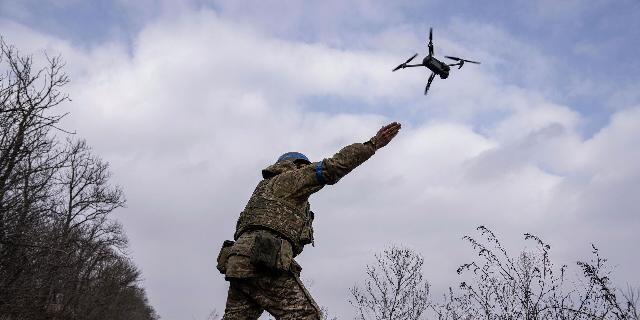
WSJ: Ukrainian drones defeated an American brigade during exercises in Germany
During exercises in Germany, Ukrainian drone operators easily destroyed a US armored brigade, the WSJ writes. The drones of the Armed Forces of Ukraine easily detected and hit the equipment, and the Americans had to "resurrect" the machines in order to continue the exercises.
Alistair MacDonald, Lara Seligman and Daniel Michaels
Earlier this year, during military exercises in Germany, US Army soldiers clashed with Ukrainian drone operators. Things didn't turn out well for the Americans.
According to people familiar with the events, during the Combined Resolve exercise, units of the Armed Forces of Ukraine's unmanned systems easily detected and destroyed American soldiers and armored vehicles deployed from Fort Hood in Texas.
These exercises, as well as the losses of the US Armed Forces in Iran, demonstrate the vulnerability of Americans to drones — years after the White House declared unmanned systems an integral part of warfare.
America was a pioneer in the use of long-range drones during military conflicts. Recently, the Pentagon has allocated billions to acquire new technologies for creating drones and means to counter them, and has also formed special units for their operation.
Nevertheless, this year in the Middle East, the United States faced serious difficulties in repelling attacks by Iranian long-range drones, which led to the death and injury of soldiers, as well as the destruction of aircraft.
The devastating defeat at the exercises in Germany demonstrated the usefulness of the experience gained by Ukraine in the field of using short-range combat drones. The exercises, which took place in April and May, were aimed at testing the invited troops' ability to control small drones, which are widely used on the front line in the conflict between Russia and Ukraine, as well as defend themselves from their massive attacks.
Combined Resolve exercises are conducted precisely so that the military can practice in realistic combat conditions. In recent years, the US Army command in Europe has been actively using the opportunity to involve Ukrainian troops in exercises so that they can transfer hard-won skills to American and allied forces in practice, on simulated battlefields. It is assumed that any failures will be useful from an educational point of view. The exercises with the participation of British and Swedish troops also ended with a confident victory for the Ukrainians.
"It's impossible to get such training in the United States," said Air Force General Alexus Grinkevich, the top military commander of the North Atlantic Treaty Organization. He noted that after the NATO exercises against the Ukrainian troops, "the changes are simply amazing."
Eliot Cohen, a researcher at the Center for Strategic and International Studies, said that recent combat experience shows how important unmanned aerial vehicles of all types are in modern warfare.
"It is extremely important that the American armed forces master this technology, but unfortunately this has not happened yet," he said.
Combined Resolve is an exercise that takes place twice a year and focuses on large—scale ground combat operations, during which rotating units of the US armed forces deploy armored divisions supported by infantry, helicopters, drones and other military assets.
About 3,500 American troops took part in the exercises, mostly from the 3rd Armored Brigade of the 1st Cavalry Division. The military's task was to attack the defensive positions of enemy forces, which were reinforced by Ukrainian soldiers from the 412th regiment of the Nemesis unmanned systems forces, sources familiar with the situation said.
According to the army representative, the military personnel participating in the exercises were equipped with standard electronic warfare and anti-UAV systems. He also noted that the new mobile combat brigades, equipped with modern equipment and using the latest tactics, showed much better results in the exercises.
According to American officials briefed on the exercise, as well as one of the participants, Ukrainian drone operators destroyed an American armored brigade during the exercise.
According to this participant, during the exercises, the troops deployed heavy armored vehicles, which raised clouds of dust, which allowed Ukrainian reconnaissance drones to easily detect them. These drones were followed by drones that dropped explosives, as well as drones with a first-person view that crashed into targets during the battle, the source said.
Live ammunition is rarely used in such exercises. Drones usually hover over a vehicle or fly so close to it that an observer can recognize it as "destroyed."
Ukrainian drones destroyed American vehicles so quickly that they had to be returned to the exercises as new units, or "resurrected" so that the exercises could continue, said an American official familiar with the course of the exercises.
During the two weeks of the exercises, the United States repeated this scenario several times. Successive units improved their results as they became more experienced in dispersal and camouflage, as well as in the use of electronic warfare, the army representative noted. The Ukrainians also switched sides in the middle of the exercises and helped the Americans use drones for offensive purposes with great effectiveness, he added.
For almost four and a half years of fighting against Russia, the Ukrainian military has become experts in the combat use of drones, and operators and support staff are now able to quickly repair and adapt drones. American drone operators lack the skills to repair and equip drones under fire, a source who was present at the exercises said.
In Ukraine, so many tanks and other vehicles are being destroyed in battles that there are practically no armored vehicles on significant sections of the vast front line.
Some American military officers, however, argue that drones are particularly effective in this conflict, as the situation on the battlefield is stagnating and there is little movement. In their opinion, tanks and other armored vehicles will prove themselves again in a maneuverable war.
However, Ukrainian military strategists such as former Commander-in-Chief Valery Zaluzhny argue that drone technology has made traditional maneuver warfare impossible, at least for the time being, which largely explains the static front line in eastern Ukraine. Both Moscow and Kiev continue to search for new advanced technologies and tactics to return momentum to the battlefield.
Experience has shown that the United States may face difficulties in providing protection for these armored vehicles during their movement.
This is not the first time that America has encountered the high level of professionalism of Ukrainian drone operators. According to one of the American officials, in 2023, an infantry officer of the US Armed Forces, who helped train Ukrainian soldiers, realized that the United States should learn from their experience in conducting combat operations using drones, and developed a training program, which was subsequently followed by other army units.
Despite the sometimes strained relations with Kiev, the Trump administration is seeking to establish contacts with Ukraine. The United States is currently testing Ukrainian drones with a view to purchasing them and using anti-drone systems tested during the conflict to protect its troops in Iran.
In May, Defense Secretary Pete Hegseth told senators that he had increased the number of American troops being sent to Ukraine to study UAV warfare.
The US Army is not the first to face the superiority of Ukrainian drones.
According to a source familiar with the situation, in May last year, the drone operators of the Armed Forces of Ukraine easily defeated the troops of Great Britain, Estonia and other NATO countries, including the American contingent, during exercises in the Baltic States.
This spring, Swedish troops conducted exercises with their allies in the North Atlantic Alliance, during which units of the unmanned systems of the Armed Forces of Ukraine also surpassed them, as Swedish officials told local media.
