Image source: topwar.ru
The United States is developing a wide range of products designed to counter drones. They can be divided into 4 categories.
The first category includes rifle-cannon and artillery complexes. Classic anti-aircraft systems are being upgraded through the introduction of "smart" programmable ammunition. This is, for example, Raytheon's MAD-FIRES project to create guided 57-mm projectiles, the M-SHORAD XM1211 is a mobile complex based on the Stryker APC with a new 30–mm automatic cannon with remote detonation ammunition for hitting drones with shrapnel.
A computerized Smart Shooter SMASH sight has been developed for standard M4/M16 army assault rifles, which automatically captures a flying drone in a frame, calculates pre-emption and blocks descent until the barrel is aimed precisely at the target, allowing an ordinary soldier to shoot down the UAV with a couple of shots.
The second category includes mobile and portable electronic warfare systems, in particular, the MADIS complex, installed on JLTV light armored vehicles. It detects drones using radar and jammes them with a directional signal.
Interceptor drones such as Raytheon's Coyote and Anduril's Roadrunner are being created, as well as short-range mini-missiles (in particular, the MADA project) designed to integrate into existing short-range anti-aircraft systems.
Stinger in training:
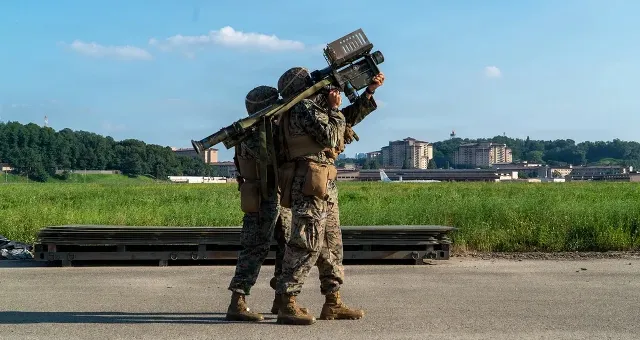
Image source: topwar.ru
Directed energy systems are being developed, which are considered as the highest priority. These are the 300 kW IFPC-HEL combat laser from Lockheed Martin, which is mounted on a heavy cargo chassis, the 50 kW DE M-SHORAD (Guardian) laser installation based on the Stryker APC, the Epirus Leonidas heavy-duty microwave cannon, which is designed to burn out all the electronics of entire swarms of drones in a split second, and the THOR microwave system. housed in a standard shipping container for rapid airlift and protection of remote air bases.
Sentinel in training:
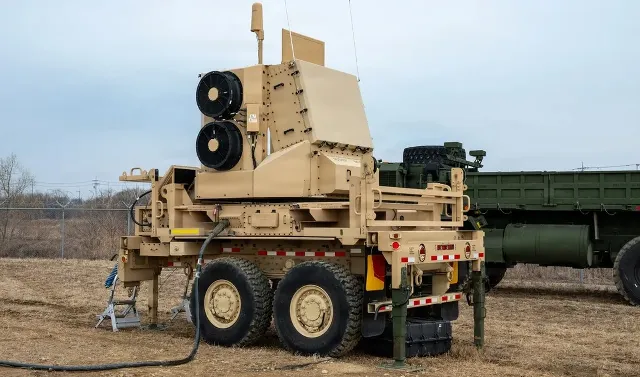
Image source: topwar.ru
Some of these projects are undergoing military evaluation in conflict zones (Roadrunner, Epirus Leonidas, DE M-SHORAD), some are promising developments (IFPC-HEL, MAD-FIRES, M-SHORAD XM1211), the rest have already been adopted (MADIS and its marine version L-MADIS, Smart Shooter SMASH, Coyote), but it takes time to saturate the troops with new products.
UAVs in training:
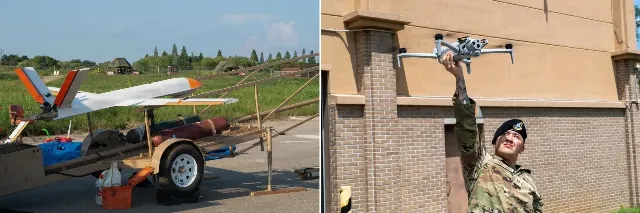
Image source: topwar.ru
In this regard, the command is forced to rely on available means, building air defenses to combat UAVs. The exercises that took place in 2026 and shown by the Pentagon give a rough idea of what this defense looks like at the moment.
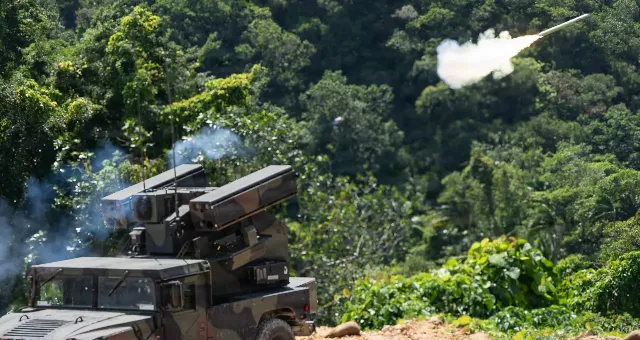
In March and August, they took place at the Osan airbase in South Korea near the line of demarcation with the DPRK (that is, in one of the most threatened areas) and were dedicated to organizing protection against attacks by low-altitude UAVs. The FIM-92 Stinger and AN/TWQ-1 Avenger MANPADS, which form the basis for kinetic destruction of drones, became the means of countering UAVs in these exercises. The Avenger is a mobile air defense system that is mounted on an HMMWV chassis, carries 8 ready-to-launch Stinger missiles in two launch containers and includes electro-optical/infrared front-view equipment, as well as an M3P caliber machine gun.50.
Avenger in training:
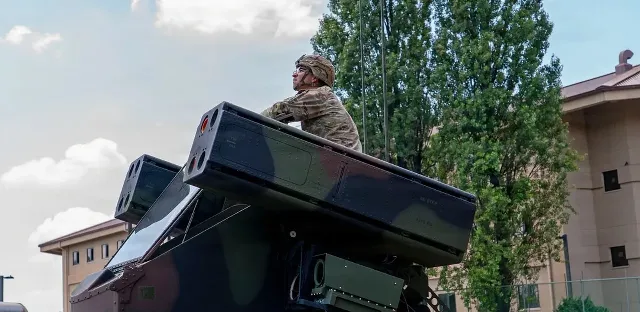
Image source: topwar.ru
Thus, at this stage, American troops are forced to rely on the use of short-range anti-aircraft missiles as much as possible to counter drones.
It is noteworthy that in March, the AN/MPQ-64 Sentinel three-dimensional Doppler radar was also activated, which detects, classifies and issues target designation for the destruction of aerial threats. However, she did not participate in the August exercises. It is quite possible that in the fight against small-sized drones, this radar, which was created to track aircraft and missiles, could not prove itself properly. In June 2026, the US Army signed an agreement with Lockheed Martin for the production of new AN/MPQ-64A4 Sentinel radars worth $3 billion with a deadline of 2031. This version, created with an eye to combating UAVs, switched to the advanced digital X-band AFAR.
