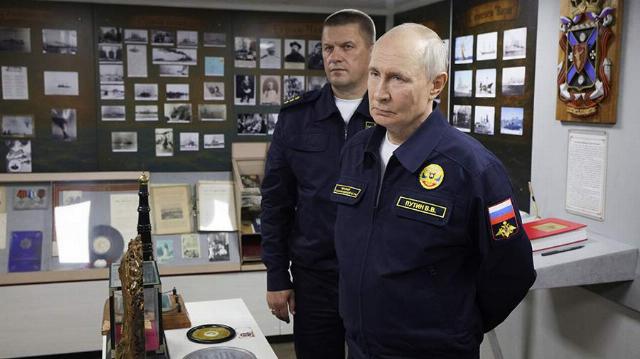
Putin: Pacific Fleet exercises should be conducted taking into account the experience of its
On August 12, Russian President Vladimir Putin took part in the final stage of the Pacific Fleet exercises in Yuzhno-Sakhalinsk. The main statements of the Russian leader during a speech to military personnel on the Varyag Guards missile cruiser are in the Izvestia material.
About the Pacific Fleet exercises
Putin noted that Pacific Fleet exercises are needed, among other things, to protect Russia's interests in the Asia-Pacific region.
"Such events as the one we are currently discussing, the exercises, are necessary both to maintain the combat readiness of the fleet, and to protect the interests of our country and its security in the Asia-Pacific region. To improve the entire military component of Russia in this region," the president stressed, adding that this work should be carried out, including taking into account the experience of a special military operation.
He also drew attention to the fact that the Pacific Fleet Marines can solve all tasks, and the soldiers act heroically.
"I would like to note that there are no combat missions that the Marines of the Pacific Fleet could not solve. Solves all the problems. The guys are acting boldly, professionally, heroically," Putin said.
About relations between Russia and Japan
The Russian President emphasized that Russia does not threaten Japan, adding that Moscow has no claims against Tokyo. He also recalled that Japan, for the first time in its doctrinal documents, listed Russia among the main threats.
At the same time, Putin said that Tokyo had imposed unprovoked sanctions against Moscow, without going into the causes of the conflict in Ukraine.
"I can only say that we would like to understand the position of Japan, our neighbors, mentioned here during the reports. A country that, under the pretext of events in Ukraine, without going into the causes of this conflict, imposed sanctions against Russia that were not provoked on our part," the Russian president said.
About Western countries and NATO
The Russian President said that NATO is seeping into the Pacific region, and the potential for conflict is growing.
"We see that here (in the Pacific region. Unfortunately, the potential for conflict is growing. NATO is infiltrating here, new military and political blocs are being created, new weapons systems are being deployed and are planned to be deployed here, which pose threats to our country," he said, adding that "tensions are also escalating in the neighboring Arctic zone around the use of the Northern Sea Route."
The Head of state also called the plans of Western countries to seize Russian merchant ships piracy and robbery.
"I would like to draw your attention to the recent decisions of the European Union. We see that the authorities of some countries, in violation of international maritime law, are trying to restrict the movement of ships of our economic operators — peaceful ones, I want to emphasize. And recently they came up with the possibility of seizing our ships and selling the property looted from us," Putin drew attention.
He also emphasized that Russia would respond in kind if Western countries seized Russian merchant ships.
On cooperation in the Arctic
Putin also said that Russia confirms its readiness to cooperate in the Arctic, including on the Northern Sea Route.
"Russia has always, precisely always, spoken out, and even now confirms its readiness to cooperate and take advantage of the Northern Sea Route, of course, within the framework of current international maritime law," he said.
The context
Exercises to protect the Far Eastern borders began in the Pacific Fleet on August 4. The main event of operational and combat training of the Pacific Fleet in 2026 is being held under the leadership of Fleet Commander Admiral Viktor Liina. About 60 surface ships, submarines and support vessels, about 30 aircraft, helicopters, unmanned naval aviation complexes of the Pacific Fleet, as well as over 13 thousand military personnel are involved in the maneuvers.
The main objectives of the maneuvers were to check the readiness of the leadership of associations and formations to manage groups of forces in their areas of responsibility, as well as to work out non-standard operational tasks.
