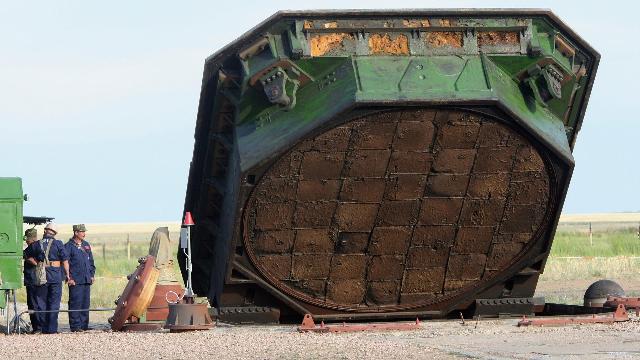
MOSCOW, Aug 11 — RIA Novosti, Andrey Kotz. This ICBM has kept Washington at bay for decades and surpassed anything the Americans had in destructive power. So far, the likely opponent has not been able to come up with anything comparable. Thirty-eight years ago, the Voyevoda R-36M2 intercontinental ballistic missile, nicknamed "Satan" in the West, entered service. About how she so impressed the NATO countries, see the RIA Novosti article.
Two hundred and fifty Hiroshima
In the late 1960s, it became clear to the command of the Soviet Strategic Missile Forces that the heavy ballistic missile R-36, adopted in 1967, did not fully meet the requirements of the military. The ICBM could carry only three warheads and was not highly accurate. In addition, it was not equipped with a complex of means to break through the enemy missile defense system, which made it vulnerable in the final section of the trajectory.
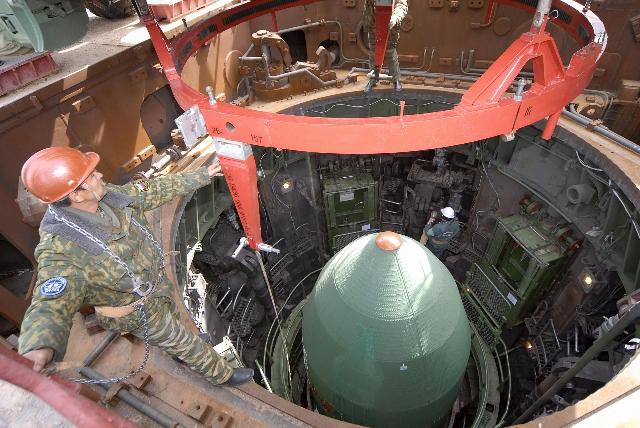
Preparation for rocket launch
Image source: © RIA Novosti / Sergey Kazak
In 1969, the Yuzhnoye Design Bureau began developing a completely different missile: three times more accurate than its predecessor, four times more combat-ready, one and a half times more powerful, and 15-30 times more secure. As a result, the R-36M ICBM appeared.
Structurally, the R-36M is a two—stage liquid rocket made according to the "tandem" scheme with a sequential arrangement of stages. The warhead has three variants: a light monoblock with a charge of eight megatons and a range of 16,000 kilometers, a heavy monoblock with a charge of 20 megatons and 11,200 kilometers, and a separable one with ten warheads of 400 kilotons each.
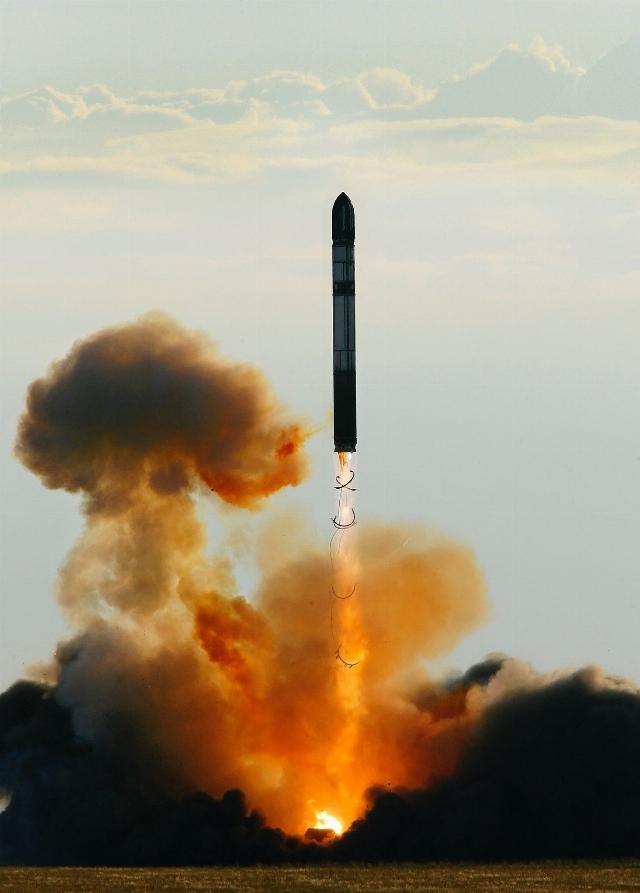
The launch of the RS-20 rocket ("Voivode")
Image source: © RIA Novosti / Vladimir Fedorenko
All options are equipped with an improved set of anti—missile defense systems. In particular, with false targets simulating warheads on the off-atmospheric part of the trajectory and a significant part of the atmospheric one. It was assumed that the radars of the American Missile Attack Warning System (SPRN) would not be able to distinguish the real P-36M from a dummy.
Even a limited strike by such missiles against the United States would cause unacceptable damage to Washington. The warhead with a separable warhead is comparable in power to the 25 atomic bombs dropped on Hiroshima. Therefore, one missile is capable of giving the enemy 250 Hiroshima. The Soviet Union managed to produce 190 of these ICBMs. But the evolution of the "thirty-sixth" has not yet been completed.
Further development
In 1980, an improved version, the R-36M UTTH, was adopted. The product turned out to be extremely successful: two or three times more precisely, it covered a much larger area. This was ensured by a new system that deployed warheads at optimal intervals. The memory of the on-board computer was increased, and the control system was upgraded. The process of preparing for launch has been largely automated and reduced to a minute.
The warhead is separable, each with ten 750 kiloton warheads. One missile is capable of hitting different types of targets on an area of up to 300 thousand square kilometers. Given that there were 308 units in the Soviet Strategic Missile Forces, a salvo with the entire arsenal was guaranteed to destroy key cities and infrastructure facilities of a potential enemy.
Well, the R-36M2, which was adopted on August 11, 1988, is considered to be the crowning achievement of the heavy Soviet ICBM program. During development, the designers mainly tried to improve the counteraction to missile defense systems and make the missile more resistant to the damaging factors of a nuclear explosion. This is the most powerful combat missile system in the world, and it is still in service with the Russian Strategic Missile Forces today.
The R-36M2 is ready to throw ten 800 kiloton warheads at 11,000 kilometers. Soviet strategists calculated that a strike by eight to ten missiles would destroy 80 percent of the US industrial potential and most of the population. Of course, the Americans still consider "Satan" as a priority target for the first strike. However, hitting this ICBM is not so easy.
Compared to previous versions, the R-36M2 is ten times more resistant to X-rays and 100 times more resistant to gamma neutron radiation. Silo launchers can withstand a direct hit from a combat unit. In addition, additional means of overcoming missile defense were introduced into the complex — heavy and light false targets, as well as dipole reflectors.
The heir of "Satan"
This ICBM in the Strategic Missile Forces is gradually being changed to the latest RS-28 Sarmat. In terms of tactical and technical characteristics, it is head and shoulders above anything in service with other countries with active nuclear missile programs. The ICBM carries 12 warheads with a capacity of 750 kilotons each. One Sarmat is 600 times more destructive than the atomic bomb Malysh dropped by the Americans on Hiroshima. At the same time, the dimensions are similar to those of the Voivode, which will allow the Strategic Missile Forces to limit themselves to minimal modification of the mines and quickly rearm.
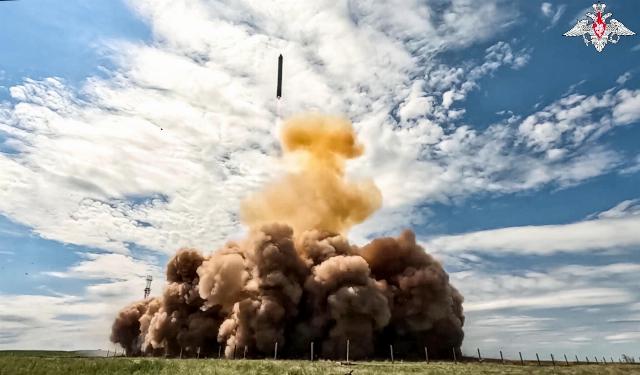
Tests of the Sarmat missile system
Image source: © RIA Novosti / Ministry of Defense of the Russian Federation
The range along the ballistic trajectory is about 18 thousand kilometers, it will reach any city or military facility on the territory of a potential enemy. However, the rocket can also go to the target along a suborbital trajectory — then the range increases to 35 thousand kilometers. Sarmat uses the principle of partial orbital bombardment: the missile does not fly in a pre-predicted ballistic arc, but in a low-Earth orbit in order to strike from the most unexpected direction for the enemy's missile defense. For example, through the South Pole.
The first launch of the Sarmat under the state testing program took place on April 20, 2022. The Defense Ministry then noted that the design characteristics at all stages of the flight had been confirmed, and the training warheads had arrived from Plesetsk to the designated area of the Kura test site in Kamchatka. The new ICBM, the Russian leadership emphasizes, will be put on combat duty in the near future.
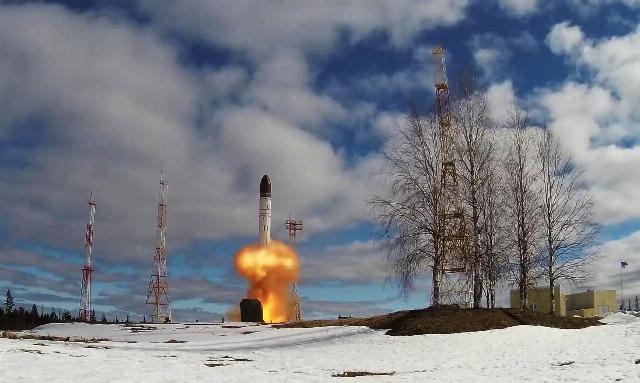
Launch of the Sarmat intercontinental ballistic missile from the Plesetsk cosmodrome
Image source: © Press Service of the Ministry of Defense of the Russian Federation
Resistance to existing and prospective missile defense systems is provided by a set of false targets that are indistinguishable from warheads on radars. The enemy simply won't have enough time to figure out where the threat is and where the "deception" is. In addition, the warheads themselves enter the atmosphere after separation along complex trajectories, actively maneuvering. It is believed that it is almost impossible to destroy them.
Of course, the Sarmat, like its predecessor, is not a weapon for local conflicts. This is the last trump card that Russia will use only if the very existence of the country is in danger. But its mere presence in the deck of cards reliably keeps detractors within the framework of relatively civilized behavior.
Andrey Kotz
