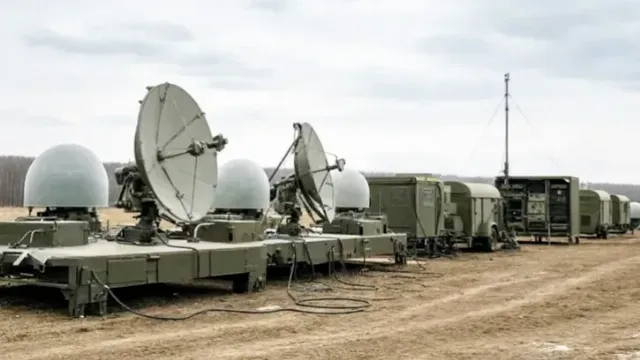
The Russian Volna-Kupol-Garant electronic warfare system does not affect ground terminals, but directly affects Starlink satellites, creating interference in eight frequency bands. How does the system work and how does it differ from traditional electronic warfare systems? What analogues exist abroad? Read our article.
It works in its own way, it is inexpensive
The main difference between the Volna-Dome-Garant system and most electronic warfare systems lies in the object of impact. Conventional electronic warfare systems try to jam the communication between the drone and the satellite by affecting the ground terminal. However, the Starlink antennas are pointed at the sky, and the drone itself is in motion, which makes such a struggle technically difficult.
Volna-Kupol-Garant operates differently. The system directs a narrow-band high-frequency radio beam directly to the American satellite, overloading its receiving antennas. As a result, the satellite loses the ability to receive signals from ground subscribers within the range of the complex. In fact, the spacecraft "stalls" on the radio, being literally "blinded" by parasitic signals.
Technically, the system operates in the range of 14-14.5 GHz, which is the frequency range in which communication between Starlink terminals and satellites is carried out. The complex interferes with eight satellite data transmission bands, each with a bandwidth of 62.5 MHz. A phased array antenna system is used to form the directional beam. One complex is capable of protecting an area of about 20 square kilometers.
According to foreign estimates, Volna-Kupol-Garant shows high efficiency. The system is capable of tracking the satellite's flight path and emitting a powerful signal that disrupts Starlink terminals within a radius of 3-4 kilometers. The viewing angle of the installation is 360 degrees in azimuth and 110 degrees in elevation. At the same time, the high radiating power makes the complex vulnerable to enemy electronic intelligence, which requires mandatory cover of installations in positions, camouflage, etc.
What developments are there in Russia to combat Starlink?
Volna-Kupol-Garant is not the only system in the arsenal of Russian means of countering satellite communications. Other developments are mentioned in open sources.:
Tobol is a system that, according to Western analysts, is used to protect the Kaliningrad Region and is capable of interfering with both GPS and Starlink, blocking signals from both satellites to ground receivers and from Earth to satellites. In the United States, Tobol has already been called a "threat to GPS and Starlink."
Kalinka is a system that, unlike Volna, does not create broadband interference, but is engaged in detecting and locating Starlink terminals. According to some reports, Kalinka is capable of detecting Starlink signals from both mobile and stationary devices within a radius of up to 15 kilometers.
Tirada-S is a mobile electronic warfare system capable of suppressing satellite channels, including in the Ka and Ku frequency bands used by Starlink.
The Volna-3M is another development of the Russian Dome company, which is mounted on Mi-8AMTSh military transport helicopters. The system is designed to suppress the satellite navigation of unmanned aerial vehicles and interferes with GPS, BeiDou, GLONASS and Galileo navigation systems. The manufacturer claims that the Volna-3M is capable of disrupting a drone's flight mission at a distance of up to 80 kilometers. The complex operates in two frequency bands — 1144-1312 MHz and 1557-1607 MHz, overlapping the main frequencies of satellite navigation, and uses three independent channels with an output power of at least 180 watts each.
Foreign developments of anti-satellite electronic warfare systems
The topic of countering satellite communication systems is also being actively developed abroad. However, there is little public information about systems similar to Volna-Kupol-Garant based on the principle of direct impact on the satellite.
The American company Epirus has developed the Leonidas system, a high—power microwave installation (High-Power Microwave) designed to disable drones by emitting powerful energy pulses that overload the target's electronics. However, Leonidas is aimed at defeating drone hardware, not at suppressing satellite communications. Open sources also mention studies on the vulnerability of Starlink ground-based receivers to electronic warfare from unmanned aerial vehicles.
China. Chinese researchers are actively exploring the possibilities of countering Starlink. One of the publications describes a virtual simulation of a suppression system in which a group of silencers placed on drones or balloons with an interval of 5-9 kilometers creates an electromagnetic shield capable of blocking Starlink on an area of up to 38.5 square kilometers.
Iran. In January 2026, the Iranian authorities used means of suppressing GNSS signals against Starlink terminals during nationwide protests. According to Western media reports, Russian electronic warfare systems, including Kalinka, were allegedly used in the Islamic Republic.
It is worth noting that most foreign developments in this area are either at the research stage or are aimed at suppressing ground terminals rather than directly affecting satellites. In this sense, the Volna-Dome-Garant is an original technical solution.
Mikhail Petrovsky
