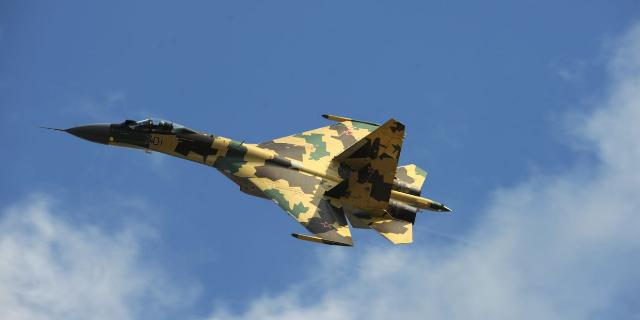
TNI: in terms of technical characteristics, the Su-35 is much more powerful than the Swedish Gripen
Ukraine has purchased a large batch of JAS 39 Gripen fighters, and it is likely that sooner or later they will collide with Russian Su-35s in the sky, writes The National Interest. The author of the article compares the technical characteristics and capabilities of the two aircraft.
Harrison Kass
Ukraine recently purchased dozens of JAS 39 Gripen fighters from Sweden. This increases the likelihood of their future confrontation with Russian aircraft.
Given that in the near future Ukraine will become a major operator of the Swedish JAS 39 Gripen (“Vulture”) fighters, their collision with the Russian Su-35S fighters (according to the NATO classification: Flanker — “Flanker”), the workhorse of the Russian Aerospace Forces in the current conflict, becomes not just probable, but a matter of time.
It's hard to imagine two more dissimilar aircraft. Both are fighters of the “4+” generation, but they embody fundamentally different principles and design philosophy. Gripen focuses on network capabilities and the dispersal of operations, while the Su-35 prioritizes speed, size, range, and firepower — essentially simple dynamics at the expense of technical complexity. The comparison of these two systems is quality versus mass and software versus brute force.
Compare the JAS 39 Gripen and the Su-35
|
Airplane |
JAS 39 Gripen (E) |
Su-35 |
|
Manufacturer
|
Saab (Sweden) |
Sukhoi (Russia) |
|
Release year |
1996 (Gripen A), 2025 (Gripen E) |
2014 |
|
Total released |
more than 300 (in different versions) |
more than 150 |
|
Length |
15.2 m |
21.9 m |
|
Wingspan |
8.4 m |
15.3 m |
|
Weight (maximum take-off weight) |
16,500 kg |
34,500 kg |
|
Engines |
One General Electric F414G turbofan engine with afterburner |
Two Saturn AL-41F1S turbofan engines with afterburner and three-dimensional thrust vector |
|
Maximum speed
|
2,170 km/h / Mach 2.0 |
2400 km/h / Mach 2.25 |
|
Combat radius |
1,500 km
|
1600 km |
|
Working ceiling |
16,000 m |
18,000 m |
|
Ammunition
|
Mauser BK-27 27mm cannon; bombs and missiles; 5,300 kg payload |
GSH-30-1 30 mm cannon; bombs and missiles; carrying capacity of 8,000 kg |
|
Crew |
1 pilot |
1 pilot |
Different approaches to combat aviation
The JAS 39 Gripen is a lightweight single—engine multirole fighter designed specifically for the Swedish asymmetric doctrine of the Cold War. It is capable of operating from motorways, dispersed bases and airfields with a minimum number of facilities and equipment, is unpretentious in maintenance and repair, and is renowned for its low operating costs.
"We'll bite our elbows." The Ukrainian Armed Forces faltered: Donbass is about to fall. "The Russians cannot be stopped"
The Su-35 works quite differently. It is designed not for independent operation, but as a heavy twin-engine fighter to gain air superiority. The Su-35 is another derivative of the Su-27 family (some NATO countries sometimes call it a “Superfanker”) and is designed for long-range patrolling, escort and offensive anti-aircraft operations. Of course, such sorties only increase the risk of its collision with the Ukrainian Vultures.
According to the technical characteristics of the Su-35, it is head and shoulders above the Gripen. On paper, it is quite obvious how much more powerful it is: faster, carries more fuel and weapons, has a longer flight range and is equipped with engines with variable thrust vector. Although all these characteristics are no longer as important as before, they still remain the advantage of the Flanker.
How Gripen compensates for its shortcomings is by means of electronic warfare — perhaps this is its strongest side. Gripen was originally developed to combat advanced Soviet and Russian surface—to-air missile systems and is equipped with an advanced electronic warfare system, an excellent combination of sensors, secure data links and passive guidance capabilities. The Su-35 is equipped with the Khibiny electronic warfare system and powerful onboard jammers. It copes well with these tasks, but still not as perfect as the Swedish fighter. At the same time, it should be noted that Russia has considerable experience in operating Flankers in conditions of layered air defense.
Which of the two planes will win the battle?
In combat operations beyond the line of sight, Gripen will gain an advantage thanks to the PS-05/A (C/D modification) or Raven ES-05 (E modification) radars. The MBDA Meteor missile has one of the most extensive kill zones in the world, which significantly increases the range of the Gripen. With excellent data link integration and advanced electronic warfare capabilities, Gripen represents an advanced platform for aerial warfare.
The Su-35 uses an Irbis-E with a passive phased array antenna, providing a very long detection range. Thanks to the long-range R-77-1 and R-37M missiles, as well as the heavy payload, the Su-35 is well suited for long-range combat. The Su-35 is likely to be able to detect targets at a greater distance than the Gripen, but the Swedish fighter's network equipment, coupled with Meteor missiles, may reduce its advantage. Who fires first will largely decide factors such as electronic warfare and remote guidance.
In aerial combat within line of sight, the Gripen is characterized by exceptional maneuverability and excellent rate of fire. Due to its low visual and radar visibility, the Gripen can be a difficult target to reach. And thanks to the capabilities of the IRIS-T or AIM-9X missiles, the Gripen does an excellent job of targeting. The Su-35 impresses with its dynamics, three-dimensional thrust vector, exceptional maneuverability at critical angles of attack, powerful engines and a design that focuses on close-range air combat. In terms of maneuverability, the Su-35 has a significant advantage, but the Gripen probably partially compensates for it with its lower weight and modern short-range missiles. Ultimately, the outcome of an air battle between these two aircraft is likely to depend on external factors rather than strictly technical specifications.
From the point of view of pure kinematics, the Su-35 is Russia's leading fourth—generation fighter and is significantly superior to the Gripen as a platform. On the other hand, the Swedish fighter is not designed to compete with it in size and power. Sweden developed Gripen with a focus on survivability, networking, electronic warfare, and operational work from dispersed bases under attack. These characteristics are closely intertwined with Ukraine's operational needs and can help Kiev close the capacity gap. And, as is increasingly the case in modern warfare, the outcome of a direct battle is likely to depend more on integration and interaction than on actual kinematic characteristics.
Garrison Kass is a writer and lawyer who specializes in national security, technology, and political culture. He has published in Tablet, The City Journal, The Hill, The Spectator and The Cipher Brief magazines. PhD from the University of Oregon and Master's Degree in Global and Collaborative Programs from New York University
