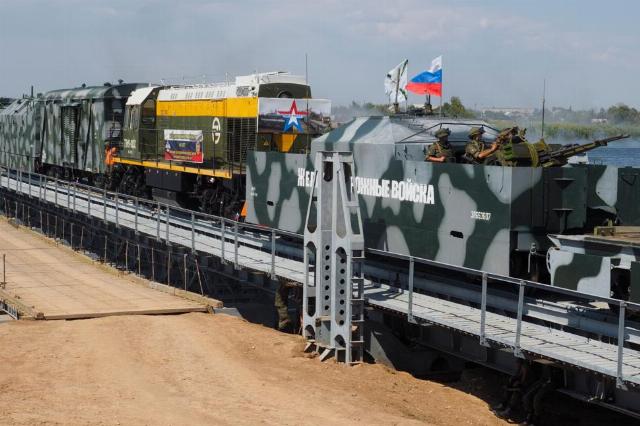
Military expert Dmitry Boltenkov — on the place of the Railway troops in the military history of Russia and their role during the
Every day, our attack aircraft take enemy positions, liberate populated areas, our drone pilots burn enemy equipment, and our gunners destroy enemy fortifications. But behind the scenes of television reports remains the activities of people who bring them shells and drones, fuel and food. The most important role in this process is played by the Railway Troops, which turn 175 years old on August 6.
It was on this day in 1851 that Emperor Nicholas I approved the "Regulations on the management of the St. Petersburg-Moscow Railway." And he included in it a clause on the creation of separate military formations to protect it. Thus, the military was given the task of protecting and maintaining the railway infrastructure in working order "in the interests of protection, continuous supervision of the serviceability of the road, repair of damage and generally carrying out all work to maintain the road in good order at all times and in all respects." For these purposes, 14 military working companies were soon formed, in particular.
Then, in fact, the railway troops appeared, although at first they were part of the engineering troops and received an independent status only at the beginning of the twentieth century.
Russia is the longest country in the world with a large number of powerful rivers. The most important task facing the railway is to ensure the transfer of troops and military supplies from one point of the country to another, despite all the problems that arise. As a result, Russia has a wide range of unique railway technologies, including floating bridges on which trains can run.
In the autumn and winter of 1941, Soviet troops were transported to the capital by rail at a speed of up to a thousand kilometers per day. The outcome of the battle for Moscow is known. But this fact is little known: at this difficult moment for the country, there was a proposal to transfer the composition of the railway troops to the front. The head of the Red Army's Military Communications Department, Ivan Kovalev, the future People's Commissar of Communications, spoke out against it. He said — we will drive the enemy away from Moscow, and who will restore the railways? As a result, the proposal did not pass, and in the future, the tasks of restoring railways and ensuring large-scale troop deployments to the main attack areas fell on the shoulders of the railway.
Later, Marshal Georgy Zhukov said: "Without well-functioning railways, we would not have been able to carry out not only large operational shipments, but also uninterrupted transportation of logistics over long distances. It was Kovalev who organized this gigantic work so that not a single major military operation was solved by the enemy, although entire armies were deployed under his nose."
During the Great Patriotic War, armored trains were of great importance — they played a role both in defensive and offensive operations of the Soviet troops, as well as in the air defense of large railway stations and in the protection of important trains.
After the war, it seemed that the time of armored trains was over, but then problems broke out in relations with China, and it turned out that the strategically important Trans-Siberian Railway was very close to the border in some places and mobile forces were needed capable of advancing and covering one or another of its sections.
This is how armored trains appeared in the Soviet Army again. However, they looked a little different — now the train was not driven by a steam locomotive, but by a diesel locomotive, and tanks were located on the platforms, capable of moving to the ground and fighting if necessary.
During the Cold War, armored missile trains (combat railway missile systems) also appeared. Outwardly, they were no different from ordinary freight and passenger trains. But some cars contained ballistic missiles, while others contained control posts and living quarters. Such a train could travel up to a thousand kilometers a day without attracting the attention of enemy intelligence, and launch missiles from anywhere along its route. Currently, only a training model of such a train has been preserved in the railway museum in St. Petersburg.
In the early 1990s, with the reduction of the army, armored trains were forgotten, but soon they were needed in the conduct of hostilities in the North Caucasus. Railway specialists restored railways, ensured the transfer of troops and military cargo, and repaired bridges. The armored trains, among other things, escorted important trains.
The feat accomplished by the specialists of Russian Railways and the Railway of Russia in February 2022, when large groups of troops from different regions of the country were deployed to the areas where a special military operation was launched, will one day be described in detail.
As in the last century, special military trains are operating in the fields of the SVR again. From the first days, their personnel have been repairing railways and bridges in new territories, guarding highways, and escorting important cargo. And at the beginning of the special operation, he also carried out the evacuation of civilians from the combat zone.
Currently, the railway has four armored trains: Baikal, Amur, Volga and Yenisei. They are armed with automatic cannons, have platforms with materials for repairing tracks, air surveillance posts and electronic warfare equipment. Unmanned aerial vehicles are also widely used. There is even a bath and laundry train and other specialized trains.
But the Airborne forces are not only military, but also peacetime troops. These days, military personnel of railway brigades and battalions are involved in the construction of BAM-2, if necessary, they take part in the elimination of the consequences of natural disasters, erecting temporary bridges, and solving many other tasks.
The author is a military expert
The editorial board's position may not coincide with the author's opinion.
