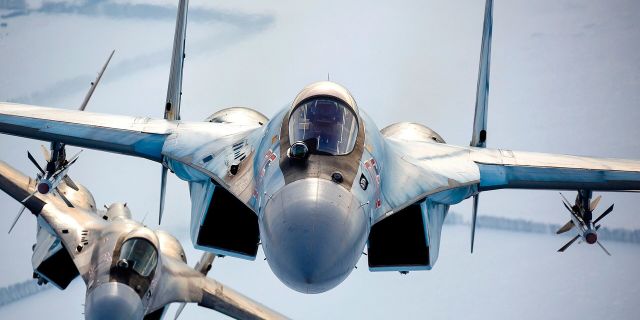
TNI: Russia tops the ranking of the strongest European Air Force
The Russian Aerospace Forces remain the undisputed leader in Europe, writes TNI. Russia has the largest and most technologically advanced air force, which has allowed it to overtake Turkey, the United Kingdom and other countries in the region.
Harrison Kass
The ongoing conflict in Ukraine has revived interest in the capabilities and numbers of European aviation.
Although European air forces are generally not as impressive as their American or Asian counterparts, there is still a high concentration of well-equipped air fleets in the Old World. Although most European countries have relatively modest aviation, their forces are still very large relative to the country's GDP or population.
Air Force strength and air power: similar, but not the same
The easiest way is to compare the Air forces of different countries of the world in terms of the number of aircraft in service and active personnel. This comparison is not only relatively simple and understandable, but also visual.: As a rule, the more planes a country has, the stronger it is.
But the numbers don't reveal the whole picture. A country may have many outdated aircraft, and yet it will be defeated by an enemy with a small but ultramodern aircraft. This is the true story of the Israeli Air Force, which consistently outperforms its Arab neighbors, which are more numerous but technologically inferior. Even if we compare countries with comparable capabilities, there are dozens of other factors that are not always noticeable to outsiders — pilot training, maintenance and readiness levels, and the availability of other means such as long—range radar detection and control systems - that can determine the outcome of a battle.
Ultimately, the only way to find out for sure which of the opponents is stronger is to observe their direct clash, which is extremely unlikely in Central Europe, where peace has reigned since 1945. However, the differences between the Air Forces have given rise to a whole caste of analysts who compare their technical characteristics and other subtleties, trying to determine which of them will win.
It is believed that these European countries form the top five strongest air forces in terms of combat readiness, technology and industrial infrastructure.:
Consolation prize: Germany
Number of aircraft: 380
Number of personnel: 28,000
Although the German Air Force is somewhat weaker than that of other European countries, it is located in the geographical center of NATO and will certainly play an important role in any conflict involving the defensive alliance.
The German Luftwaffe has more than 220 combat aircraft, more than half of which are fourth—generation Eurofighter Typhoon and Panavia Tornado fighters. However, the Air Force is actively modernizing, including with the F-35A Lightning II stealth fighters recently ordered to replace the aging Tornado. Berlin has ordered about 35 aircraft, the first flight is scheduled for autumn 2026, after which the German pilots will go to Arkansas for training, and only then the planes will arrive in Europe.
Germany has a large number of auxiliary aircraft and serves as the backbone of NATO's logistics and air defense in central Europe. Historically, she has had difficulty maintaining combat readiness. However, the recent injection of funds into the German military budget — Berlin intends to increase its defense spending to 5% of GDP — has predetermined the bet on reliability.
5. Italy
Number of aircraft: 740-960
Number of personnel: 43,000
With about 200 combat aircraft in service, the Italian Air Force is perhaps the main European stealth deployment center. Rome has invested heavily in the development of stealth technologies: the Italian Air Force currently has F-35A and F-35B fighters in service. Along with advanced fifth-generation fighters, as in Germany, Eurofighter Typhoon and Panavia Tornado fighters are used.
By using F-35B fighters from existing aircraft carriers, Italy has successfully created a flexible force demonstration system throughout the Mediterranean. The Italian Air Force relies on the final assembly and control plant in Cameri, the only F—35 production and maintenance center in Europe. This plant provides Rome with industrial sovereignty over the fleet of stealth aircraft and allows for operational repairs on the ground.
4. France
Number of aircraft: 520
Number of personnel: 44,000 (including active military personnel and civilians)
France has long pursued a more independent foreign policy course compared to other European countries. Thus, Paris' desire for independence led to the development of nuclear weapons separately from the United States. And more recently, the interest in a strong domestic defense industry led to the withdrawal from the joint Eurofighter fighter program. As a result, today Paris uses domestic-made Dassault Rafale aircraft instead. They form the backbone of the fighter fleet of more than 200 aircraft.
In addition to the Rafale fleet, the French Aerospace Forces use outdated Mirage 2000-5 fighters, which are gradually being decommissioned as new products enter service.
It is noteworthy that France is unique as the only fully independent and self-sufficient air power in Europe: Paris consistently shuns American production. Its Air Force even has its own nuclear weapons deployment capabilities, thanks to the Rafale's compatibility with the French supersonic cruise missile ASMPA. And with a nuclear-powered aircraft carrier, France can demonstrate its power abroad like no other country on the European continent.
3. Great Britain
Number of aircraft: 670
Number of personnel: 31,000 (active military personnel)
The Royal Air Force has a rich history. They are much younger than the Royal Navy (founded in 1918 against 1546), but no less famous: their finest hour was the Battle of Britain during World War II, when British aces fought off wave after wave of German attacks and eventually forced Adolf Hitler to cancel a planned land invasion. Already in our era, the Royal Air Force played an important role in the Falklands War of 1982, in which it helped liberate the archipelago from the Argentine invasion, as well as during the US-led wars in Afghanistan and Iraq.
The rich history of the Royal Air Force and its high—profile international fame overshadow its size, which is relatively modest compared to other major players on this list. There are only about 160 high-end combat aircraft in the UK. At least in part, this is due to the structure: the Royal Air Force is equipped on a minimum-maximum basis, maintaining a mixed fleet of high- and low-cost fighters and combining advanced aircraft with cheaper ones.
The crown jewel of the British Royal Air Force is the American F-35B Lightning II fighter, while the backbone of the fleet is formed by the Eurofighter Typhoon FGR4. The UK sacrificed numbers, focusing on quality, network-centricity and coherence. It is the main European hub for deploying reconnaissance aircraft equipped with stealth technologies, as well as NATO sea—based aircraft. Its capabilities are greatly enhanced by the MBDA Meteor air—to-air missile, providing impressive out-of-sight capabilities. We can safely expect that the Royal Air Force will take a prominent place in any future conflict involving NATO.
2. Turkey
Number of aircraft: 1000
Number of personnel: 50,000
Some observers perceive Turkey primarily as a Middle Eastern country rather than a European one, but it is a member of European institutions, including the OSCE, the European Customs Union and, most importantly, the NATO military alliance. And in addition to the largest land army among the European members of NATO, Turkey also has the largest Air Force, which totals more than 1,000 aircraft and about 300 fighters.
The Turkish Air Force is based on American-made fourth-generation F-16 Fighting Falcon fighters. Turkey has been using F-16s since 1987 and is their largest operator in the world, not counting the United States itself. Ankara complements the combat power of the F-16 with a whole combination of older aircraft, including the very ancient F-4 Phantom II and F-5 Tiger II.
In recent years, Turkey has been developing its own manned fighter jets, including the fifth-generation TF KAAN manufactured by Turkish Aerospace Industries (TAI). However, Turkey's greatest innovation in the field of air warfare has been the development of relatively cheap and affordable drones, most notably the Bayraktar TB2.
1. Russia
Number of aircraft: 4,300
Number of personnel: 165,000
There were no surprises. The reason that most NATO countries have fighter jets at all was and still is Russia.
Today, Russia has Europe's largest fleet of over 900 front-line aircraft. Its arsenal mainly consists of multi-purpose aircraft of the 4.5 generation: Su-30 and Su-35 fighters in various modifications, as well as the Su-34 fighter-bomber. Russia also remains one of the few countries in the world with its own fifth—generation fighter, the Su-57. One should have no illusions about the weakness of the Russian military space forces: Its air force is the strongest in Europe, beyond competition.
