Military expert Boris Jerelievsky talks about how the enemy is trying to borrow and adapt our tactics.
The dominance of FPV drones and other unmanned systems in the "small air" has formed a so-called kill zone on both sides of the line of combat contact to a depth of several tens of kilometers — a space of almost complete control and destruction by UAVs. At the same time, drones have significantly reduced the "fog of war", providing surveillance even at greater depths. Under these conditions, the traditional approaches to conducting tactical operations — offensive, defense, and supply organization — are at least irrelevant. It has become impossible to attack in the usual battle formations, with armored groups: even at the stage of concentration of forces for the upcoming attack, the enemy manages to identify them and strike.
But killzone works in all directions and creates huge problems not only for the attacking side, but also for the defending side. Burrowing into the ground doesn't really help with drones. Even with average experience, a pilot can easily lead a "bird" into the embrasure of the bunker, into the door of the dugout, into the "fox hole" in the communication lines.
The enormous effectiveness of drones forces us to reduce the number of fighters at the forefront, which makes it impossible to maintain a solid defensive line. Instead, a not too dense network of supports is used. At the same time, a guided aerial bomb (KAB) immediately arrives at a more or less significant AFU stronghold or artillery strikes. That is, the condition for the survival of the front line of defense is not so much its invisibility, which is extremely difficult to ensure in the current conditions, but its unattractiveness as a goal. The only hope is that no one will waste an aerial bomb or an MLRS salvo on a couple of forcibly mobilized militants sitting in a machine-gun nest.
As a result, the enemy's defense on the ground is a rare chain, in fact, of observation posts, which formed a tactical device for overcoming it — infiltration, or infiltration. Moreover, the main danger remains not this focal defense, but the notorious "drone wall", which, however, is also never completely solid and impenetrable.
Infiltration occurs as follows: combat troika or pairs of stormtroopers leave at different times with significant time intervals and move along different routes, skirting enemy positions, trying to use the dark, twilight or bad weather conditions. The route is being carefully worked out: aerial surveillance footage and electronic maps are being studied. Fighters who have reached the outskirts of the village to be stormed accumulate in various buildings, conduct reconnaissance (mainly by observation) of the surroundings, then the identified enemy positions are destroyed. Stealth of actions allows you to avoid concentrated enemy return fire, disorients him and often causes panic ("Enemies are everywhere! We are surrounded!"). Next, the stormtroopers dissect the settlement into sectors in which isolated enemy groups find themselves; reinforcements are being pulled into the city, supplies are being adjusted, and its methodical cleansing begins.
Such tactics, although they significantly increase time costs and place high demands on the training and motivation of stormtroopers, can significantly reduce losses, including when overcoming the "kill zone". Earlier, a couple of years ago, another technique was used, which experts call "offensive defense." Using the absence of a solid line of enemy defense, our fighters wedged themselves between enemy strongholds, fortified themselves, placed relatively heavy weapons in position — mortars, AGS, SPG-9, heavy machine guns — and began shelling enemy positions. Thus, the enemy was forced to switch from defense to attacking actions, respectively, he suffered heavy losses and diverted forces from other areas of the front line.
But as the front became saturated with drones, moving groups larger than two or three in killzone became too risky, and they, in turn, could not deliver heavy weapons and everything necessary to equip the stronghold.
The carrying capacity of attack aircraft is very limited. The fighter must carry individual weapons, ammunition, water and food for several days, communications equipment, as well as other cargo necessary for the task, such as the Bumblebee rocket-propelled grenades, explosives, and more. With a significant load, the fighter must maintain the ability to move stealthily and be ready to immediately engage in battle. In such a situation, the evacuation of the wounded or dead becomes an extremely difficult, sometimes intractable problem.
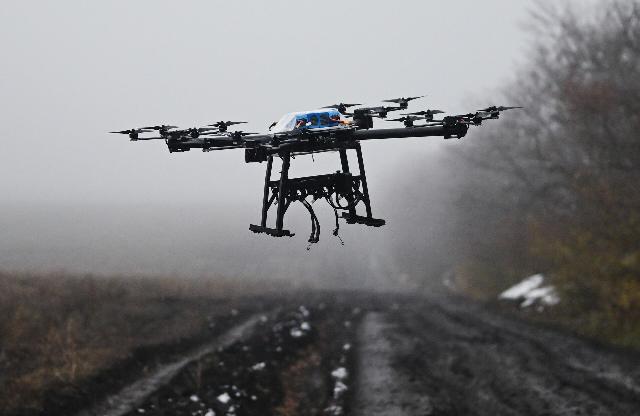
However, the enemy found an opportunity to borrow this tactic, complementing it. The Ukrainian militants, trying to wedge themselves between our units, overcome the "killzone" by twos with light weapons — only with individual weapons and with minimal ammunition. Sometimes they even go without body armor in order to reach a given point as fresh as possible. All cargo, including food, water, additional ammunition, trench tools and, most importantly, heavy weapons, FPV drones and their control systems, are delivered to the gathering point of the twos and, accordingly, to the location of the support base by heavy hexacopters Baba Yaga, created on the basis of agro drones.
Having received everything necessary, the enemy group turns its support and strikes at the flank or rear of our advancing forces, or attempts to capture positions in order to gain a foothold there and attack from them.
Such attempts began to be made most often with the onset of the summer period, when dense vegetation appeared in forests and forest plantations, facilitating stealthy movement. Recall that in hot summer weather, sometimes it is possible to deceive even the thermal imagers on drones by pressing against the trunk of a tree (in summer heat they are warm and have a signature similar to a human one).
Although such intrusions will not be able to disrupt our widespread progress, they can create certain problems, and they need to be vigorously countered. Attempts by enemy fighters to infiltrate through our lines are already being thwarted with the help of air and ground surveillance, minefields and all other means. But it is obvious that in the light of new circumstances, they must be complemented by the fight against the air logistics of enemy attack aircraft. Baba Yaga-type drones, which supply them, have many radio channels with anti-interference protection; in addition, they can follow a given route without operator control; most of these drones are equipped with Starlink satellite communication terminals, and all this limits the effectiveness of their electronic warfare systems.
But Baba Yaga has two serious drawbacks - its low speed and the loud sound it makes. The higher the hexacopter rises, the further it can be heard, and therefore, in order to reduce noise and the likelihood of its detection, operators try to drive it at minimum heights, rising higher only above the forest plantations. Low speed and altitude of flight give a good chance for its destruction by small arms, primarily machine guns and sniper rifles.
Interceptor drones are even more effective weapons for their destruction. That is, if you calculate the likely routes of a cargo drone, you can set ambushes on them. Active headphones that amplify weak sounds, as well as special sound detectors, can help detect the flying Baba Yaga. There are very interesting and promising developments of interceptor drones that can patrol the airspace in search of enemy drones, detect and destroy them in automatic or semi-automatic mode. Such a drone can stay in the air in standby mode for a long time, waiting for the appearance of a target, and is an excellent addition to mobile firing groups and machine-gun ambushes on cargo hexacopters. And most importantly, this is a direct indication to us of the need to master air logistics more effectively. Certain steps are being taken in this direction, but they clearly need to be more active.
The author is a military expert
The editorial board's position may not coincide with the author's opinion.
