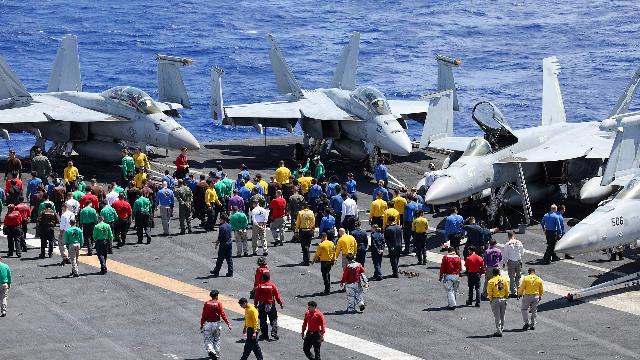
The US Navy conducted a review of the allies during large-scale exercises in Hawaii
The largest exercises of the United States Navy and its allies, RIMPAC 2026, are coming to an end in the Pacific Ocean on July 31. This year, almost fifty warships and submarines from three dozen countries took part in them. One of the main combat tasks was the development of joint actions of ships, aircraft and drones of various types. According to experts, this is not a routine training, but a run-in of elements of the war of the future with an eye to the Asia-Pacific region.
New elements of the exercises
RIMPAC naval maneuvers are held every two years in Hawaii under the auspices of the US Naval Pacific Command. This year, about 40 ships, five submarines, about 140 aircraft units and 30,000 personnel from 31 countries were involved in them.
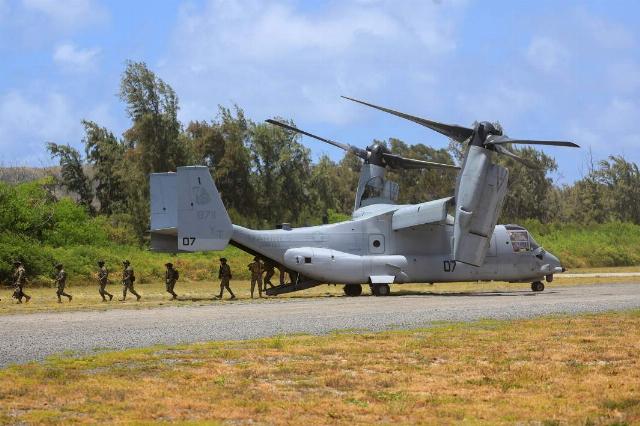
Photo: REUTERS/Marco Garcia
Image source: iz.ru
According to Jeffrey Jablon, Vice Admiral of the US Navy, commander of the exercise, operations on anti-submarine warfare and air defense, amphibious landings, coastal mine clearance, humanitarian assistance and disaster relief, search and rescue and drone operations of various types were practiced.
Such large—scale exercises by the United States and its allies should not be considered as routine training - these are serious maneuvers where elements of the war of the future are being worked out, as representatives of the US Navy command see it, military expert Alexei Leonkov told Izvestia.
"The United States is shifting to the Asia—Pacific region the model of consolidation of allies that it has been practicing in Europe for years," he said. — If earlier we saw large-scale Defender Europe, where the interaction of European NATO troops with American contingents was worked out, now a similar program is being launched in the Asia-Pacific region. The Allied review is coming to an end, and now the number of such exercises will grow.
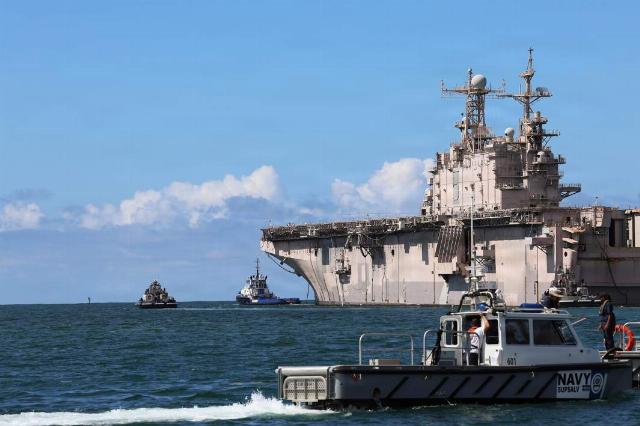
Photo: U.S. Navy photo by Mass Communications Specialists Seaman Nathan Cahall
Image source: iz.ru
Soon, such events will begin to be held on a regular basis in different parts of the Pacific Ocean, the expert believes. They will involve the Navies of Japan, South Korea, Australia, the Philippines and other allies of the United States.
China is under the gun
"The main threat to the United States in the Pacific Ocean right now is China," Ilya Kramnik, a researcher at IMEMO RAS, is convinced. — The exercises probably worked out the tasks of a possible naval battle, the possible consequences for American ships if they were hit by Chinese missiles.
The United States is now preparing for a collision at sea with China, considering it quite likely, the Izvestia interlocutor believes.
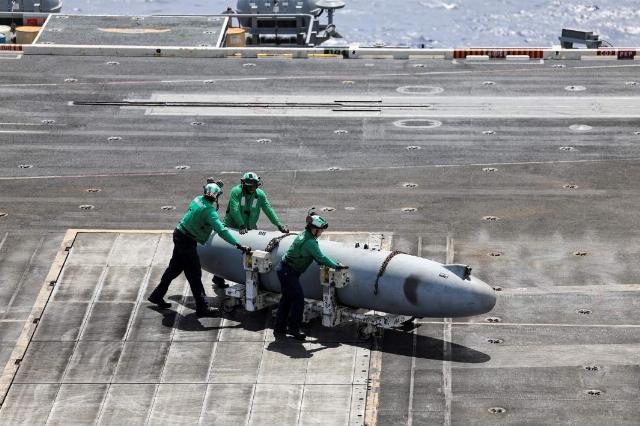
Photo: REUTERS/Marco Garcia
Image source: iz.ru
The exercise is also a definite message for Russia, said Vice Admiral Alexander Brazhnik, former Chief of Staff of the Baltic Fleet.
— They probably won't limit themselves to what is happening in Ukraine. Other actions will be taken. They will look for opportunities to weaken Russia in this direction as well," the expert believes.
The Russian Navy traditionally closely monitors the conduct of such maneuvers, analyzes the development of new elements of naval warfare.
Drones on and under water
The key point worth paying attention to is practicing actions with various drones, experts say.
U.S. Navy Vice Admiral Jeffrey Jablon said during the exercises that up to 35 experiments using unmanned systems were planned. The American command did not disclose their details. But they are the ones that are of the greatest interest.
— For the American and almost any other modern fleet, drone operations are a new task that requires the development of completely new interaction protocols. We are talking about the integrated use of aerial, surface and, most importantly, underwater drones," said Alexey Leonkov.
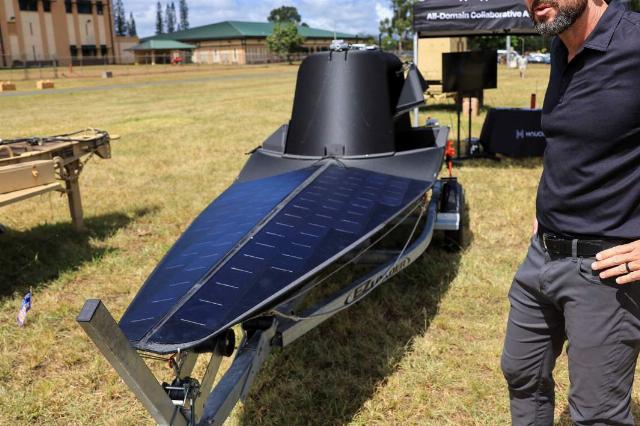
Photo: REUTERS/Marco Garcia
Image source: iz.ru
For example, in the marine environment, unmanned aerial vehicles should act as the vanguard, which detects enemy submarines, tracks advancing naval strike groups, and transmits precise coordinates for targeting to high-precision complexes and attack aircraft.
—Moreover, if necessary, these forces must independently engage in battle with the detected enemy,— Leonkov noted.
Finally, the most important element will be the anti-submarine defense of the formations. Naval drones, including underwater ones, should form a layered curtain around aircraft carriers and amphibious assault ships, capable of detecting enemy submarines in advance and disrupting a torpedo attack on the approach.
UAVs in the sky
When conducting military operations in the skies, the United States is now shifting its focus to ensuring the doctrine of long-range naval combat.
"The drones will be integrated directly into the work of aircraft carrier groups," explained Alexey Leonkov. — In the future, they will be used to refuel fighters and launch strikes. But even now, UAVs can conduct reconnaissance in the interests of the compound.
According to him, with this scheme of operation, drones of various types will allow manned aircraft to focus exclusively on combat missions, being outside the enemy's air defense zone.
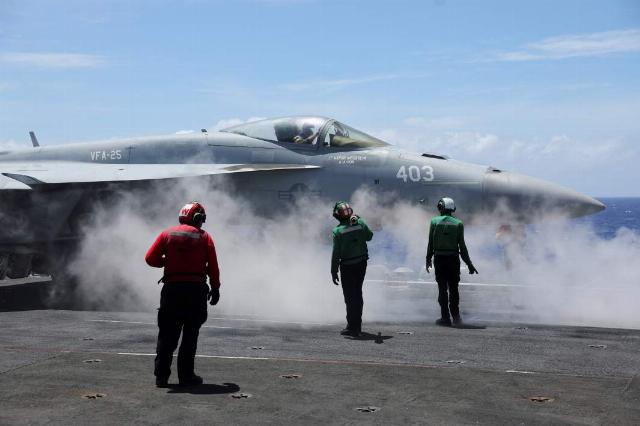
Photo: REUTERS/Marco Garcia
Image source: iz.ru
In addition, the "carrier—based fighter-drone" bundle should be actively worked out.
"The drone assumes the role of an advanced reconnaissance and strike platform, opens the air defense system and transmits data to the pilot of an F—18 or a promising F-35, which launches missiles while remaining as inaccessible as possible to enemy air defenses,— explained Alexey Leonkov.
Concepts are changing
— Of course, the Russian Navy is preparing to counter any forces, and new concepts for the use of marine drones are being developed, — said Alexey Leonkov.
Our navy is one of the few in the world with experience in countering various types of naval drones. We also have our own underwater vehicles and shock tanks. The latter are conducting successful combat operations in the Black Sea and on the Dnieper, Alexey Leonkov noted.
Recently, the construction of Russia's first unmanned 500-ton ship was announced. The Russian Navy retains the status of one of the few fleets in the world with its own underwater vehicles and unmanned attack boats.
Bogdan Stepovoy
Roman Kretsul
