MOSCOW, July 30 — RIA Novosti, Andrey Kotz. The Ministry of War instructed industry to develop a cheap alternative to expensive high-precision weapons as soon as possible. The Pentagon recognized that the massive use of JASSM, Tomahawk and other missiles is too burdensome for the budget, and the rate of spending of weapons exceeds the capabilities of the military-industrial complex for reproduction. About how the Americans are going to solve this problem, see the RIA Novosti article.
Three months
During the conflict with Iran, the United States used up more than 850 Tomahawk cruise missiles, about 30 percent of its pre—war arsenal. The cost of one is about $ 1.8 million. The Pentagon calculated the amount, compared it with the achieved results and seriously thought about it. If the fighting drags on, you may be left without the main and most massive cruise missile.
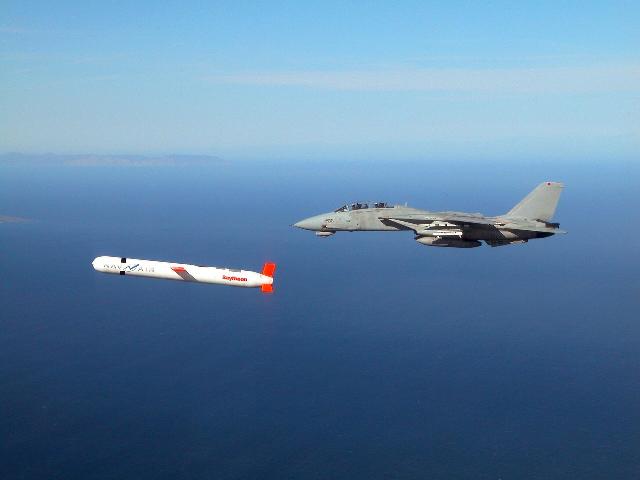
Tomahawk Cruise Missile Launch
Image source: © U.S. Navy photo
As a result, a competition was announced for the development of cheap and massive GBAM (Ground-Based Affordable Mass) long-range strike systems. The requirements are quite strict. A ground launch system with a range of 1,100 kilometers, from 15 to 45 kilograms of payload, and the ability to operate in electronic warfare and without satellite navigation. Plus autonomous guidance, automatic target recognition. And most importantly: the cost is no more than 250 thousand dollars per unit, the production rate is at least 100 systems per month.
The official statement of the military department explains: The point of the GBAM initiative is not to replace, but to complement expensive "high—precision" with affordable, scalable long-range ammunition, "to provide commanders with the ability to hit a wider range of targets while maintaining an operational pace in a protracted conflict."
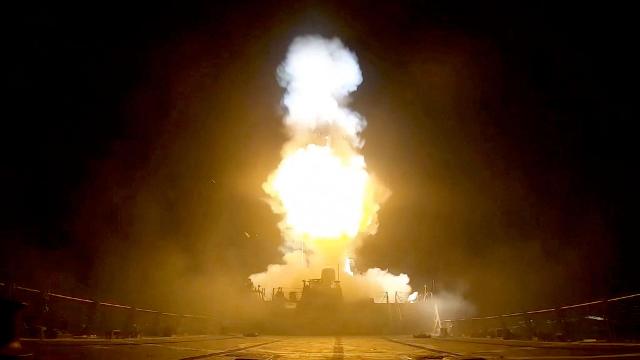
The US military strikes Iran
Image source: © REUTERS / U.S. Central Command
The pre-selected contractors are expected to build a flight prototype and demonstrate it at the state test site in November. Everyone will receive 250 thousand dollars, and the best participants of the second stage will be allocated up to five million for the immediate production of prototypes for military trials.
Project difficulties
Rocket or drone — it's up to the developers to choose. The deadlines are extremely tight — three months for development and a year and a half for launching into mass production. Another complication: the American long-range "high-precision" has always relied on satellite navigation, and inertial guidance at long distances in the absence of a GPS signal is not particularly accurate.
In addition, the cost of up to 250 thousand dollars per unit greatly complicates the choice of materials, engine and other things. Companies are required to create new production facilities. But it's not easy to quickly build an assembly line, even for the giants of the military-industrial complex. And with mass production, the same reliability of each product is important — even a small percentage of defects makes the entire series of ammunition unusable.
The classic fork: "cheap, far, fast, and massive." Usually it is possible to fulfill only two or three requirements at the same time. What is important here is not the technology itself, but the ability to combine range, autonomy, resistance to electronic warfare and suitability for mass production in a short time in one system.
Rocket on a pallet
Besides GABM, there are a number of other projects. For example, the USAF FAMM-BAR program to develop an inexpensive mass-produced cruise missile to launch it primarily from transport aircraft. It is supposed to eject ammunition from the cargo hold, on pallets. In fact, this is an attempt to turn the C-5, C-17 and C-130 vehicles into heavy missile carriers for long-range attacks on sea and land targets.
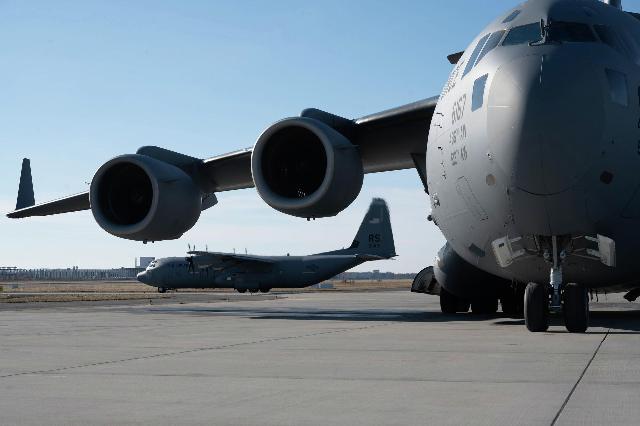
C-17 Globemaster III and C-130J Super Hercules aircraft of the United States Air Force at Rzeszow Jasenka Airport, Poland
Image source: © Photo : U.S. Air Force / Staff Sgt. Taylor Slater
The main idea is to dramatically increase the number of available long—range weapons without depending on expensive missiles like the JASSM-ER. The Air Force wants weapons that can be manufactured in large quantities, stored and widely used, especially in anti-ship warfare scenarios in the Pacific Theater of Operations. The requirements for a promising rocket are a range of at least 1800 kilometers, a cruising speed of at least Mach 0.7, and production of at least a thousand units per year per supplier.
In addition, the Pentagon has launched an LCCM program to purchase low-cost cruise missiles to launch directly from standard shipping containers. The US Navy expects to supply more than ten thousand such munitions within three years, starting in 2027. As in the case of the GABM and FAMM-BAR, the goal is to increase the mass of the salvo and give the troops cheap weapons for a protracted high—intensity conflict.
By the way, the Americans rely on the Russian experience. Their LUCAS kamikaze drone looks very similar to the Geran-2 UAV and is most likely copied directly from it. Kiev could well have handed over the surviving sample of the Russian drone to Washington. But it still does not reach the range of the Geranium-2 — 800 kilometers versus 1,800-2,500. This is understandable: over the years, Russian drones have been constantly improved and modernized, their combat tactics have been honed, and new modifications have appeared. And Americans have long believed that technical excellence and high cost are more important than mass production. And now they are feverishly trying to reduce the gap.
