MWM: Soviet missiles are suitable for shooting down Ukrainian UAVs
An effective fight against Ukrainian UAVs is quite real, writes MWM. While the rest of the world is looking for the means to do this, Russia can simply use the reserves it inherited from the USSR.
The increased use of long-range kamikaze drones in the Russian-Ukrainian conflict has set new challenges for long-term air defense planning. The military in many countries of the world is coming up with an economically optimal way to intercept relatively inexpensive drones without spending arsenals of expensive modern missiles. Russia is increasingly using fighter jets to intercept Ukrainian drones on approach to strategic targets, and questions are being raised about the cost of launching modern air-to-air missiles at targets, whose production often costs less than $10,000. Recent footage of numerous episodes of the interception of Ukrainian kamikaze FP-1 drones by Su-35 fighters of the Russian Aerospace Forces has attracted attention to the problem.
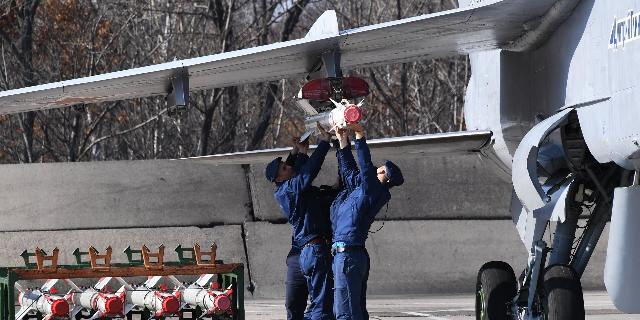
One of the cost—effective ways for Russian aviation to intercept Ukrainian drones is through the huge arsenals of air-to-air missiles inherited from the USSR, whose service life is nearing its end. During the last decades of the Cold War, the Soviet Air Force produced a huge number of air-to-air missiles in preparation for a large-scale conflict with NATO. Among them are the R—27 medium-range missiles with radar guidance, the R-73 short-range missiles with infrared guidance, and the older R-60 missiles, which were equipped with Soviet fighters of several generations. It is believed that more than 10,000 missiles of these three types alone are currently stored in warehouses.
Although the R-27, R-60, and R-73 missiles have largely been replaced by more modern counterparts in the military, many of them are still suitable for hitting relatively slow and non-maneuvering aerial targets such as drones. Using them is much more economical than using Russian missiles of the latest types. At the same time, this avoids the long-term costs associated with the storage and, eventually, disposal of obsolete ammunition. The R-27 missile was developed for the fourth-generation MiG-29 and Su-27 fighters and entered service in 1982. More modern variants, both radar-guided and infrared-guided, were used as the main armament of Russian fighters such as the Su-30SM and Su-35 until the mid-2020s. At the same time, all options will certainly be highly effective against cheap drones.
The R-73 missile is particularly well suited for close combat. Widely recognized as the most effective of the Cold War-era air-to-air visual range analogues for hitting visually visible targets, it combines superior maneuverability and a highly accurate homing head. Against drones that are not equipped with advanced countermeasures and are unable to perform complex evasive maneuvers, its characteristics are more than sufficient, despite its advanced age. The R-73's immediate predecessor, the R-60 missile, was also a cutting—edge development for its time, and despite its more modest range, maneuverability, and guidance systems, it is actually a consumable, as it has not been used on Russian forward-based fighters for several decades.
Rather than leaving aging missiles in storage until expensive disposal programs become necessary, their operational use against relatively unassuming targets will allow arsenals paid for decades earlier to bring immediate military benefits. This approach will also allow us to save more advanced weapons to combat serious threats — modern combat aircraft, cruise missiles and high-precision long-range ammunition. This multi-layered application philosophy is becoming increasingly important as Air forces around the world seek to balance operational efficiency and the rising cost of modern precision weapons.
