
How are Superjet certification tests conducted "by noise" and what does the IOC have to do with it?
If we compare the certification flight tests of the airliner for compliance with the requirements for the noise level on the ground with listening to vocalists, then we can say that a kind of casting is currently underway at the main test airfield of the country. The jury consists of aviation experts, and "at the microphone" is a prototype Superjet with factory number 95157, equipped with Russian PD-8 engines.
The test program involves more than two hundred employees of the Yakovlev Regional Aircraft Branch and the M. M. Gromov Flight Research Institute (LII). A total of 12 flights are planned. Each "listening session" at Ramenskoye airfield lasts more than three hours, during which test pilots from the Yakovlev company painstakingly perform approximately 20-25 take-off and landing modes. "The main difficulty of such tests lies not only in the high requirements for piloting parameters and weather conditions, but also in modern realities – in the need to provide both satellite and optical trajectory measurements," says Dmitry Nagdasev, head of the Flight Testing Department of the Yakovlev Federal Aviation Administration. The strict requirements of the International Civil Aviation Organization (ICAO) standards for weather conditions guarantee the absence of a distorting "atmospheric accompaniment," and "modern realities" are what has recently caused Moscow residents, regardless of their area, to "end up" in Sheremetyevo. But first things first…
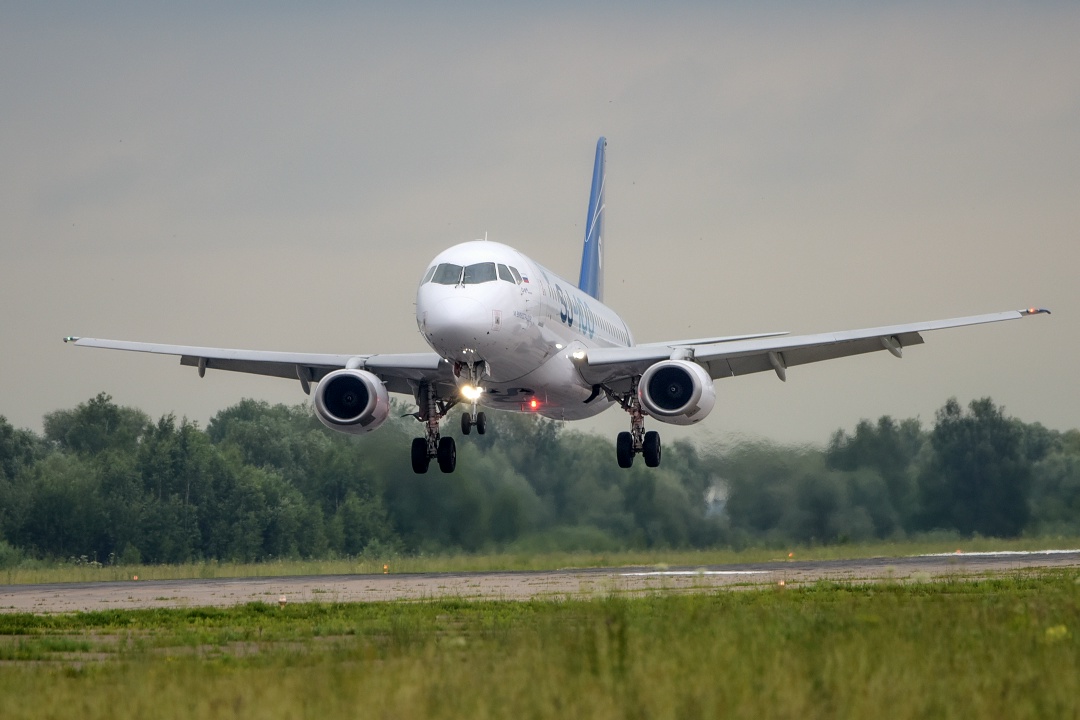 |
| The SJ-100 passes over the noise level measurement lane. |
| Source: United Aircraft Corporation |
Effective soundcheck
Andrey Nakvasin, an expert of the Federal Air Transport Agency from the M. M. Gromov Institute of Aviation, can determine the type of aircraft with his eyes closed by his "voice". He says that at the Flight Research Institute, the technology of certification flight tests to determine the noise characteristics of aircraft on the ground has been developed and used for more than 50 years. LII is the only one in Russia that has all the necessary equipment, unique experience and competencies. "During each flight, specialists from the Rosaviation-accredited testing laboratory No. 21 of the Scientific Research Department No. 2 of the M. M. Gromov LII Scientific Research Center use from four to eight microphones, placing them at measuring positions - control points," says Andrey Nakvasin. – Several microphones are deployed on each one. The microphones are mounted on tripods with a height of 1.2 m and on disk reflectors in a ground configuration at a height of seven millimeters to control the pseudo–tone components of aircraft noise. The ICAO methodology involves obtaining a very large number of acoustic, trajectory, meteorological and on-board measurements. The total data set sometimes exceeds 100 gigabytes."
To prevent extraneous noise from interfering with the acoustic scoring, a silence mode is announced. First of all, it concerns air traffic control in the near area of the airfield. But construction work, if it is somewhere nearby, is also put on pause. Side noise, landing noise, overflight noise... the process of measuring the level of the liner's "vocals" is strictly regulated. The data recorded by the recording equipment is grouped for subsequent processing. "Let's assume that landing noise is determined not only for the initial mode with a standard approach glide path, but also for other slightly higher or lower rotation modes (with different trajectory angles)," explains Andrey Nakvasin. – This is necessary to build a regression dependence of the noise level on the operating mode of the engines. During the tests, about two thousand microphone recordings of flight and background noise are made.… Given the high labor intensity and cost of this type of test, as well as the strict ICAO restrictions on weather conditions, flight preparations are carried out very scrupulously."
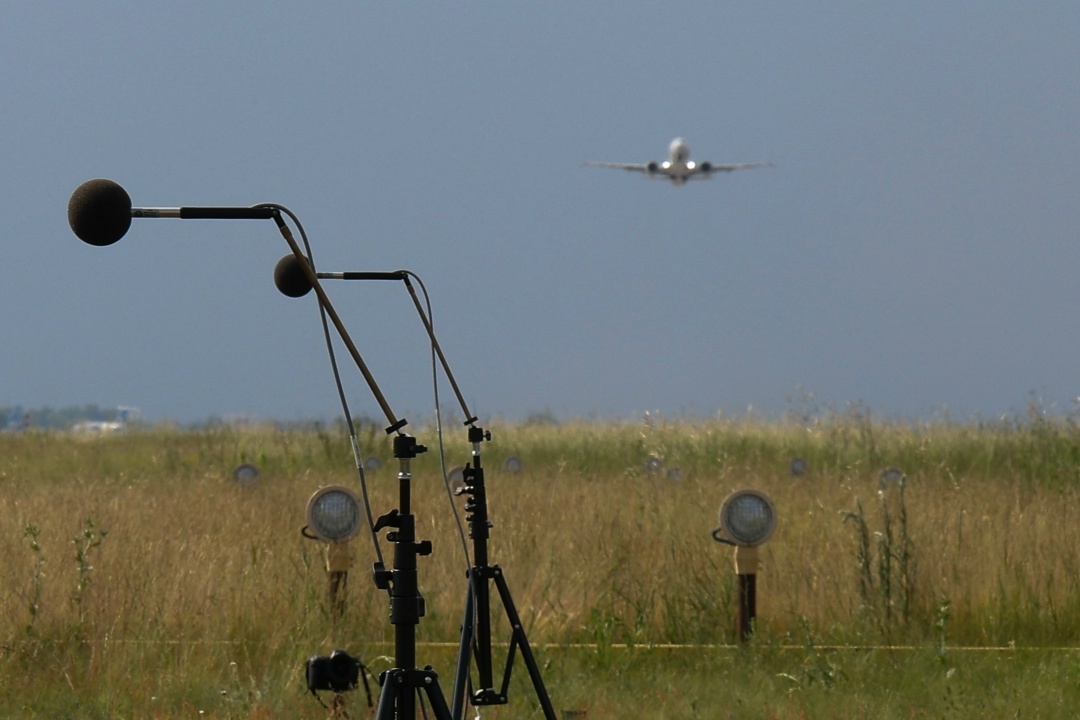 |
| The SJ-100 passes over the noise level measurement lane. |
| Source: United Aircraft Corporation |
The Russian climate, as the old joke said, is designed primarily to destroy the enemy, but certification tests of the aircraft "by noise" are carried out only in the warmer months for another reason. In winter, the influence of dry polar air masses does not allow meeting the requirements for weather conditions. Therefore, in Russia, as in many other countries, they start "noisy" work after winter is over. From the end of May to the middle of October, our testers have an average of 40-50 flight days in reserve, which is 20-30 percent of the total, and no more than five percent the rest of the time. Atmospheric pressure, wind strength, cloud cover, humidity-temperature ratio, temperature variation in altitude – all these factors affect the attenuation coefficient of sound and distort the spectra. If the permissible values are exceeded, the weather conditions are considered "non-calculated", which means that the data obtained for noise assessment cannot be used. Therefore, the weather is very much expected here. "For example, today is the flight day: the test participants have been in full readiness since seven in the morning. It's 2 p.m., but there hasn't been a flight yet," says Andrey Nakvasin. "The weather forecast is negative: the lower edge of the cloud cover does not meet the target and precipitation is predicted."
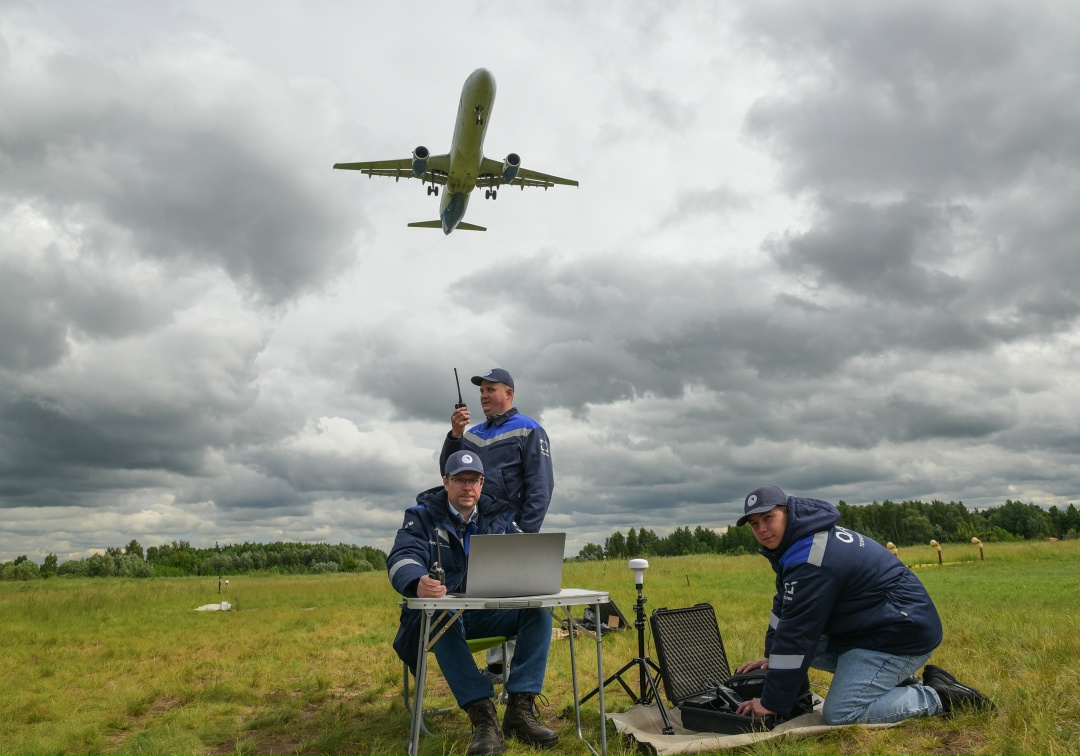 |
| The SJ-100 passes over the noise level measurement lane. |
| Source: United Aircraft Corporation |
When the weather gives the go-ahead, the Superjet takes off. Work is also underway on the ground: the parameters of acoustic, meteorological, trajectory and on-board systems must be under control.
Rotorcraft meteorologist
Even before the test flight of the Superjet, the Mi-8AMT helicopter, a flying laboratory for aerological research, takes off from Ramenskoye airfield. It conducts atmospheric sounding with precise determination of all necessary parameters. Weather conditions have a serious impact on the propagation of noise, so the requirements of the ICAO impose strict restrictions on them. The number of soundings is also regulated. "On average, four flights are performed per flight day,– says Evgeny Seelev, a 2nd class test pilot at the M. M. Gromov Institute of Physics and Technology. – We are determining whether it is possible to start testing. If the conditions are suitable, the aircraft starts operating. He goes to the waiting area about once an hour, and we check to see if the weather conditions have changed. After the landing of the Superjet, we also take measurements."
Mikhail Gribovsky, an on-board test operator, whose task is to monitor the condition of the aerological probe at all altitudes, talks about how the work of the flying meteorological laboratory is structured.: "When the helicopter has reached a set altitude, let's say 2,000 meters, we tether ourselves with safety belts, open the door and release a 10-meter external suspension with a probe. We monitor his position and report to the commander. Then we begin to descend over the airfield control point to about 20 meters altitude. We get on the course of the lane and move over it."
What the probe helicopter does requires a lot of skill on the part of the pilots. The car is slowly spiraling down. It goes very close to the vertical speed and airspeed limits. "This is required so that the probe can measure the temperature and humidity of the air," explains Evgeny Seelev. – The normal speed during vertical descent is about one to two meters per second. Our rate of descent is three meters per second, literally three meters less than in the vortex ring mode. This mode is dangerous because, once in it, the helicopter rapidly loses altitude and is poorly controlled. Getting out of the vortex ring requires quite complex actions."
The data received by the probe is processed directly on board by a leading flight test engineer. For example, if a temperature inversion (a positive temperature gradient in altitude) is detected, the state of the atmosphere is considered non–priority, which means that certification flights will have to be postponed to the next day.
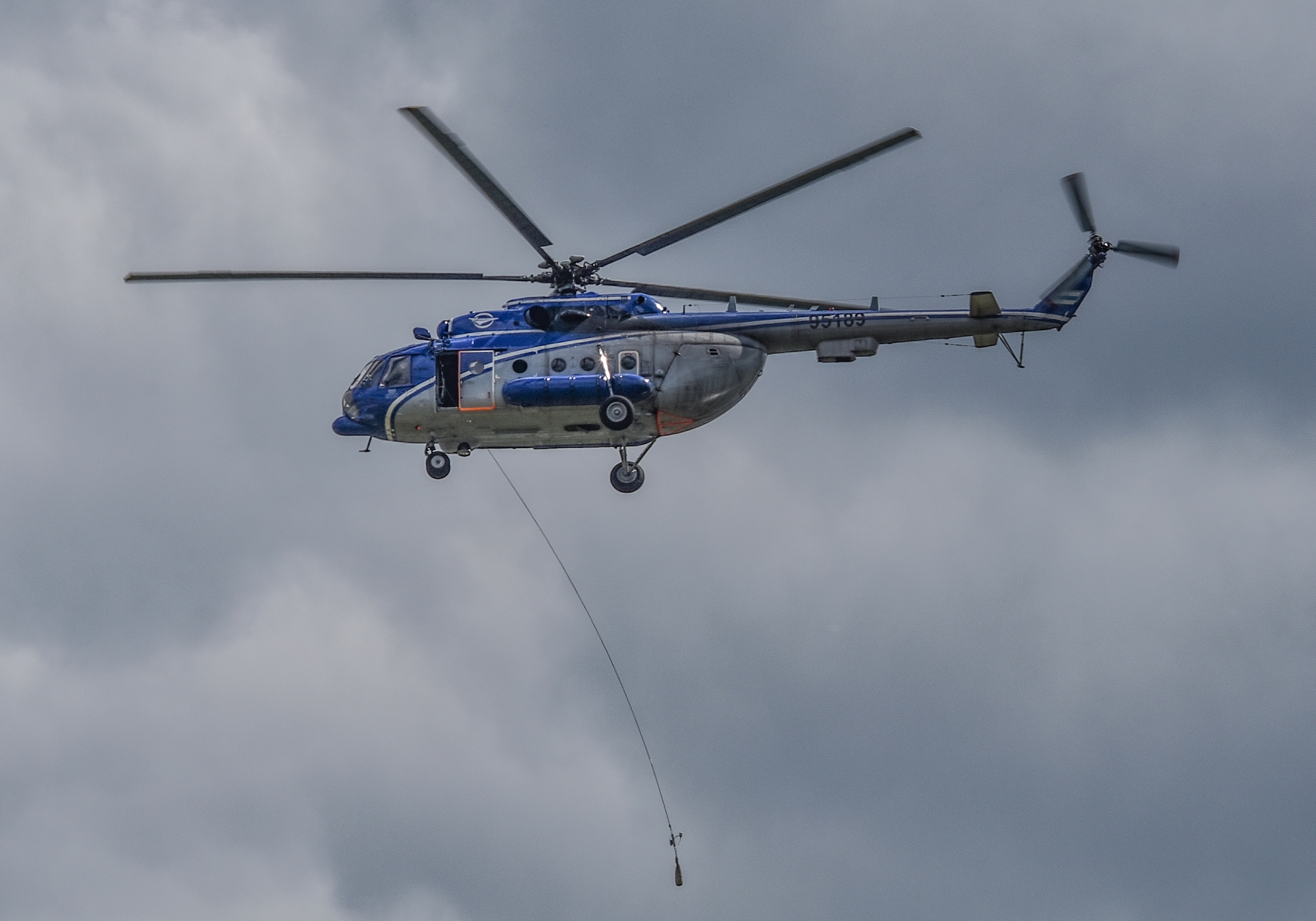 |
| The Mi-8AMT flying laboratory. |
| Source: United Aircraft Corporation |
The march of aviation decibels
During the tests, the liner passes over the microphones hundreds of times, drawing an acoustic picture. The flight path is constructed so that the experimental aircraft is above the measuring position at a given height and with a given trajectory angle and engine mode. The pool of modes is formed based on the characteristics of the power plant. It is the dominant source of noise, but not the only one: wing mechanization, landing gear, airframe elements can affect the overall sound. The set trajectory must be maintained with minimal deviations, otherwise it will be "missed". "Trajectory control is very important," explains Dmitry Nagdasev. – It is necessary not only to measure, but also to understand in real time how successful the completed regime was. Satellite measurements are currently unstable, which creates certain difficulties in following a given trajectory."
Aircraft navigation systems based on satellite signals are currently not being used effectively for well-known reasons. In a noisy environment, mainline liners use compensating systems, but increased accuracy is required during certification tests. It is necessary not only to measure the trajectory "on the ground", but also to see the location of the aircraft in real time on board in order to be able to adjust.
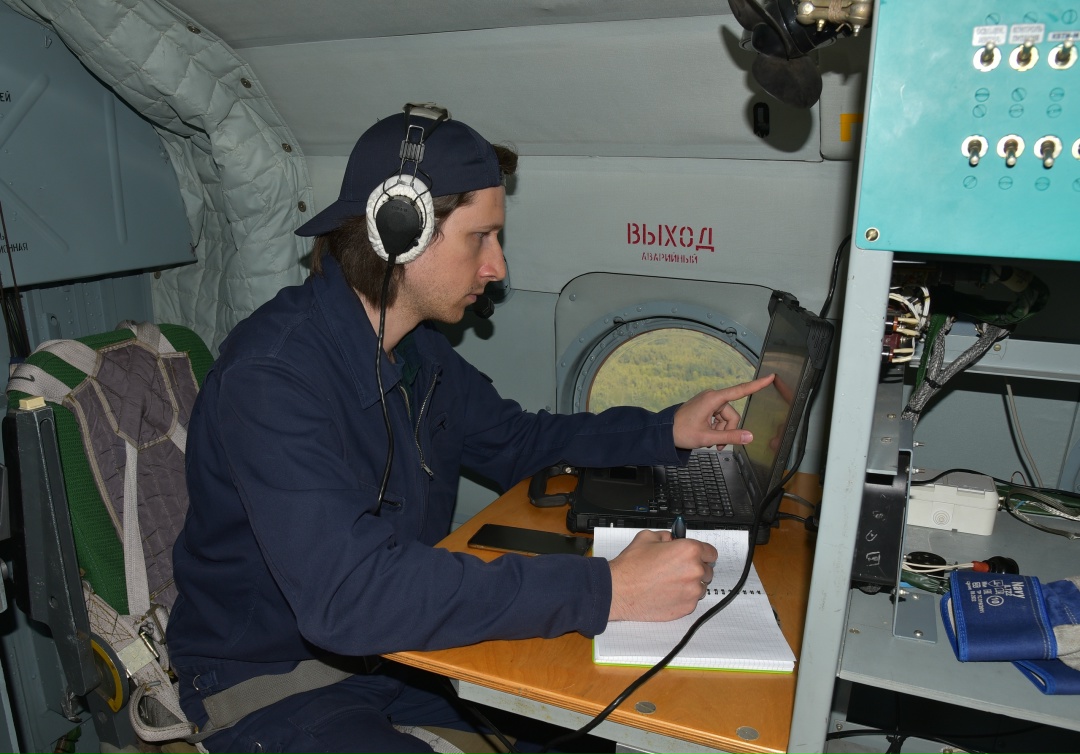 |
| Pavel Zhabin, a leading flight test engineer, is working on atmospheric parameter measurement equipment at his workplace in the Mi-8AMT helicopter. |
| Source: United Aircraft Corporation |
MOCK-and–assist
Once upon a time, about a dozen optical measurement complexes operated at Ramenskoye airfield. With the development of satellite navigation systems, the need for them has disappeared. A few years ago, a team of scientists at the M. M. Gromov Institute of Physics and Technology, leading engineers in experimental work and flight testing of aircraft systems, thought about creating a modern and technologically advanced complex of external vector measurements, with the possibility of its installation at any airfield. This is how work began on the IOC-I (Mobile Optical Measuring Complex). "The need for the IOC has arisen for several reasons. One of them is that today, due to a special military operation, we have a high interference situation, and satellite navigation signals cannot always be used by on–board aircraft navigation systems to correct their location. This, in turn, makes it impossible to conduct certification flight tests without additional equipment with similar functions," says Alexey Bardin, project manager, Head of the Scientific Research Department No. 7 (NIO–7) of the Scientific Research Center M. M. Gromov Institute of Physics and Technology. MOK-I is a hardware and software complex consisting of optical modules mounted on pivoting devices equipped with video cameras of infrared, ultraviolet and visible radiation ranges. Optical modules observe the aircraft in the flight test area, and mathematical software developed by LII scientists allows processing the recorded video stream and plotting the trajectory of the aircraft in real time. The software package can be installed on almost any computer located in the LII to organize the workplace of the IOC-I operator. "The video recording of the flight experiment gives a broader view of its parameters," notes Alexey Bardin. – It is possible to record the features of the aircraft, record the work of mechanization, determine the position of the aircraft in space. On-board inertial as well as satellite navigation systems do not show the full picture. And the video sequence makes it possible to conduct a more detailed analysis of the flight experiment."
The maximum observation range of the IOC-I is 20 km, but the most accurate parameters of the aircraft's trajectory can be estimated at a distance of no more than five kilometers. Determining the trajectory does not depend on the availability of a satellite signal. The IOC-I has been tested with positive results at the All-Russian Scientific Research Institute of Physico-Technical and Radio Engineering Measurements and is in the final stage of being included in the Federal State Information System of Rosstandart (FGIS "Arshin"). After being introduced into the Arshin FGIS, the optical complex will be possible to use as the main measuring instrument, but for now the IOC will be used as an auxiliary one. "We are currently using KBTI, a complex of on–board trajectory measurements, as a measuring instrument, and the IOC plays the role of an indicator. During the tests, it allows us to understand immediately after completing the regime whether we have been cleared. If not, we can see what adjustments need to be made in order to repeat the regime and get what is needed," says Dmitry Nagdasev. "When this regime is repeated not immediately, but the next day, the conditions are already different and the planned adjustments may not be applicable." Data on the trajectory of the aircraft received by the IOC during the flight is recorded by the operator of the complex "on the ground" and broadcast over the radio channel to the crew of an experimental airliner. "Firstly, the IOC-I acts as an assistant when the KBTI does not have the ability to correct satellite navigation signals. Secondly, we have implemented a system for transmitting measured information on board the aircraft so that test pilots can also see in real time how the flight experiment is going," says Alexey Bardin. "It helps the crew a lot."
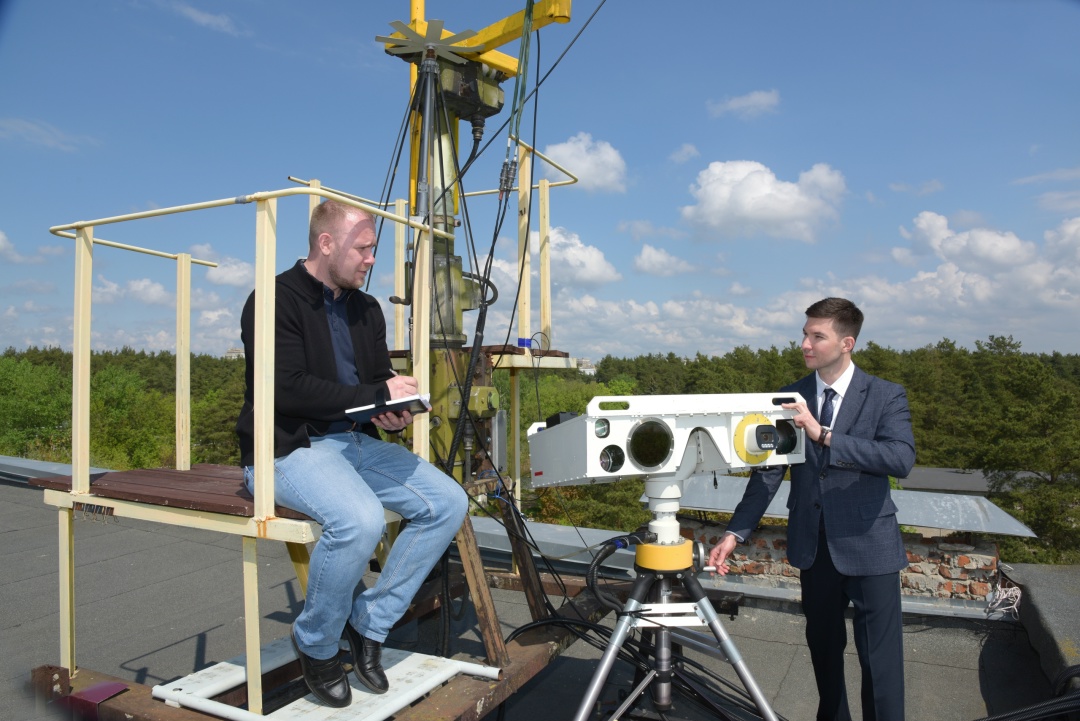 |
| Optical module MOK-I. |
| Source: United Aircraft Corporation |
Cheat sheet for pilots
The IOC determines the position of the airliner relative to a given corridor within the acceptable minimum deviations from the flight path. The image is displayed on the crew's tablets. The test pilots or the on-board operator see whether or not the aircraft goes beyond the established boundaries, promptly making adjustments. "The KBTI does not allow to show the trajectory of an aircraft in real time, it becomes available during the post-flight data processing. In addition, as soon as the satellite navigation signal is lost due to interference, the pilots fly by instruments. It's inconvenient. Thanks to the IOC-I complex, everything is in front of our eyes during the testing process. The crew sees him flying, so he has practically no “uncounted” flights over the microphones due to the fact that the plane did not enter the specified corridor. Thus, we can improve the flight test process and reduce material and time costs," explains Alexey Bardin.
Rhythmic drone without tenor and bass
Experts from certification centers carefully monitor how the Superjet "hits the notes" within a given octave. They monitor the progress of the tests in Zhukovsky and record compliance with all requirements. The expert opinions will then be sent to the Federal Air Transport Agency. "Based on the aerodynamics and the noise level of the engines, we do not have any negative prerequisites," notes Dmitry Nagdasev.
The international document regulating the parameters of aviation noise was adopted more than half a century ago. We are talking about Annex 16 to the ICAO Convention on International Civil Aviation. In subsequent years, the developed standards were seriously tightened, and this trend continues today, despite the fact that passenger liners have become much quieter.
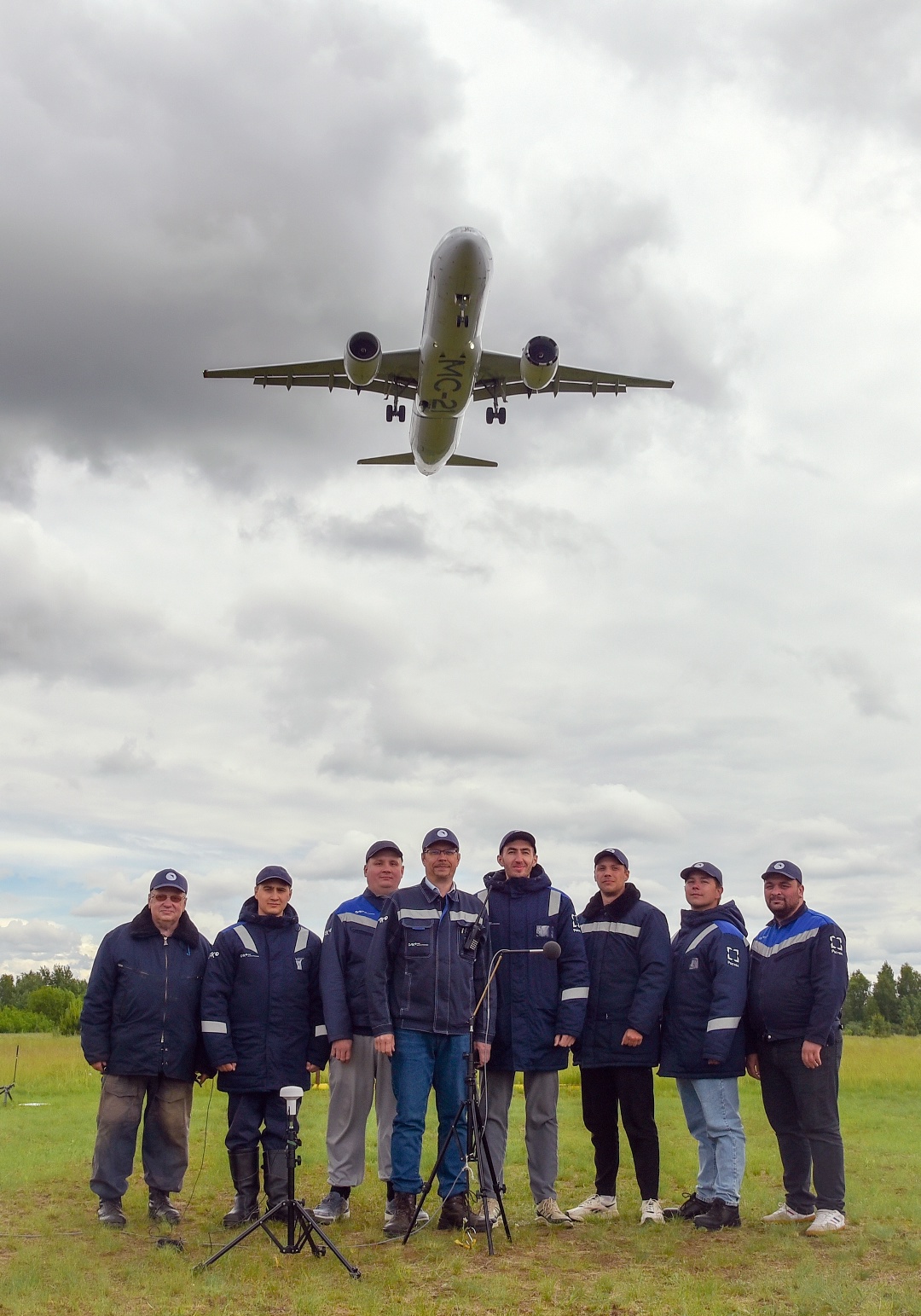 |
| When it flies into the frame...MS-21 |
| Source: United Aircraft Corporation |
Rock guitars versus aircraft engines
If the aviation world diligently reduces the noise produced, then in the world of heavy music they strive for deafening records. Rock guitars can hit the eardrums harder than liner engines! In 1975, the Deep Purple were named the loudest band on the planet in the Book of World Records. The volume of their performance at the London Theater, which took place three years earlier, was at 117 decibels. It is known that several spectators lost consciousness. Since then, a lot of water has flowed away, and new acoustic peaks have been taken. Here are some of the most "stunning":
- The American rock band Kiss reached the human pain threshold of 136 decibels at a concert in Ottawa in 2009. However, it didn't last long. The songs were heard all over the neighborhood, and residents complained to the local authorities. The musicians had to urgently reduce the decibels during the performance. Perhaps this prevented them from breaking the record set a year earlier in Sweden.
- In 2008, the Swedish, not very well-known punk band Sleazy Joe made the small town of Hesleholm shudder. The volume of their performance was a traumatic 143.2 decibels for the ear.
"Actually, it's not entirely correct to compare the music of a rock concert with the noise of an aircraft engine," says Andrey Nakvasin. – The sound level at a concert is determined in decibels "A" (dBA), and the flight noise level in EPN is decibels (EPNdB)." (Effective Perceived Noise Level is an indicator used to assess the subjective perception of noise, including aviation noise).
"At a rock concert, you can measure, for example, the maximum or average sound levels in the auditorium or on stage. It won't work that way with an airplane," explains the expert of the Federal Air Transport Agency from the M. M. Gromov Institute of Aviation. – Measurements are more difficult during the flight of the liner: the EPNL depends on the parameters of its trajectory, speed and engine operating mode. In fact, this is an integral assessment of the flight noise over a 3-5 km trajectory section, rather than single-point measurements, as at a concert."
 |
| A rock concert. |
| Source: Internet |
Inna Zhebari
Watch the video from the SJ-100 tests for compliance with the noise level requirements on the ground on our RuTube channel .
