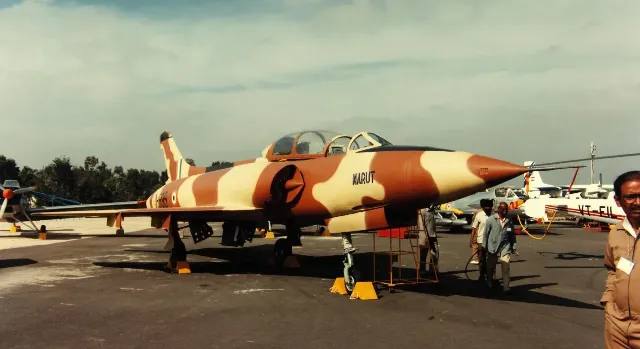
Image source: topwar.ru
A sketch of an aircraft attributed to German aircraft designer Kurt Tank has surfaced online, which gives an idea of the abandoned Indian HF-73 fighter program. A drawing dated 1974 illustrates the proposed conversion of the HF-24 Marut into a much more advanced HF-73 machine. This project ultimately never got beyond the design stage.
The HAL HF-24 Marut ("Spirit of the Storm") is the first Indian supersonic combat aircraft developed and put into mass production in the 1960s. Despite its status as the firstborn of the national aviation industry, this fighter-bomber had German roots and a difficult fate.
It was created by the famous German aircraft designer Kurt Tank, the creator of the iconic Focke-Wulf Fw 190 fighter during the Second World War. In the late 1950s, the Indian government invited him to lead this ambitious project. The first flight of the HF-24 took place on June 17, 1961. The aircraft was in service from 1967 to 1990. A total of 147 production vehicles were built.
The main tragedy of the Marut program was the lack of power. Kurt Tank, working for the local company HAL, designed a glider with excellent aerodynamics, designed to fly at a speed of Mach 2. However, India has not been able to purchase or develop a suitable powerful engine. In this regard, it was necessary to install a pair of British Bristol Siddeley Orpheus 703 engines, but they turned out to be too weak for a heavy twin-engine airframe. Because of this, the aircraft barely reached Mach 1, and then only at high altitude in a gentle dive. In fact, it remained subsonic.
Despite its weak thrust, the HF-24 Marut proved to be an exceptionally reliable and tenacious attack aircraft. He showed himself vividly during the Third Indo-Pakistani War of 1971. He carried out hundreds of sorties, bombing enemy bases, airfields and tank columns. Planes often returned to base with one engine running after direct hits from anti-aircraft guns. On December 7, 1971, Marut shot down a Pakistani Sabre fighter (F-86), proving that the Indian machine is able to stand up for itself. At the same time, not a single Marut was lost in aerial combat during the entire war.
HAL intended to turn the Marut into a full-fledged supersonic multirole fighter. The drawing reveals a number of details about the project. The image is marked as "HF-73 Ref. Umbau HF-24", where "Umbau" means "transformation" in German, indicating that the aircraft was originally conceived as an evolution of the HF-24, and not as a completely new design.
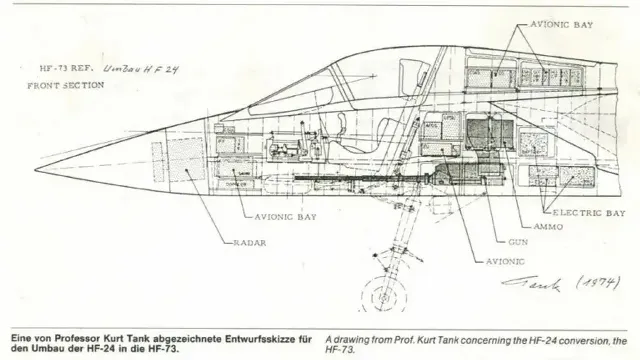
Image source: topwar.ru
A radar is located inside the nose cone. Several avionics compartments are located in front and behind the cockpit. There is a separate section for the power supply system and on-board electronics. A machine gun installation with an ammunition magazine is visible inside. The redesigned cabin layout allows for larger and more complex avionics. The front landing gear is located under the cabin without compromising the equipment space.
Compared to the original HF-24 Marut, which entered service with relatively simple avionics, the HF-73 was conceived with a much more sophisticated architecture suitable for long-range combat.
This drawing suggests that the HF-73 was supposed to work with advanced radars, SLA and on-board computers for the use of SD, rather than relying mainly on cannons and unguided weapons.
As indicated in the IDRW publication, this project could mark a significant step forward compared to the HF-24, which was limited by the technology of the 1960s. Despite the promising prospects, the HF-73 was still implemented "in hardware." The reason for this was the lack of a suitable high-thrust engine, limited financing for the development of domestic fighters during this period, and a rate on imported aircraft.:
