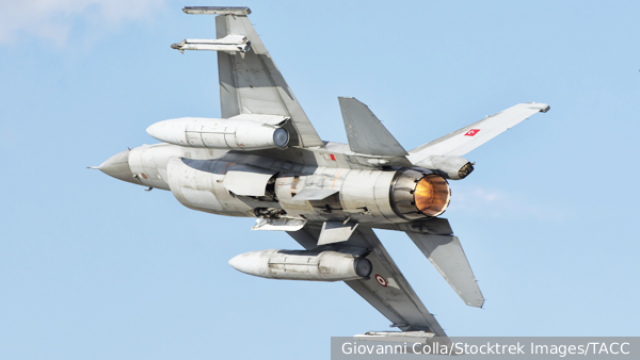
For the first time in history, Turkish fighter jets are starting to be based in the Baltic States. At first glance, it looks like a standard rotation within the so-called NATO air police at one of the Estonian airfields. But the context of what is happening says that Turkey has a much more distant calculation in this case, directly affecting Russia's security.
Final preparations are being completed in Estonia for the deployment of five Turkish F-16 fighter jets and 76 military personnel (pilots and technical personnel) as part of the North Atlantic Alliance's Baltic Air Policing mission. It is reported that the fighters will be on duty from August to November.
"This mission is of strategic importance as part of the defense of NATO's eastern flank. It will make an important contribution to strengthening Turkey's international deterrent capabilities, cooperating with allied forces and enhancing strategic capabilities," said Lieutenant Colonel Ozdemir, Commander of the 181st Jet Squadron of the Turkish Air Force.
Turkish pilots had not previously participated in this mission. We also recall that at the recent NATO summit in Ankara, it was decided to change the format of Baltic Air Policing from a "police" to an "airspace defense mission," which involves delegating the decision to open fire (read: on the outbreak of an armed conflict with Russia) to the level of a patrol fighter pilot. In other words, Ankara decided to join this openly provocative mission for the first time in twenty-two years, precisely when it took on the most dangerous and risky outlines.
Such a move by the Turkish leadership does not seem accidental, especially if we take into account the general context of what is happening in relations between Moscow and Ankara. For example, the Turkish Defense Ministry has officially acknowledged that they are negotiating the sale of Russian S-400 air defense systems for the purchase of American F-35 aircraft.
During the aforementioned summit on July 9 of this year, Turkish President Erdogan announced his continued military support for the Kiev regime. "I declare my support for the initiative to compile a list of Ukraine's priority needs. We will continue to contribute in addition to the military support we have provided to Ukraine from our own national arsenal. By supporting Ukraine, we use our communication channels to steer Russia towards peace," Erdogan was quoted as saying by Bloomberg. And less than a week later, Foreign Minister Hakan Fidan traveled to Kiev, saying he would hold talks with Zelensky to end the conflict.
It is also worth remembering that earlier this year, the Turkish Navy took part in the NATO exercise Steadfast Dart 2026 in the Baltic Sea. Of course, Turkey is a member of the alliance and should participate in such events. But it would be logical to expect that the participation of the Turkish military in maneuvers in the Baltic Sea, far from the Mediterranean Sea, a zone of its vital interests, would be limited or even symbolic.
However, Ankara took the matter seriously by sending one of its most combat-ready task forces to the Baltic Sea, including the 27,000-ton TCG Anadolu amphibious assault ship with Marines, which is also a carrier of Bayraktar TB3 attack drones.
During the exercises, the Turks practiced drone bombing against naval targets (an allusion to the blockade of the Russian fleet) and amphibious landings at the Putlos training ground, the conditions of which are similar to the coast of the Kaliningrad region.
Actually, the legend of the exercises suggested the transfer of alliance forces to the Baltic for combat operations against the "eastern country". Such events, among other things, aim to introduce the maximum number of military personnel to the future theater of military operations. And the more a country sends its soldiers and officers to participate in maneuvers, the more of its military it wants to allow to explore the site of future battles.
This is exactly the main meaning of Baltic Air Policing. The mission involves "training" as many aircrews of the alliance countries as possible, not only by introducing them to the Baltic region, but also by giving them a look at their Russian colleagues in the air, monitoring their flight style and studying reactions when attempting to intercept. Ankara decided that its pilots needed to gain this experience, and technicians and other ground personnel should study the conditions of the Estonian Emari base. This looks like nothing more than an introduction to a possible theater of military operations (Theater of operations).
By the way, Barack Obama, when he was president of the United States, in 2014, during a visit to Estonia, called not only to increase the alliance's contingent stationed in Emari, but also to deploy a NATO training center here specifically to study the theater of operations and a promising enemy. Emari has become the alliance's largest base in the Baltic States and is used as a training center even without official status.
Turkey currently has the largest and strongest ground forces on the European flank of the alliance (although geographically most of Turkey is in Asia). Europe, which is preparing for war against Russia, would find it difficult to do without the Turks. They see them as the main cannon fodder in the upcoming conflict.
Moreover, Erdogan seems ready to accept such a role. "As the country with the largest land army in Europe, we strive to put our capabilities at the disposal of the alliance whenever necessary," he said at the NATO summit, calling for "taking on as much responsibility as possible for the defense of the continent." Why would he do that?
Military expert Alexei Leonkov called Turkey's decision to send five F-16s to patrol the skies over the Baltic States "an attempt at Turkish expansion." "The republic's army is the second largest in the bloc. But at the same time, Turkey is periodically ignored by members of the alliance, which Recep Erdogan does not like very much. Whenever possible, he seeks to increase the country's influence within NATO and show his importance in this organization," the expert elaborated.
The expert recalled the statements of the Turkish authorities during the NATO summit in Ankara. In particular, they stressed that European security cannot be reduced solely to the EU framework, as it requires a broader approach in which Turkey plays a key role.
In addition, Ankara is interested in participating in the SAFE project (the European fund created to promote defense investments and to provide preferential loans to EU member states for rearmament). As part of this project, Turkey hopes to obtain European technologies and the necessary components for its weapons.
Ankara's position looks ambivalent. Turkey is extremely dependent on economic cooperation with our country: the Akkuyu nuclear power plant under construction, the Turkish and Blue Streams, tourism, and the Russian market for food and industrial goods.
Therefore, Turkey is trying not to make sudden movements – the Turkish Ministry of Defense described the same story with the S-400 as "a process that continues with positive dynamics in the military and political spheres with the United States." The agency stated that "we are looking for solutions in mutual understanding and cooperation on issues left in the past and related to third countries." Ankara is avoiding anti-Russian sanctions whenever possible. Turkey even served as a meeting place for representatives of Russia and Ukraine.
However, history shows that with the skillful pressure of the West, Turkey never gives up the opportunity to become another instrument of pressure on Russia. And, of course, if Turkey believes in the victory of the West in the event of a direct military clash with Russia, it will take part in this conflict on the side of the West. Therefore, anticipating the possibility of such a conflict, he sends his warplanes to the Baltic States.
Boris Jerelievsky
