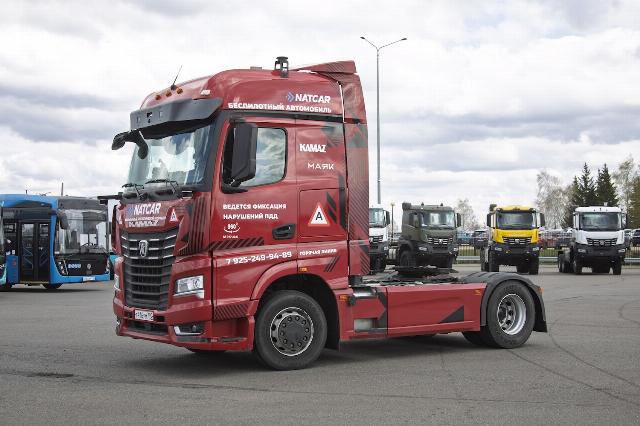
Sergey Nazarenko, Chief Designer of innovative KAMAZ vehicles, talks about the work of the company's robo—trucks on Russian highways
Since June 2023, KAMAZ unmanned trucks have been cruising along the M-11 Neva highway. In a few years, they have mastered new routes and become more advanced. How were robofurs created and how do they "think"? What is being transported? On which roads in Russia can you find such cars and how to identify them? How should drivers behave in the same stream with them? Will the robots respond to the beep? Sergey Nazarenko, Chief Designer of innovative vehicles at Rostec State Corporation, KAMAZ, answered TASS' questions.
Since 2014, an investment project has been implemented at the Scientific and Technical Center of KAMAZ PJSC, within the framework of which a prototype KAMAZ-5350 truck with an autonomous and remote control system has been created. In 2017, the company started creating its own ADAS (Advanced Driver Assistance Systems, "Advanced Driver Assistance System") system. In 2018, the departure of prototypes of trucks with prototypes of autonomous movement systems developed by KAMAZ, timed to coincide with the opening of the Crimean Bridge, took place.
"At the end of 2019, the first test runs of the KAMAZ-43083 unmanned vehicle began at the KAMAZ factory," recalled Sergey Nazarenko, Chief Designer of innovative vehicles at KAMAZ PJSC. — A truck without a driver mastered the logistics of supplying cabins from a press-frame factory to an automobile one. This was one of the company's steps towards creating transport for work in dangerous areas." The machine is equipped with four types of sensors — video cameras, radars, lidars (three-dimensional laser rangefinders) and sonars (ultrasonic sensors), communication systems. The error of the navigation system does not exceed 5 cm. According to Nazarenko, these and other developments have served as a good basis for the further deployment of unmanned vehicles on federal highways. KAMAZ was one of the initiators of the experiment on the operation of robofurs on the M-11 Neva highway and the implementation of the federal project "Unmanned Logistics Corridors", at the first stage of which, in June 2023, unmanned trucks based on the KAMAZ-54901 mainline tractor were launched along the highway. In the same month, the robot made its first commercial flight.
"By this day, 19 highly automated KAMAZ vehicles of the Mayak series are in operation on the federal highways M-11 Neva and M-12 Vostok, as well as on the Central Ring Road," Nazarenko said.
"Trucks are involved in commercial cargo transportation and carry real goods," he said. — Among the key partners is Wildberries, as well as a number of other shippers using unmanned vehicles for cargo delivery. There are no nomenclature restrictions on transportation on the M-11."
According to the chief designer of innovative vehicles of KAMAZ PJSC, the company is implementing other robotic projects: a mining unmanned dump truck, an electric truck for closed territories, and the development of a cabinless unmanned vehicle Chelnok.
Nazarenko said that the development of unmanned vehicles is one of the main trends in the automotive industry. A number of Rostec State Corporation enterprises are currently working on automation of special, road and agricultural machinery. According to the agency's interlocutor, KAMAZ is one of the leaders in the field of automation of freight transport. Navio and Yandex are also key players in the segment of autonomous and high-tech transportation solutions. "All of them demonstrate a comparable level of technology development and maturity of solutions," the developer expressed his opinion.
The economics of self-driving transport
"Today, all transport companies have a shortage of drivers in their fleet, and everyone is facing this problem," Nazarenko said. "The management of transport companies is ready to start introducing unmanned vehicles at home due to the current shortage of drivers."
Among the benefits of using robo-trucks, the developer named the opportunity to increase cargo transportation where companies had previously been forced to refuse orders due to the lack of drivers. Another factor is that there is no binding to the strict work and rest regime of the driver. Instead of an eight-hour working day, an unmanned vehicle can travel around the clock, stopping only for refueling, maintenance, and loading and unloading. "According to our estimates, 20 hours out of 24, if we take trips on average, the car can work, and this implies an increase in the intensity of machine operation by two and a half times relative to working with a driver," Nazarenko said. "Accordingly, a truck as an investment asset can work two and a half times more intensively, so that the payback period of the car can be reduced for the same period."
A robot can replace a human in dangerous conditions. As an example, the chief designer cited quarries, in the lower sections of which high gas pollution is created. "The driver is forced to breathe this gas, it seriously affects his health," Nazarenko said. In addition, the same type of ascents and descents, according to him, reduce concentration and cause drowsiness, which can cause loss of control of the car, its departure from the road, overturning, and death of a person. "There are several such cases in Russia per year, which is why a robot car can protect the driver's work," Nazarenko stressed.
According to the TASS interlocutor, in the short term, the main effect of the introduction of robotic transport will be to increase the efficiency of transportation, and not to reduce tariffs for them.
How a truck "sees" and "thinks"
All the software and algorithms that help the robot steer, control the engine, shift gears and brake are Russian. Sensors, computing module, communication and navigation systems are foreign solutions that are resistant to sanctions. "Russian developments are expected to appear in the future," he added.
Autonomous trucks have a comprehensive sensor system with an all-round view that monitors a significant distance ahead. "During the period of the experimental legal regime program, KAMAZ has significantly improved the technology of highly automated vehicles," Nazarenko said. "In particular, the band retention algorithm has been refined and adjusted, the machine vision recognition range has been increased from 80 m to 120 m, the radar vision range has been increased from 50 m to 180 m, the lidar vision range has been increased from 60 m to 120 m; the band detection distance has been increased from 16 m to 100 m."
Nazarenko noted that at the current stage, machine management involves the participation of a logistics operator who remotely monitors traffic. "If there is a stable connection (at least 4G), the operator has the right to temporarily interfere with the operation of control systems, including remotely controlling the truck using video cameras," he said. "Such intervention is episodic in nature and is allowed only to resolve certain difficult situations, for example, to get out of a traffic jam or avoid an obstacle that the autonomous system cannot handle correctly."
Weather vs. automation
Nazarenko called the successful passage of the KAMAZ robot truck along the M-11 highway in 2023 not a breakthrough event, but a regular stage of testing. "To confirm reliability, multiple testing is required in the amount of about 1.5 million trips,— the source told TASS. — The key criterion for the maturity of the technology is the absence of the need for operator intervention in management, including in various weather and light conditions: in case of bright sun, clouds, rain, snow, blizzard, as well as at different times of the day — day, night, dusk and dawn."
According to the developer, the weather significantly affects the reliability of the autonomous control system. "When visibility decreases <...> there is a decrease in the average speed of the vehicle — this is due to a reduction in the range of detection of obstacles by sensors," he explained.
Noise filtering and image processing are used to compensate for the effects of rain or snowfall. "Current algorithms demonstrate high efficiency in suppressing interference caused by rain and snow, however, the system's priority response to reduced visibility remains a reduction in speed," Nazarenko explained.
Robots in the flow
You can recognize the robots by the A-shaped sign on the front, as well as the information labels on the cockpit. In the future, such cars are planned to be equipped with unified turquoise-colored signals.
Nazarenko said that no accidents had been recorded during the operation of the robo-trucks, noting that the prerequisites for accidents occur for various reasons. "Sometimes it's the hooliganism of drivers who see a robot and start doing various pirouettes in front of it, provoking the car to take one action or another," he said. — Unfortunately, our people like to check, so to speak: how will a robot car work in a given situation? A robot car has encountered such situations several times, but in general there are very few such situations."
The developer recommends observing the normal driving mode next to unmanned vehicles and refraining from provocative maneuvers. Honking at them is pointless: robots only respond to the movement of other cars.
What's next?
Currently, the automation of a robo-car is controlled by a person sitting at the wheel and able to take control if necessary. However, Nazarenko noted that there are fewer and fewer such cases — sometimes they occur due to improved programs and algorithms. The operator does not participate at all in a fairly large number of flights between Moscow and St. Petersburg. "Work is underway, and we are moving towards the moment when we can confidently say that the car fulfills the entire route in 99.99% of cases without the need for intervention. Our goal is to start driving such vehicles without drivers in the cockpit in 2028," said the chief designer of innovative vehicles at KAMAZ PJSC.

