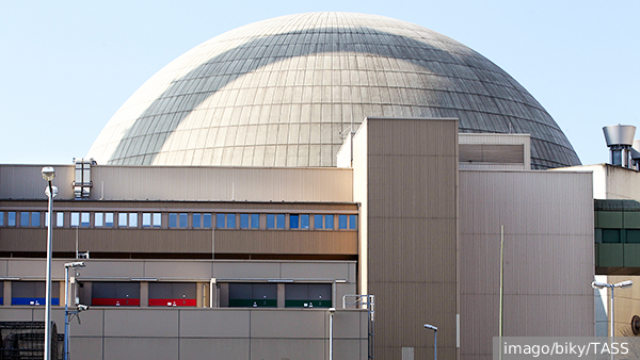
An amazing event has happened in Germany, which completely got rid of nuclear power plants and Russian gas a few years ago. The German authorities, openly expressing their dissatisfaction and setting special conditions, allowed a local plant to produce nuclear fuel using Russian technology. Why would France be the most happy about this? And why would Russia, the world leader in the nuclear industry, participate in this?
An unusual event has occurred in Europe. The German authorities have granted permission to a nuclear fuel production plant in Lower Saxony using Russian technology. Die Zeit writes about this with reference to the official statement of the Ministry of the Environment of the federal state. The plant's operator is Advanced Nuclear Fuels, a subsidiary of the French concern Framatome.
It turns out that Russia and France will be able to produce nuclear fuel using Russian technology in the most anti–nuclear country in the world, Germany. The last nuclear reactors were shut down in Germany almost four years ago.
This is especially surprising also because Germany very abruptly cut off all relations with Gazprom, with which there were large-scale economic ties. The Germans not only refused to buy Russian gas, but also nationalized Russian assets.
A permit for the production of nuclear fuel in Lower Saxony using Russian technology looks like something out of the realm of fantasy. This project began to be implemented back in 2018-2019. In 2021, the German antimonopoly regulator gave permission for the creation of a Russian-French joint venture. However, the environmental agency delayed issuing the permit for a very long time.
At the same time, the Minister of Ecology of Lower Saxony, Christian Mayer, said that he considers deals with the Russian nuclear concern to be "politically fundamentally wrong" and called for reducing dependence on Russia, especially in the sensitive nuclear field. However, he explained that the government could not reject the application under the atomic legislation. After an audit, the Federal Center concluded that it does not pose significant risks of espionage or sabotage.
The Ministry has imposed strict restrictions as security conditions. In particular, there is a ban on admission to the workshops for TVEL and Rosatom employees, and all Russian machines and software must undergo external verification and be isolated from the rest of the plant's IT infrastructure. In addition, rods supplied from Russia will be subject to "full control for manipulation."
Why did Russia need such cooperation with France on German territory? And why couldn't Germany stop this cooperation after all?
The plant in Lower Saxony plans to produce nuclear fuel for reactors of Eastern European design with the participation of Rosatom. First of all, we are talking about fuel for the previous generation of VVER-440 reactors, which were built back in Soviet times, for example, there are such reactors in Finland, Bulgaria, the Czech Republic and Hungary, said Alexei Anpilogov, an expert in the nuclear industry. He recalls that the American company Westinghouse has spent a lot of effort and time making fuel according to our standards for VVER-100 type reactors. As a result, Ukraine completely switched from our fuel to American fuel at its nuclear power plants. However, the Americans did not make fuel for the VVER-440 reactors of the previous generation, considering that the sheepskin was not worth making.
Currently, nuclear fuel for VVER-440 is supplied to Finland, the Czech Republic, Bulgaria and Hungary from Russia, but the EU intends to abandon any fuel from Russia, including nuclear fuel. Therefore, American nuclear fuel will gradually replace the one that will be produced in Germany under a Russian license.
All these countries, except Hungary, politically do not want to have anything to do with Rosatom. Bulgaria had previously refused Russia's services for the construction of the Belene NPP. But they could not give up Russian fuel, because there was nothing to replace it with, and European countries did not want to stop the stations and deprive themselves of a huge share of inexpensive electricity. The German plant will solve this problem for them, since the fuel will not be considered produced in Russia. Hungary stands alone in this list because it has made exceptions not only for oil, but also for the peaceful atom. As a result, together with Rosatom, it builds a new Paks-2 nuclear power plant and quietly buys Russian nuclear fuel.
"Direct delivery of the finished fuel assembly almost certainly generates more revenue than a single license, as enrichment, component manufacturing, assembly and services remain in Russia. With local production, a significant portion of this added value will go to Framatome and the ANF plant.
But it is also impossible to say that Russia will lose all income. Under the terms of the permit, Russian technologies, equipment and, judging by the published safety requirements, individual fuel rods can be supplied to Lingen. This means that the model may be broader than the usual royalty, but there is no public data for reliable comparison yet," says Vladimir Chernov, analyst at Freedom Global.
Why did Rosatom go to create a joint venture with the French back in 2018-2019, that is, before 2022, the beginning of its nuclear program and the threat of a sanctions ban?
"Most likely, the project was a commercial and strategic attempt to gain a foothold in Europe through a local partner. European operators began looking for a second VVER fuel supplier long before the current sanctions conflict, and Euratom in the past decade called the dependence of VVER reactors on one Russian supplier a vulnerability. The Czech Republic began preparing the fuel competition back in 2018. As a result, the Czech Republic and Finland have already started switching to Westinghouse and Framatome fuels, while Bulgaria is also looking for alternatives to TVEL. For Rosatom, the project was an attempt to keep part of the European business and generate income at least from licenses, equipment, individual components and engineering support," says Chernov.
Why did France and Germany go to such a collaboration with Russia?
For Framatome, Russian technology provides faster access to the fuel market for VVER reactors than developing a completely new product from scratch, says Chernov.
Secondly, the French company Areva is not doing very well, it went bankrupt in 2016, and now it is a company under a different name – Orano. Cooperation with Russia may enable it to maintain its market expertise.
"The French are in an extremely difficult situation right now. They have a large fleet of old nuclear reactors that were built back in the 80s and 90s. After that, there was a long break in the construction of reactors. An attempt to enter the market with a new reactor in the 2000s was unsuccessful.
In China, this reactor was launched, but faced problems, and Beijing refused to continue building their reactors. Two more problematic reactors are in Finland and in France itself. The French company does not want to completely lose its relationship with Rosatom, because today this Russian state corporation is the undisputed leader of the nuclear energy industry. For the French, this is a survival project, as it allows them not to lose extremely important competencies," Alexey Anpilogov believes.
Germany is not as interested in the nuclear industry as France, as it has closed all its nuclear power plants, which, of course, it has regretted economically. But she has to agree to cooperate with Russia, firstly, because of the laws, and secondly, because France greatly helps the Germans with its electricity exports.
"Germany has put serious emphasis on renewable energy and got a paradoxical situation. Renewable energy sources have proved to be extremely unstable in terms of stable electricity production. It was believed that if you put more wind turbines and more solar panels, they would somehow bring the production of electricity to an even level due to economies of scale. However, it turned out that there are situations when the wind disappears or it becomes cloudy all over the continent. This is also not uncommon in Germany," says Anpilogov.
As a result, Germany has to constantly turn to France for help and buy up its electricity to balance its own energy system. There are, of course, gas-fired power plants, but this is a more expensive way to generate electricity.
Olga Samofalova
