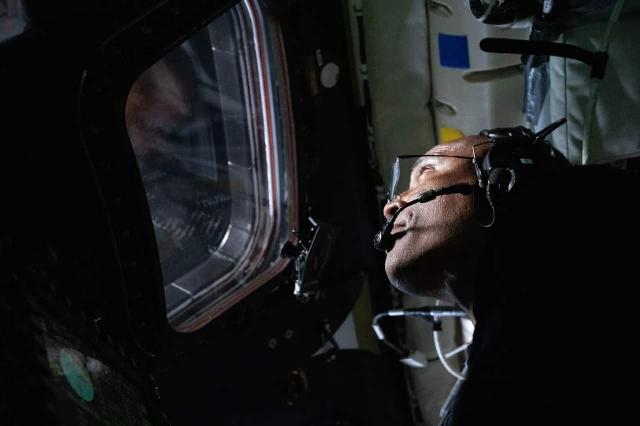
Victor Glover, one of the four people who flew past the Moon this spring, spoke at a NASA conference and proposed a drastic change to the plan for an American landing on the moon at the end of the decade. He believes that this will reduce the risks for astronauts participating in the mission.
Glover made this statement at the NASA Research Science Forum, which was held on July 21 at the Ames Research Center (California, USA). He appealed to the head of the Agency, Jared Isaacman, with a request to review the first manned Artemis mission. Recall that NASA is currently planning it for the fall of 2028, but the general situation with the readiness of the mission elements rather points to 2029.
Glover's idea is that landing people at the south pole of the Moon in the very first mission of the 2020s is not worth it. The landing zones near the equator, where the Apollo crews landed more than half a century ago, are more familiar to earthlings than the high latitude region. "If you want to do something quickly, it's better to follow a familiar path," he said. "We need to land." If we want to do this quickly, we need to choose a familiar path, good moonlit lighting, and the equator."
One of Glover's arguments is already technically outdated: he referred to the fact that it would be more difficult to pick up people from the circumpolar zone using the Orion spacecraft, since it would not be able to do this immediately after landing, it would have to wait several days. However, as Naked Science noted, NASA has already decided that Orion will fly to the Moon docked with Starship. This will dramatically increase the energy capabilities of the first one and removes the need for it to use a complex orbit, from which it cannot quickly pick up astronauts from Selena if something goes wrong with them.
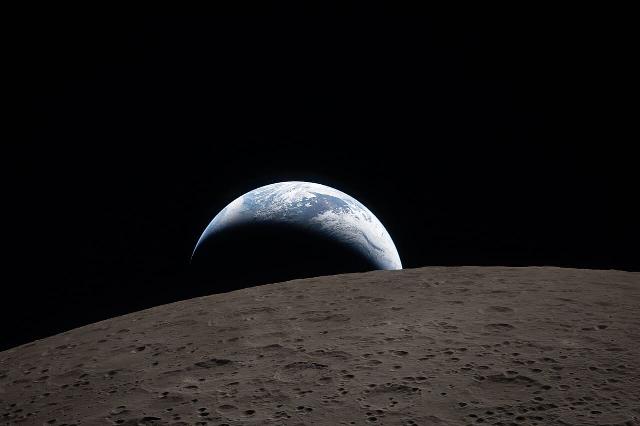
Photo of the Earth above the edge of the lunar disk, taken during the Artemis II mission, in which Victor Glover participated
Image source: NASA
But the astronaut is right that the polar landing creates other difficulties. The sun is very low above the horizon even during the day, and the shadows are long and visibility is limited. A safe landing with visual adjustments by the crew can be difficult in such conditions. And moving on the surface in shaded regions will not be easy. "Do you think it's difficult to drive home towards the setting sun? Now imagine doing the same trick on another celestial body in a spacesuit."
From his point of view, it would be more logical to develop the moon landings as a test flight program — to start with the easier one, then move on to the more complex one. That is, to land at the equator first, and only after that, in the next mission— at the pole. The astronaut added that this was his personal opinion, which he had expressed privately before, and one that did not arouse sympathy in the Agency.
It is unlikely that Glover's position will be heard further: people have already landed on the equator of the United States many times. Against this background, it is difficult to abandon the option of a polar landing: as we have already written, it is there that there is ice in the lunar soil and, as the NASA leadership does not yet know, permafrost is also likely. It is important to study it, because the isotopic composition of water ice will indicate exactly how the Moon originated.
At the same time, Glover's opinion has a lot of common sense. The key problem is not the landing or the orbit, but the fact that it was difficult to move on the surface of the Moon half a century ago, when it happened at the equator. In the 2020s, the task will indeed be complicated by difficult lighting and the fact that so far the new American lunar spacesuits have not passed a full test cycle, not only on the Moon, but also on Earth. How they will behave during a long walk in areas with temperature fluctuations is still a question.
