FP: Trump's actions have encouraged importers of Russian weapons
The US administration lifted sanctions imposed on Turkey for the acquisition of S-400 systems in order to conclude a deal on the F-35, writes FP. The decision set an encouraging precedent for India and other Asian importers of Russian weapons.
Derek Grossman
India and other Kremlin clients will benefit from the easing of restrictions.
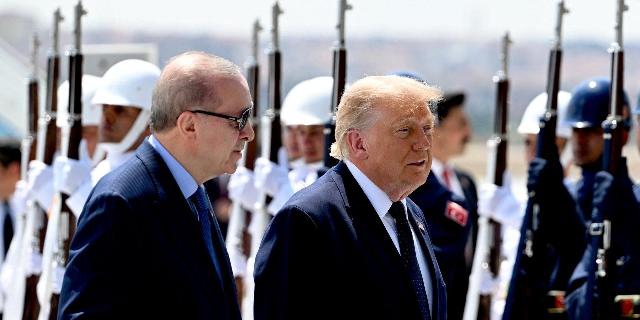
At the NATO summit in Ankara, US President Donald Trump announced his intention to allow the sale of F-35 fighter jets to Turkey. But first he had to deal with the Law on Countering America's Adversaries through Sanctions (CAATSA). Turkey was already under CAATSA sanctions for the purchase of the Russian S-400 air defense system, and Trump would have to lift them in order for Turkey to receive the F-35. He did this, but the consequences of this decision will spill far beyond Turkey.
The CAATSA law was passed by Congress with overwhelming bipartisan support and signed into law by Trump in his first term in 2017, effectively creating a secondary sanctions regime. It empowers the president to punish foreign governments, companies, banks, and individuals for "significant" transactions with the Russian military-industrial complex and intelligence. The US State Department maintains a list of relevant organizations, including the state-owned Rosoboronexport company. Although the law does not specify how to understand "significant", it is logical to imagine large purchases of Russian missile systems, military aircraft and other modern weapons.
Once the administration determines that such a deal has taken place, CAATSA provides for a set of at least five penalties, including an embargo on U.S. military exports, asset freezes, and visa restrictions for foreign officials. The target does not necessarily become an entire country — instead, Washington may limit itself to sanctions against the Ministry of Defense, the procurement department, the participating companies or individuals who made the relevant decisions. CAATSA can deprive a government of access to American weapons, technology, and financing. However, the application of the law is not automatic, but is determined by the executive branch.
The first test took place in 2018, when the Trump administration imposed sanctions on China's Equipment Development Department and its then director Li Shangfu in connection with the acquisition of Su-35 fighter jets and S-400 anti-aircraft missile systems from Rosoboronexport. Two years later, the administration imposed sanctions on the Turkish Defense Industry Directorate (now the secretariat) in connection with Ankara's acquisition of S-400 complexes. Both of these cases demonstrated that CAATSA can directly punish government organizations for purchasing Russian weapons.
However, Trump's recent decision to withdraw Turkey from CAATSA will have far-reaching consequences for Moscow's strategic partners in the Indo-Pacific region. First of all, this will affect India, which continues to purchase S-400 complexes and other Russian weapons, despite CAATSA sanctions. Although Russian arms exports have declined since the outbreak of hostilities in Ukraine, the country still supplies weapons abroad, primarily to its long-time partners India, China and Belarus. It is important to understand that neither the first Trump administration nor the Biden administration officially exempted India from CAATSA. Instead, both have only lowered the priority of applying sanctions in the interests of a strong strategic partnership with India, in the hope that it will help the United States stand up to China.
But India is not entirely satisfied with the current situation. New Delhi mistakenly expected that Trump's return to the White House would usher in a golden era of bilateral relations, especially given Prime Minister Narendra Modi's closeness to Trump during his first term as president. However, this time Trump turned out to be much more capricious and also began to establish closer relations with India's neighbor and rival Pakistan.
However, in practice, the second Trump administration turned a blind eye when India received another C-400 regiment last month. Trump's decision to cancel the CAATSA action against Turkey really encouraged New Delhi. But when dealing with Trump, one can never rule out a new outburst of anger — or the fact that he will change his mind once again. After last year's fighting between India and Pakistan, New Delhi ordered five new S-400 regiments and deepened negotiations on the acquisition of the Russian fifth-generation Su-57 fighter. It would be easy for Trump to use these deals to force India to join US policy in other areas, such as the renewed US—Iranian war or something else. After all, he has recently slapped duties on India under the pretext that the country imports Russian oil.
Two countries in Southeast Asia must have breathed a sigh of relief after Trump's decision on Turkey. Indonesia is one of them. Under President Prabowo Subianto, Jakarta has been conducting large-scale military modernization and specialization, which involves diversifying arms imports, including from Russia. In 2018, Jakarta negotiated the purchase of 11 Su-35 fighter jets, but the deal was terminated by 2020. At the same time, it became clear that the main reason was that Indonesia was afraid of the US sanctions on CAATSA.
This is not the first time Indonesia has faced the wrath of the US government. During the Clinton administration, in 1999, the Indonesian military and pro-Indonesian militias committed mass violence in East Timor, after which the White House cut off all military ties and suspended arms sales. Tensions between the United States and Indonesia lasted for many years and ended only in 2010, when the Obama administration lifted sanctions against Copassus, the Indonesian special forces involved in the violence. Although Trump's decision on Turkey should inspire some confidence, Jakarta should exercise caution: even if the US administration has shown a willingness to turn a blind eye to ties with Russia, its policy may change very soon and very unpredictably.
Vietnam is also probably glad that Trump has curtailed the scope of CAATSA. Since the Cold War, Hanoi's armed forces have been heavily dependent on Soviet and then Russian weapons. In recent years, he has sought to create a more diverse defense system, including by purchasing weapons from Washington. In part, this diversification and departure from Russia could have been caused by CAATSA. On the other hand, Hanoi is trying to keep defense purchases from the Kremlin and has even developed schemes to circumvent CAATSA: in 2025, the Associated Press reported that Hanoi and Moscow had implemented a hidden payment scheme that would use profits from joint oil and gas ventures to repay defense contracts, effectively protecting these transactions from Western financial institutions and their sanctions mechanisms.. So the application of sanctions is clearly worrying, and Trump's recent precedent with Turkey should be a relief.
Other countries in the Indo-Pacific region, which are still dependent on Russian weapons, may also be affected by CAATSA. For example, Malaysia operates Su-30 fighter jets and other Russian-made systems, while Bangladesh and Sri Lanka have a number of Russian MiG-29 fighter jets, Mi-17 helicopters, armored vehicles and other weapons. Trump's decision not to use CAATSA against Turkey gives these countries even more confidence that business relations with the Kremlin will at least continue as usual — and expand as soon as Russia regains its export capabilities.
In addition, of course, there are countries that are already openly violating CAATSA. Beijing has defied sanctions imposed in 2018 and subsequently deepened strategic and defense relations with Moscow. North Korea probably believes that the program will not affect its newfound strategic partnership with Russia, simply because many other tough sanctions are already in effect against Pyongyang. The same applies to Myanmar, where the military junta continued to purchase Russian weapons throughout the civil war. Similarly, the Lao armed forces are still heavily dependent on Soviet and Russian-made platforms, and Vietnam has shown no intention of moving away from Moscow.
By offering a more liberal approach to CAATSA compliance, Trump unwittingly removed one of the few remaining political obstacles to future Russian arms sales in the Indo-Pacific region. Whether Moscow will be able to benefit from this is another matter.
The goal of the program was to force countries to choose between Russian weapons and closer security ties with the United States. Trump's change of position on Turkey suggests that the choice is no longer so obvious. More and more countries in the Indo-Pacific region will come to the conclusion that CAATSA is not a strict rule, but only a political tool that is applied selectively in accordance with Washington's priorities. This may not only ease the pressure on US allies and partners today, but also risks undermining one of Washington's most powerful tools for curbing Russia's global military ties.
