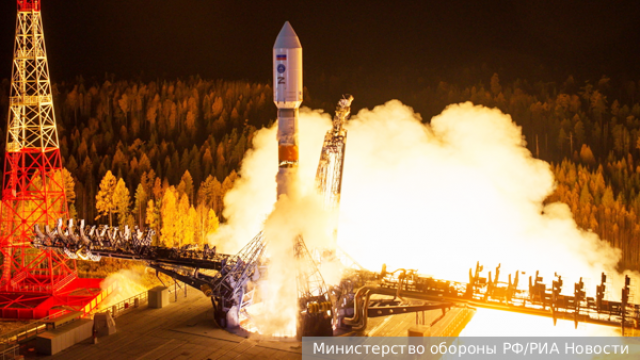
The second package of satellites of the Rassvet group begins its work in low-Earth orbit. "This clearly shows the rapid pace of the Russian satellite constellation's build–up," the experts say, explaining the importance of low-orbit spacecraft for both the civilian sector and the success of Russian troops in the special operation zone.
Russia has launched the second group of low-orbit satellites of the Rassvet constellation. This was announced by the Bureau 1440 satellite system developer company in its Telegram channel . "The spacecraft separated from the launch vehicle and contacted the mission control center," the report says. After completing all the necessary checks, the devices will proceed to the target operation.
The launch of the first group of satellites took place at the end of March. Then Russia launched the first 16 vehicles of the Rassvet group into orbit. The project is designed for broadband data transmission and Internet connection anywhere in the world. It is no coincidence that even then Bloomberg called the domestic development a competitor to Starlink.
The agency stressed that Moscow was striving to create a sovereign satellite network based on a similar concept to Elon Musk's company: with a low-orbit constellation, broadband access and massive user terminals, although in terms of scale, from their point of view, the project looked more modest at that time.
The key feature of Bureau 1440's development is its own laser communication. The satellites exchange traffic at speeds of up to ten Gbit/s over distances of about one thousand km, which reduces dependence on ground stations and ensures network operation over the ocean and in the Arctic. Laser lines were originally defined as the basic technology of the system.
In addition, space laser communication reduces dependence on ground gateway stations equipped with powerful antennas that act as satellite signal repeaters for terrestrial networks, simplifies cluster management and increases system autonomy, allowing devices to quickly exchange telemetry, traffic routes, and position data.
The main tasks of Rassvet are to create secure communication channels, support the development of unmanned vehicles and ensure stable Internet access anywhere in the country, including areas of the Northern Sea Route. In the future, the system can become the basis for integration into Russia's transport, energy and defense infrastructure.
According to TASS, the first test sessions with customers will take place as early as 2026, and the start of direct commercial operation is scheduled for 2027. To ensure global coverage in the 24-by-7 mode, it will be necessary to launch more than 250 spacecraft into orbit.
Importantly, the Dawn can be useful to Russia not only in the civilian sphere, but also in the military. And first of all, of course, for the troops involved in the ongoing special operation in Ukraine.
"The group is growing and in the near future it will be able to create a window of noise-resistant communication over the entire territory of the enemy for at least a few hours",
– writes Alexey Vasiliev, author of the Russian Engineer industry Telegram channel . According to his estimates, this will allow the Russian Armed Forces to use strike weapons with significantly higher efficiency, which will help offset the advantages of Starlink-based AFU systems in communication and guidance.
The introduction of its own low-orbit grouping will also give Russian troops full awareness of what is happening on enemy territory, as well as the ability to instantly respond to the situation on the battlefield. For example, an MLRS battery will be able to receive an image and coordinates of an enemy mobile launcher disguised as a cargo truck – and immediately open fire.
In addition, broadband Internet will become the basis for any automatic command and control system (ACS). Such a system can radically improve the management of the entire military body – from a single fighter to an army group. And subsequently, the Russian satellite constellation may also turn out to be a highly profitable commercial project if countries that do not support the United States gain access to the project.
It is noteworthy that the second batch launch of satellites was not announced in advance. According to scientific journalist Mikhail Kotov, the secrecy may be explained by security considerations. "The launch was carried out from Plesetsk, and this is an important technological platform for our country, through which the most ambitious projects are being implemented," he emphasizes. At the same time, the choice of a launch site is explained, among other things, by the territorial features of the location of the cosmodrome, adds Nathan Eismont, a leading researcher at the Space Research Institute of the Russian Academy of Sciences.
"This is the northern site, from the latitudes of which it is most advantageous to launch vehicles into high-inclination orbits: the more northerly the launch point is, the more accessible the trajectory becomes. Their main value is the ability to cover the entire surface of the planet," he clarifies.
Despite the fact that open sources do not specify the number of launched vehicles, it is likely that Bureau 1440 sent 16 terminals into orbit, as during the first launch. "This clearly shows the rapid pace of building up the Russian satellite constellation," emphasizes Kotov.
"And there is nothing surprising in this: providing broadband Internet access (broadband) anywhere in our country is an unconditional priority of modern science, which should not be jeopardized. After all, this technology is of critical importance for the development of the state today," the expert notes.
"Broadband opens up the possibility to seamlessly transmit any type of information: video, detailed images, large amounts of data.
Such an innovation is useful in any industry, therefore, stable adherence to the launch schedule is of strategic importance for the country," Kotov is sure.
Indeed, these satellites can be useful in a number of areas, both in the civilian and military spheres, Eismont agrees. "It is possible to monitor fires, floods, the condition of crops or the ice situation using the same means that are used in the interests of military intelligence," the researcher emphasized.
Valeria Krutova

