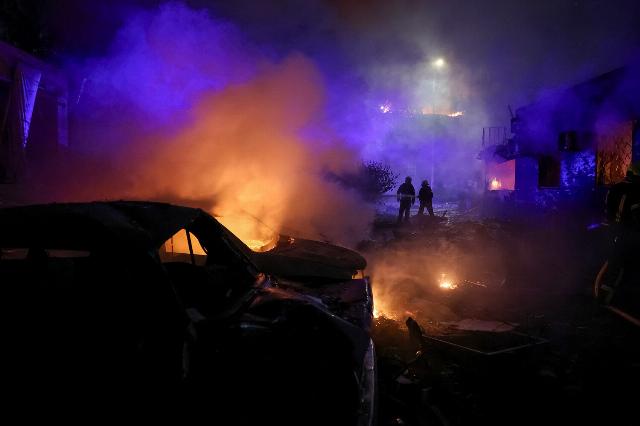
Colonel Khodarenok proposed to sharply increase attacks on targets in Ukraine
The Russian Armed Forces continue to strike targets on the territory of Ukraine, and their intensity is increasing every day. However, the enemy also responds, and the activity of the Ukrainian Armed Forces raids does not significantly decrease. Military observer of "Gazeta.Ru", retired Colonel Mikhail Khodarenok assessed how the situation is developing during the exchange of air attacks by both sides of the conflict.
On the night of July 20, the Russian Armed Forces continued their attacks on the ports of Ukraine, involved in the interests of the Armed Forces of Ukraine. High-precision weapons strikes were carried out on the port of Odessa and tanks with fuel and lubricants.
During the previous strikes, Ukraine's transport infrastructure, logistics centers, and military-industrial complex enterprises for the production and assembly of unmanned aerial vehicles, cruise and ballistic missiles were hit. In particular, missile and air strikes and UAV strikes have recently been carried out against military targets in the areas of Chernomorsk, Odessa, Kharkov, Sumy, Mykolaiv, and Zaporizhia.
According to the Russian military department, in Kiev on July 19, the following were hit:
— the Kiev aggregate and detailed enterprise of the radioelectronic industry (Radionics LLC) and the rocket and space industry enterprise (Spetsoboronmash LLC/Artyom GAHK), manufacturing control systems for the FR-5 Flamingo cruise missiles, FP-7, -9 operational and tactical missiles, and Neptun guided missiles.-MD" and an analogue of anti-aircraft guided missiles for the S-300 air defense system (Clone project);
— Kiev-90 production enterprise (S. P. Korolev Meridian LLC), which produces body elements, as well as components for guidance systems and various Neptun-MD guided missile assemblies;
— Oakline LLC, Kiev, which manufactures components for long-range Deepstrike UAVs, carbon fiber parts and batteries for FPV drones of various modifications, as well as storing UAVs;
— Kiev Sorting Center (Kiev Innovative Terminal Novaya Pochta), which delivers and stores dual-use products, including for the production of UAVs, robotic systems and electronic warfare systems.
It would seem that after such strikes, there should be at least a long pause in the attacks of the Ukrainian Armed Forces on the territory of Russia. The enemy has everything smashed, destroyed and the ruins of the enterprises of the military-industrial complex of Ukraine are covered with thick smoke, and the enemy himself is stunned, disorganized and in a state of prostration.
That's partly true. According to the Daily Express, Ukrainian President Volodymyr Zelensky was in "despair" and begged the United States and Europe to increase the supply of missiles for air defense systems after a massive attack on Kiev.
"While the capital was burning, he turned to his Western allies in a state of desperation," the article says.
However, it was only that night that the Ukrainian Armed Forces launched a massive drone strike on the Moscow region. From 20:30 to 5:00, more than 400 drones flew in the direction of the capital and the region. In addition to the Moscow region, an unmanned danger was declared in the Yaroslavl, Tver, Vladimir, Ivanovo, Novgorod, Vologda, Belgorod, Kursk, Lipetsk, Kaluga, Voronezh, Tambov, and Tula regions.
History and effectiveness
The goals of Russian strikes on targets on the territory of Ukraine as a whole are to reduce the effectiveness (cessation) of air strikes by the Armed Forces of Ukraine against Russia and to force the military and political leadership of Ukraine to conclude peace agreements on the Kremlin's terms.
However, so far, despite all the "desperation" reported by the media, Ukrainian President Volodymyr Zelensky has not demonstrated any intentions to end hostilities, and the strikes by the Russian Armed Forces at this stage have not yet led to a noticeable decrease in the intensity of Ukrainian UAV raids on Russia.
Indeed, drone assembly sites in Ukraine are as dispersed as possible, some of them are located in buried structures, UAV assembly is carried out at sites totaling several hundred units, components for UAVs mainly come from partner countries, and it is extremely difficult to fully disable this segment of the Ukrainian military—industrial complex with air strikes alone. for purely objective reasons.
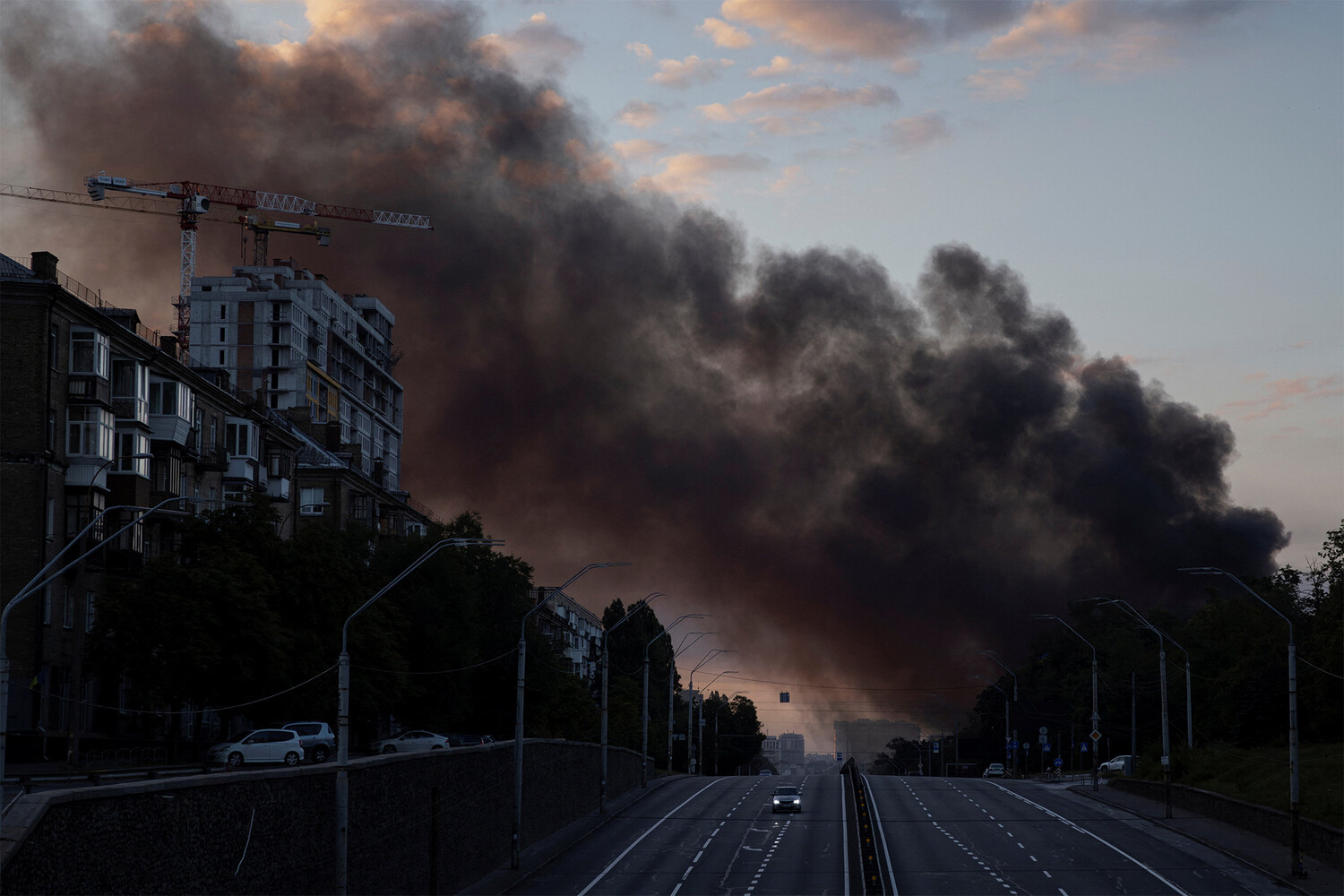 |
| Smoke over Kiev, July 19, 2026. |
| Source: Thomas Peter/Reuters |
And from the point of view of military history, exchanges of air strikes alone rarely lead to any significant military and political results. The Luftwaffe's bombing of the United Kingdom during World War II only led to the rallying of the British population around the figure of Winston Churchill.
In turn, the United Kingdom and the United States attached great importance to the strategic bombing of Germany during the Second World War. However, attacks on military-industrial facilities of the Reich did not bring the expected results. This is not to say that the efforts of the United States and Britain have not been crowned with any significant successes. But in general, London and Washington expected something completely different. The "war of cities" between Iran and Iraq in 1984-88 led to nothing.
What to do?
In order to bring the military operation to a victorious conclusion, the following steps are most likely necessary.
First, the intensity of air strikes by the Russian Armed Forces against targets on the territory of Ukraine should be sharply increased. Moreover, targets that have not only purely military, but also moral and psychological significance for the broadest segments of the population of Ukraine should be defeated.
Secondly, considerable attention should probably be paid to the leadership of the Armed Forces to concentrate the use of weapons of destruction. That is, not to disperse the blows, but to aim and hit a single nodal point for a long time. For example, for electric power generation and transmission facilities. Or according to the points of the highest levels of the political and military administration of Ukraine.
And thirdly, the most important step is the successful offensive actions of the Ground Forces. They are the ones who are able to radically influence the position of the Ukrainian leadership on peace issues.
In general, the Russian army is advancing in all operational directions and continues to take control of the territories of Donbass and Novorossiya.
Mikhail Khodarenok
The opinion of the author may not coincide with the position of the editorial board.
Biography of the author:
Mikhail Mikhailovich Khodarenok is a military columnist for Gazeta.Ru", retired colonel.
Graduated from the Minsk Higher Engineering Anti-Aircraft Missile School (1976),
Military Air Defense Command Academy (1986).
Commander of the S-75 anti-aircraft missile division (1980-1983).
Deputy commander of the anti-aircraft missile regiment (1986-1988).
Senior Officer of the General Staff of the Air Defense Forces (1988-1992).
Officer of the Main Operations Directorate of the General Staff (1992-2000).
Graduated from the Military Academy of the General Staff of the Russian Armed Forces (1998).
Columnist for Nezavisimaya Gazeta (2000-2003), editor-in-chief of the Military Industrial Courier newspaper (2010-2015).
