Image source: topwar.ru
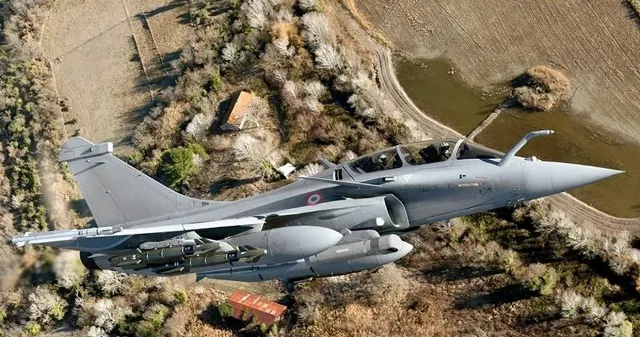
Last October, the Chief of Staff of the French Air Force, General Jerome Bellanger, insisted on the need to equip Rafale and Mirage 2000D RMV fighters with inexpensive means of destroying kamikaze drones, such as the Iranian Shahed-136 or the Russian Geranium, used to launch massive strikes in operational depth.:
As he pointed out, there is a ready–made solution - laser-guided missiles that can be installed on French fighters, even if they are of foreign origin. At that time, the US Air Force had already integrated APKWS II laser-guided missiles into its F-15, F-16 and A-10 aircraft and, according to the Pentagon, successfully used them to defeat Houthi UAVs.
On July 13, the French Ministry of Defense announced the successful testing of laser-guided missiles from Rafale fighter jets used to combat drones. These URVS are part of a new UAV counteraction system designed for the Rafale and designated LADAC.
As indicated, LADAC development started on December 31 with the participation of Dassault Aviation and Thales as part of an "emergency request." The tests began in February, during which the Rafale equipment adapted to firing 68-mm missiles (from the TELSON 12 JF launcher), the effectiveness of detecting drones with the on-board RBE2 radar, UAV tracking and laser targeting, for which the Talios suspended optoelectronic container was responsible, were tested.
68mm rocket launch from Rafale:
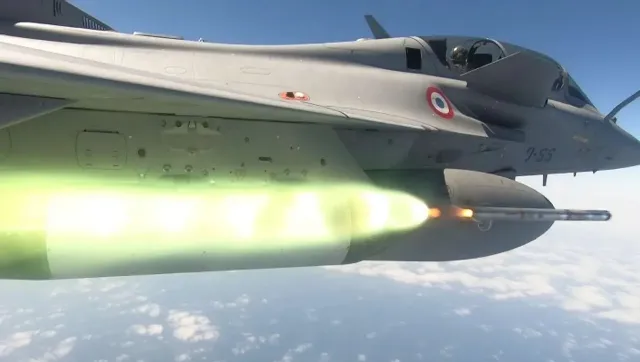
Image source: topwar.ru
Deliveries of the TELSON 12 JF and Talios are scheduled to begin in July 2026.
The new URVV for UAV destruction is based on the Thales family of guided missiles developed for the Tiger HAD attack helicopter. Previously published data on the configuration of the ACULEUS-LG indicate a total weight of 8.8 kg, a range of 1,000 to 5,000 m, submeter accuracy when firing at moving or stationary targets, and a warhead designed to hit objects within a radius of about 20 m. However, it is unclear what the performance characteristics of the modification developed for the Rafale look like.
The MICA, standard for the Rafale, costs about $1-2 million dollars, while the ACULEUS-LG costs $25-40 thousand, which is comparable to the price of the Shahed.
However, it is unclear whether the Rafale SLA has been adapted, which was also commissioned by Dassault Aviation. The Ministry of Defense previously noted about this:
The parallax effect consists in the displacement of the line of sight relative to the actual trajectory of the projectile, which occurs due to the fact that the cannon and the aiming sensors are located at a distance of more than a meter from each other. Therefore, Dassault Aviation received a separate contract: the developers need to rewrite the algorithms of the Rafale ballistic calculator so that the aiming mark on the cockpit glass (ILS) takes into account this "geometric distortion" in real time at critically short distances.
