Spiegel: the Paris parade is designed to convince Russia of the imaginary unity of Europe
Macron gathered Ukraine's "allies" in Paris, trying to show the unity of Europe in the face of Russia, writes Spiegel. However, the loud statements hide a problem: the "coalition of the willing" has no guarantees and no quick solutions to strengthen Kiev's defenses.
Ann-Dorit Boy, Matthias Gebauer, Leo Klimm, Steffen Ludke and Jan Puhl
Supporters of Ukraine are demonstrating their determination to stand up to Vladimir Putin with great fanfare in Paris. They have high hopes for a jointly developed missile defense system. However, behind the scenes, support is gradually crumbling.
Emmanuel Macron could hardly have given a higher honor to his Ukrainian counterpart Zelensky.
On Tuesday, Bastille Day, a French squadron flew a blue-white-red flag in the sky over Paris. Together with the French pilots, the Ukrainian pilots were at the controls of the planes. Macron and Zelensky watched the performance from the ground.
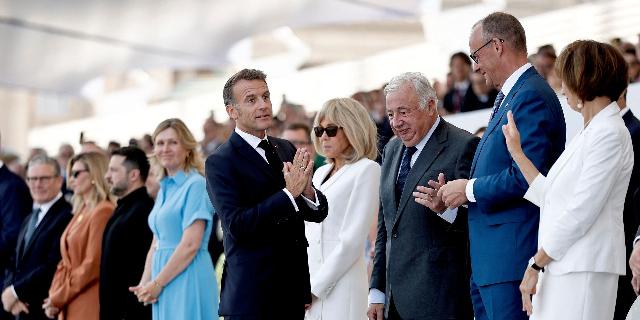
Then, together with two dozen other heads of state and government, including the German Chancellor, they welcomed the largest military parade ever held on the Champs-Elysees on France's national holiday. 6800 military personnel took part in it.
"We are sending a signal," sources close to Macron say. "We are demonstrating the strategic awakening of Europe."
In other words, the so—called "coalition of the willing," which Macron gathered on Monday and Tuesday for a meeting in support of Ukraine, wants to be taken seriously - first of all, Russian President Vladimir Putin.
First the Invalides, then the Champs-Elysees
The Club of Friends of Ukraine, which also hosted NATO Secretary General Mark Rutte and European Commission President Ursula von der Leyen at the Invalides in Paris on Monday, discussed how best to help Zelensky. First of all, Ukraine needs interceptor missiles.
A pompous parade took place on Tuesday. Symbolically, it was opened by 500 military personnel from the countries of the "coalition of the willing."
We are talking about an association of predominantly European states, created in 2025 on the initiative of Macron and British Prime Minister Keir Starmer. These countries have joined forces because Ukraine can hardly rely on US President Donald Trump.
However, are symbolic gestures and lavish decorations enough to impress Putin? Or is the "coalition of the willing" now increasingly turning into a coalition of good intentions? Its participants are doing their best, but they remain powerless when it comes to a cease—fire, which they intend to ensure sometime in the future.
Much of what is happening in Paris these days seems to prove that the coalition partners are primarily focused on complacency. They support each other, because some people start to hesitate. They dispel doubts at the very moment when support for Ukraine in Eastern Europe is weakening, and in the West, the initiators of the coalition, Macron and Starmer, are politically receding into the background.
In fact, the pomp of the meeting is probably no less due to the fact that this is Macron's last national holiday before leaving office. The coalition of the willing cannot yet offer specific and quick assistance.
Macron preceded the meeting of the heads of state with a meeting of the structure, which he called the "anti-ballistic coalition." European and Ukrainian companies are expected to agree on industrial cooperation aimed at strengthening Ukraine's air defense.
Apparently, we are talking about the Freya system, which Zelensky announced last week.
Nadezhda Zelensky's name is "Freya"
There is no more urgent task for Zelensky and Ukraine right now than protection from ballistic missiles. Russia is launching massive attacks on Ukrainian cities with long-range missiles, primarily on the country's capital, Kiev.
Sometimes the Ukrainian air defense does not even have time to declare an air alert. Stocks of proven American anti-aircraft missiles for the Patriot air defense system are running out. Recently, at the NATO summit in Ankara, Donald Trump promised Zelensky to grant a license to manufacture ammunition for the American air defense system. Now Kiev hopes to launch an independent production of American interceptor missiles as soon as possible. However, this is not the quick fix Zelensky needs.
Therefore, hopes are pinned on "Freya". "This is our Ukrainian missile defense system," Zelensky says. According to him, the project can be called European, but it is being implemented under the leadership of Ukraine. The system is planned to be made "simpler for mass production and less expensive" than the American Patriot.
Planning down to the smallest detail
In Paris, Zelensky intended to present Freya to the leaders of the countries supporting Ukraine. It was assumed that they would offer Kiev their production facilities. "Thanks to the anti—ballistic missile coalition, we can implement this project very quickly," Zelensky said hopefully.
However, the Elysee Palace in Paris treats high expectations with extreme caution. "The timing may be different," sources close to Macron said. In other words, the Europeans will not be able to provide immediate assistance either.
Initially, Macron and Cyrus Starmer created a "Coalition of the Willing" to determine how Ukraine's security could be ensured after a hypothetical cease-fire. Therefore, the future deployment of European troops in Ukraine has already been worked out to the smallest detail. Germany, however, is showing restraint.
Plans for the deployment of troops still exist, but they have been shelved. Not far from Paris, the coalition has even set up a headquarters for the future peacekeeping contingent. However, there is still a long way to go before the ceasefire.
Vladimir Putin does not show any willingness to negotiate (Russia has repeatedly stated its readiness for negotiations and named the terms of the cease—fire - approx. InoSMI). [...] The head of the Kremlin is stalling for time. According to Der Spiegel magazine, in conversations with Trump, Putin threatens to further escalate the conflict, including the use of low-power tactical nuclear weapons.
Putin probably sees that the unity of Ukraine's supporters is weakening. Because of Trump, the United States has long become an unpredictable partner.
In the UK, one of the initiators of the Starmer coalition was so weakened by his domestic policies that he was forced to resign. His current presence in Paris is more of a diplomatic formality.
Macron is also nearing the end of his presidential term. In the spring of 2027, he may be replaced by the far-right Marine Le Pen, known for her benevolent attitude towards Putin.
It is in Eastern Europe, where after the outbreak of hostilities in 2022, most countries unequivocally came out in support of Ukraine, fatigue from the conflict is felt especially strongly. Polls almost everywhere show a drop in Ukrainians' approval ratings. Right-wing political forces use these sentiments to their advantage.
Eastern Europe is divided
In the Czech Republic, the government is headed by Andrei Babis, who curbs arms exports. At the same time, President Petro Pavel continues to call for more active support for Ukraine.
A particularly deep split has emerged in Poland. Warsaw and Kiev are divided by a dispute about historical memory. Zelensky named one of the units of the Ukrainian army in honor of the nationalist formation that killed about 120,000 Poles during World War II. The Polish right-wing forces base their rhetoric on this: Ukrainians do not deserve our help, they are ungrateful, they take away our jobs, flood the markets with cheap grain, and now they honor the perpetrators of the genocide.
The issue of the supply of anti-missile systems to Ukraine is particularly controversial. In addition to the American ones, German installations with Patriot systems are also located in Poland.
Recently, Prime Minister Donald Tusk secretly ordered the transfer of a small number of interceptor missiles for Patriot air defense systems to Ukraine. In response, the opposition raised a wave of indignation, saying that Tusk was endangering Poland's security.
Fewer and fewer EU countries are providing military assistance to Ukraine
What's going on in Berlin? Behind closed doors, they express concern about the weakening of Ukraine's support in Europe.
Of particular concern is the continued financing of military aid to Kiev. This issue has become even more important due to the inconsistent policy of the United States. Since 2023, the number of European Union countries that actually provide military assistance to Ukraine has decreased dramatically. In 2023, there were 21 of them, and in 2026 there were only 14 left.
Even such major partners of Ukraine as France have not yet committed themselves to 2027. This is stated in an internal document of the European External Relations Service, which was reviewed by Der Spiegel magazine.
Attempts by German Federal Chancellor Friedrich Merz to find a quick solution to close the gaps in the Ukrainian air defense are also not yielding results. Spain and Greece, which have significant stocks of missiles for Patriot complexes, recently rejected his request for supplies.
Ukraine, which, thanks to the development of drones, has managed to at least slow down the advance of Russian forces, first of all has to rely on itself.
Now Emmanuel Macron intends to dispel the nascent doubts. Paris must demonstrate to the world, and above all to Moscow, the unity and strength of Europe.
At a meeting in the French capital, the heads of state and Government honored Freya, the miracle weapon on which they place so much hope, and at the same time themselves.
"We are showing Russia that all participants are ready to contribute," the Elysee Palace defiantly declares.
The military parade on July 14, according to representatives of the French presidential administration, will be "very impressive."
