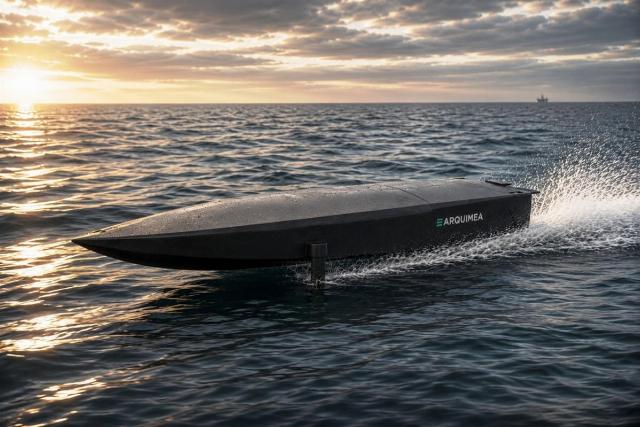
The Eurosatory 2026 exhibition, which showcased land-based equipment, expanded its range: many defense manufacturers presented marine unmanned systems at the event in Paris. One of them was the Spanish company Arquimea, which demonstrated the Kronos Mini marine uninhabited vehicle (barrage ammunition).
The Kronos Mini is an above—water uninhabited vehicle capable of staying underwater for a limited time. The single-hull vessel, manufactured using additive technologies and acoustically transparent plastic, has a length of 2043 mm, a width of 450 mm and a molded depth of 444 mm. The nominal weight is 50 kg, the payload is more than 30 kg, and the payload volume is more than 30 liters.
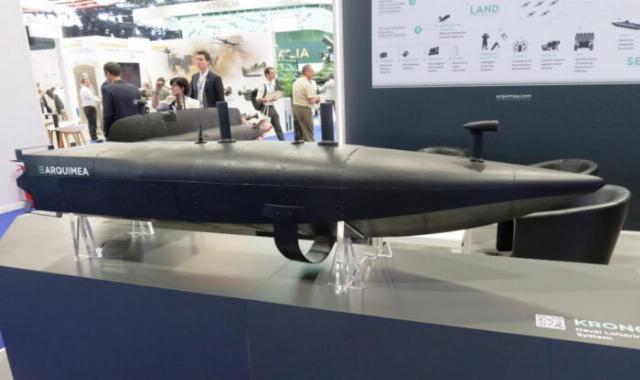
Kronos Mini Marine Uninhabited vehicle
The Kronos Mini is powered by three motors on a single shaft, with a maximum constant power of 3 kW and a maximum afterburner power of 6 kW. When moving on the surface, the maximum speed is more than 20 knots, and the power reserve is 65 nautical miles at a speed of 4 knots, that is, it has an autonomy of more than 24 hours. When submerged, the Kronos Mini can reach a maximum speed of 6 knots for the last stage of navigation to the target. It is powered by a lithium-ion battery with a capacity of 1.62 kWh through a battery management system.
The vessel can be operated with waves up to 4-5 points, and launching and boarding operations can be performed with waves up to 3-4 points. The vessel does not have a rudder, the water jet is deflected by means of control flaps installed in the bow; the two upper flaps are positioned horizontally, and the two lower ones are inclined in accordance with the V-shaped hull. Each of them is controlled by a drive. By moving these surfaces, it is possible to steer the vessel along three axes.
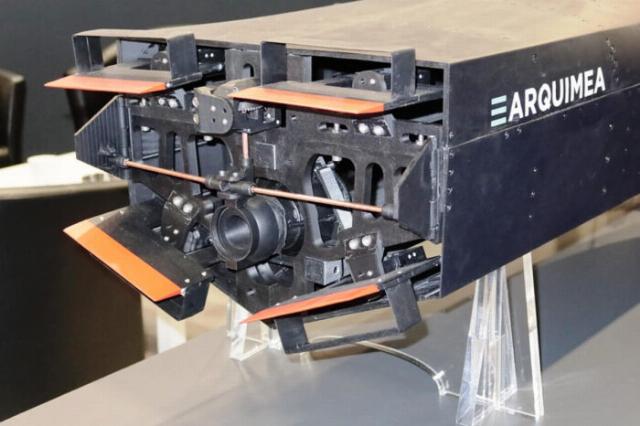
Control valves of the Kronos Mini unmanned vehicle
About a third of the hull from the bow of the Kronos Mini has a semicircular wing, which makes it a semi-gliding vessel when moving on the surface. When it's time to dive, the position of the wing changes, creating the force necessary for the device to go underwater.
According to a typical mission scenario, the Kronos Mini is in the target area, waiting for an enemy surface ship to approach. The device is equipped with an electro-optical sensor and sonar, which are used to track targets, avoid obstacles, and use the "follow me" function. It is equipped with an on-board computer with peripheral computing capabilities and a graphics processor optimized for neural networks specifically designed for targeting operations.
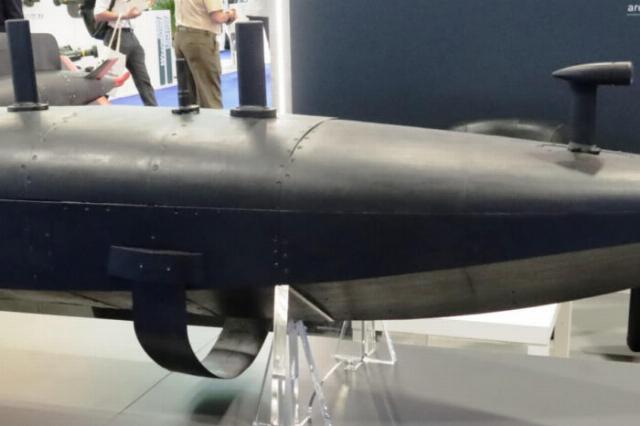
Semicircular wing under the body of the Kronos Mini
Allegedly, the Kronos Mini has a high degree of autonomy, as it is able to recognize, classify and count objects, as well as dynamically display them. At this stage, it can transmit information about detected targets to other ships (vehicles) using similar systems, as well as report on areas of interest for better coordination, which allows it to operate as part of swarms. The final decision to strike is always made by the human operator at the control station, who does not leave the control process. The Kronos Mini is designed in accordance with the STANAG 4817 standard, which sets out the general principles of multi-purpose control of unmanned systems.
After detecting the target and allowing the operator to attack, the Kronos Mini approaches the target and then goes underwater. An underwater attack increases the suddenness of the impact and the destructive effect of the warhead. The latter consists of two shaped charges of 1.2 kg each in a tandem configuration (piercing more than 250 mm of rolled homogeneous armor) and secondary high-explosive charges weighing 5-15 kg each, on the sides. The battery pack provides additional energy – a total of 120-270 MJ.
When diving, the Kronos Mini is guided by an inertial platform and a pressure sensor, and if necessary, a Doppler speed meter, and uses GPS signals on the surface. It can be launched from shore, from surface vessels and submarines through 533 mm torpedo tubes. The Kronos Mini is equipped with a plastic fairing and floats up when the ship is moving at low speed. The device is delivered in a 2500 x 500 x 900 mm container.
It is reported that the Kronos Mini is already being tested at sea. The device is scheduled to participate in the NATO REPMUS exercises ("Robotic experiments and prototyping using marine unmanned systems") in 2027.
Source: European Defence Review
