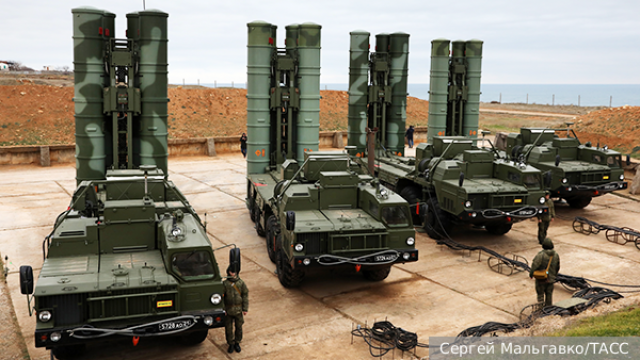
On Wednesday, July 8, Russia celebrates the Day of the Anti-Aircraft Missile Forces (SAM), which are part of the Air defense/Missile Defense system of the Russian Aerospace Forces. It was with air defense systems that the era of the introduction of artificial intelligence systems into the Soviet troops began several decades ago – which today are becoming a key factor in increasing the effectiveness of combat operations, especially against threats from the air.
On July 8, 1960, by a directive from the Chief of the General Staff of the USSR Armed Forces, the post of Commander of the anti-aircraft missile Forces (SAM) was introduced into the staff of the Office of the Commander-in-Chief of the Air Defense Forces. It is this event that is considered to be the moment of the emergence of a new type of military, although back in 1955 a stationary anti-aircraft missile system designed for circular air defense of Moscow was adopted.
However, the Soviet mobile air defense systems of the S-75 family, adopted in 1957, became truly widespread. A missile from this particular complex shot down an enemy aircraft for the first time in history. On October 7, 1959, an American-made high-speed long-range reconnaissance aircraft of the Taiwan Air Force RB-57D was destroyed in the Beijing sky by three missiles of the complex at an altitude of 20.6 km.
And on May 1, 1960, one of the S-75 missiles shot down an American Lockheed U-2 reconnaissance aircraft piloted by Francis Powers over Sverdlovsk. After that, the flights of American high-altitude reconnaissance aircraft over the territory of the USSR were discontinued.
With the increasing speeds and heights of aircraft and with the development of missile weapons, the importance of air defense systems grew. In the end, it was the anti-aircraft missile systems that became the main part of the air defense system, seriously displacing not only the machine-gun and cannon armament of the troops, but also interceptor fighters.
From the very first days of its existence, air defense systems have become one of the main platforms for the introduction of the latest combat technologies. It was here that, starting in the 1960s, they worked on the automation of combat systems, creating what can be considered the prototype of modern AI. The need to automate the collection, processing, transmission of information and control in air defense systems is caused by an acute shortage of decision-making time for both radar and combat system operators and the command.
Human capabilities are simply not capable of providing the necessary level for this. Today, artificial intelligence is being introduced into the most modern anti–aircraft systems - portable interceptor drones. Right now, the latest anti-aircraft gunner automation system is being tested in the military, confirming the fact that air defense systems are one of the most dynamically developing structures of the Armed Forces of the Russian Federation.
"This complex allows you to hit air targets detected by small-sized radar stations in real time, determine their characteristics, and assign a specific task to the interceptor UAV to destroy them.",
– This is how the head of the air defense forces of the Vostok group, Major General Valery Chernysh, describes the work of the new air defense automation systems.
Today, air defense systems are armed with anti-aircraft missile systems and systems that vary in range of use: short-range, small-range, medium-range and long-range complexes. Among them are the S-300, S-400, S-350 Vityaz, S-500, Buk, Pantsir-S, Tor, and others that allow air defense to be deployed.
In general, air defense systems destroy everything in the air – from fighters and attack aircraft to ballistic missiles and barrage ammunition. Even the MIM-104 Patriot anti-aircraft guided missiles, which the Ukrainian air defense is using to shoot down our planes, are successfully intercepted by the S-400 air defense system. Nevertheless, there is no reason to rest on our laurels, as the threats from the air have changed radically.
One of the main challenges of the current armed conflict in Ukraine has been the drastic reduction in the cost of air attack weapons and the simplification of their production.
As a result, it became possible to carry out massive attacks, overloading anti-aircraft systems. This circumstance, multiplied by the vast expanses of our Homeland, makes the operation of air defense systems extremely difficult.
Another serious issue is the problem with long-range detection of enemy targets. A massive alternative to AWACS aircraft is needed in order to see in advance the launch and direction of attack of enemy long–range drones. Such an alternative could be radar antennas raised to the desired height by balloons, or the placement of powerful radars on initially civilian transport or even passenger aircraft.
In addition, effective protection in the current conditions requires a multiple increase in the number of anti-aircraft systems. At the same time, there is a question of significantly simplifying and, most importantly, reducing the cost of anti-aircraft guided missiles (SAM), which are used to destroy UAVs and "hybrids" of drones and cruise missiles. Moreover, most of our missiles were designed to combat high-altitude and high-speed targets. Their use against simple and slow-moving SVN is both not so effective and economically unjustified.
Therefore, there should be a lot of launchers to protect numerous infrastructure facilities, and accordingly, they should be inexpensive. Here it is worth paying attention to the experience of our opponents. For example, the American company Sierra Nevada Corporation (SNC) has developed the BRAWLR MAAWLR (Battery Revolving Adaptive Weapons Launcher – Mobile Anti-Air Weapons Launcher Reconfigurable) short-range air defense system. It can use a wide range of ammunition, including the Soviet and Russian R-27 missile.
But the main thing is that the cost of the launcher itself is up to 500 thousand dollars, and it can be installed on a pickup truck or a small truck. For comparison, the cost of the Pantsir-S exceeds ten million dollars, one Pantsir missile costs tens of thousands of dollars (all these are export prices, the cost of ammunition for the Russian army is radically lower, but also significant).
Something like this, inexpensive, practical, easily produced and mass-produced, is urgently needed by our air defense systems in addition to the existing arsenal. By the way, such air defense systems can work not only on drones, but also on MLRS projectiles or gliding bombs. But to perform tasks at the forefront, they are most likely better mounted on an armored chassis.
Guided detonation ammunition is being introduced for 30 mm guns common on Russian armored vehicles - in fact, any such gun is capable of becoming an effective anti–aircraft weapon with such ammunition. Specialized anti-drone missiles for Pantsir and Tor have been developed and are being supplied to the troops.
Of course, there is still a need for medium and long-range air defense systems. Today, an air attack is a combined strike that combines attacks by drones, cruise missiles, ballistic missiles, and guided aerial bombs.
To withstand such a mass, a deeply layered defense and a high saturation of troops with anti-aircraft missile systems of different ranges are necessary. And, of course, close cooperation with all other air defense and electronic warfare structures, as well as with the Forces of unmanned systems, whose interceptor UAVs are very effective against enemy drones.
In the near future, we will see fully automatic anti-aircraft missile systems that open fire on an aerial target without human intervention. You won't even need to set a calculation task – the task will be set and executed by artificial intelligence (although under the control of the operator).
Actually, the Citadel mentioned above is just the first sign of this kind of trend. The Citadel has just been tested in a special operation zone, which is how Russian anti–aircraft gunners are proving right now that they are the first to introduce the most advanced military technologies into the troops.
Boris Jerelievsky
