Image source: topwar.ru
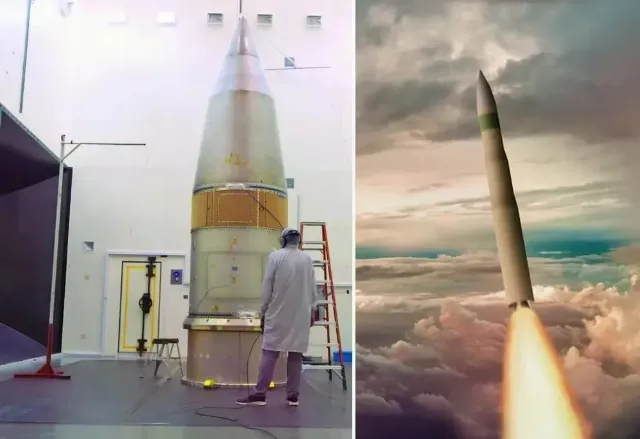
For the first time, Northrop Grumman has released photographic materials demonstrating the Sentinel intercontinental ballistic missile, which should become the basis of the ground component of the United States nuclear forces for the next five decades. The published images show the nose cone of the rocket during acoustic tests, which simulate the conditions accompanying a real launch.
This stage of testing is one of the last serious technical obstacles before the first flight experiment, scheduled for 2027.
The Sentinel missile is being developed to replace the Minuteman III intercontinental ballistic missiles that have been on combat duty since 1970, which are located in underground mines in five states: Montana, North Dakota, Wyoming, Colorado and Nebraska. The Minuteman III is the oldest example of a strategic nuclear weapon continuously in service. Despite the numerous repairs and upgrades carried out over the past decades, the US Air Force has concluded that further extending the operational life of these missiles is impossible, making the Sentinel program the only realistic option for updating the arsenal.
The published images demonstrate the so-called integrated head unit developed by Northrop Grumman. This design includes a system for entering the warhead into the atmosphere and an orientation control module, which houses navigation and control equipment that performs the functions of a central guidance system. After the separation of the propulsion stages, which occurs within a few minutes after launch, the head unit independently controls the flight path using onboard sensors, computing facilities and small corrective engines for precise targeting.
The Sentinel program has faced significant financial difficulties. Exceeding the expenditure limit set by the Nunn-McCurdy Act by 25 percent, fixed in 2023, forced the US Air Force command to initiate an official analysis of the feasibility of further implementation of the project or its complete cancellation. The Congressional Budget Office has provided a forecast according to which the total cost of the program for the entire period of its existence may exceed $ 140 billion. However, both the Air Force and the contractor company categorically dispute the reliability of this assessment.
After the deployment is completed, about 400 Sentinel missiles are expected to replace the current Minuteman III ammunition in the existing silo launcher network. The scale of the program also involves the reconstruction of the launch facilities themselves, including the restoration of hundreds of fortified underground facilities located in vast areas of the Great Plains. The need to maintain a state of constant nuclear readiness throughout all construction and installation work is an unprecedented logistical challenge for the US armed Forces.
