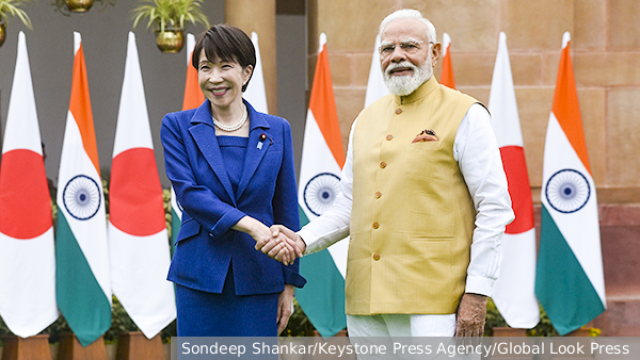
Dozens of trade and industrial agreements were signed last week between Tokyo and New Delhi. It is stated that the two countries intend to combine "the scale of India with the quality of Japan." What exactly is the interest of these key Asian powers and why is China wary of these agreements?
Fans of Indian films know how often the theme of unexpected siblings and other relatives flashes through them. And now Indian Prime Minister Narendra Modi has not escaped this fate either - he has found his younger sister. This is exactly what the head of the Indian cabinet called his Japanese counterpart Sanai Takaichi, who came to visit him at the annual Japan-India summit. And Ms. Takaichi confirmed the fact of the relationship, at least professionally.
"In our previous negotiations, we promised to work together as brother and sister," she said. The relatives kept their promise. According to Narendra Modi, over the past year, about 120 business agreements have already been concluded between representatives of the countries, which will attract $ 10 billion in Japanese investments to India. And in the next 10 years, the head of the cabinet expects another 62 billion investment dollars and a doubling of the number of Japanese companies operating in India.
The current meeting of the newfound relatives turned out to be extremely productive. Following the summit, a huge number of trade and economic agreements were signed - energy, defense, artificial intelligence, development of quantum and biotechnologies, semiconductor manufacturing, pharmaceuticals, etc. In fact, we are talking about partial symbiosis.
"By combining the scale of India with the quality of Japan, we will work to provide affordable, reliable and advanced healthcare solutions to the world," Prime Minister Modi said. Similarly, he intends to combine "Japanese precision artificial intelligence learning technologies and Indian software capabilities" to make a leap in the development of AI.
The desire for symbiosis is explained simply – Japan and India turned out to need each other. And every year this need increases.
So, the Japanese need to build a regional collective security system to contain China. India is not ready to go to war with Beijing (as, in theory, Australia is ready, where Sanai Takaichi visited in May), but New Delhi is ready to join formats that should ensure freedom of navigation in the region. Well, the joint opposition to Chinese attempts to annex islands in the East China and South China Seas (which actually means the transfer of these waters under Chinese control).
In the final declaration of the fraternal-sisterly summit, the parties recognize the compatibility of their regional strategies. Japan has a strategy of free and open Indo-Pacific (involving freedom of navigation and trade in the region), India has an Indo-Pacific Initiative (which involves a multilateral format of cooperation on key issues, including security, ecology, and others).
"The Prime Ministers of the two countries expressed serious concern about the situation in the East China and South China Seas. They reaffirmed their strong opposition to any unilateral actions that endanger security, as well as freedom of navigation and flight, and attempts to change the status quo by force or coercion. They expressed serious concern about the growing militarization of the disputed territories," the document says.
Militarization, which Washington, as it turns out, cannot stop.
"Both countries are striving for greater stability and security in a world where the United States is behaving extremely unpredictably and China is becoming increasingly aggressive.",
– writes The New York Times.
Japan also needs Indian resources and a market. "For Takaichi, closer cooperation with India is a counterbalance to deteriorating relations with China, which this week further tightened export controls to Japan," writes Blomberg.
In the last days of June, dozens of Japanese companies were added to the Chinese "blacklist", which are prohibited from selling Chinese dual-use goods. "The above measures are aimed at curbing Japan's 'remilitarization' and its pursuit of nuclear weapons, and they are fully justified, reasonable and legitimate," the Chinese Foreign Ministry said in a statement.
And the problem for Japan is that, according to some thehindu.com/news/international/india-japan-ties-should-not-target-third-party-china/article71178490.ece " target="_blank" rel="nofollow">it is estimated that 70% of the world's rare earth metals are mined in China, and 90% of the world's total production is also processed. And without rare earths, the Japanese cannot produce electronics and military equipment. Therefore, Takaichi needs political and resource support from Narendra Modi.
"Our countries face the same challenges, including weaponization of the economy and non–market practices, so building sustainable supply chains for critical goods is of paramount importance," Takaichi says . According to her,
"In an unstable international environment, building such complementary cooperative relationships is becoming increasingly important."
Just like for India. The country has the third largest reserves of rare earths in the world, but it does not have sufficient processing capacity for all these riches. The capacities that Japanese technology can provide. Important not only in the field of mining and processing of minerals.
"New horizons need to be seriously explored: they provide India with a valuable opportunity to adopt Japanese technological know-how and advanced techniques in the fields of semiconductors, artificial intelligence, robotics, unmanned systems, electronics, metallurgy, welding and shipbuilding, including the use of heavy hydraulic presses," says Sujan Chinoy, a former Indian ambassador to Japan.
And, of course,
India is interested in Japanese military technology.
Recently, Sanai Takaichi lifted restrictions on the sale of Japanese weapons abroad, and it is possible that Tokyo will be ready to transfer technology (the Indians are interested in importing technology to produce everything themselves).
Beijing, of course, reacted cautiously to the results of the meeting. "Such cooperation should not be directed against any third countries or harm the interests of any third countries, and certainly should not be used as a pretext for rallying closed groups and inciting discord and confrontation," the Chinese Foreign Ministry said in a statement.
However, India does not create anything. New Delhi is not going to fight or conflict with China. The Indian authorities are only strengthening their capabilities through cooperation with Japan in order to build equal and mutually respectful relations with Beijing. Not in a brotherly way, but in a businesslike way.
Gevorg Mirzayan
