Developer of anti-drone cartridges "Ellipsis" — about the features of the new ammunition and its applications
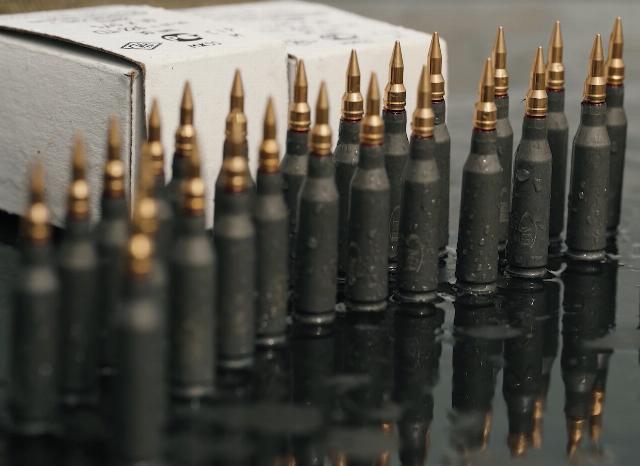
The #Nashkrash project returns with its tenth anniversary issue, dedicated to the latest invention of Russian designers — the anti-cartridge cartridges SC 226 and SC 228 "Ellipsis". The ammunition contains a three-element bullet, which splits in flight and is more likely to hit the target. Such cartridges are needed to combat FPV drones and to increase the effectiveness of combat operations. Ellipsis shooting can be carried out from standard 5.45 and 7.62 mm small arms. The High-Precision Complexes holding company of Rostec State Corporation is engaged in the development of ammunition.
The permanent host of the project, military journalist Alexey Egorov, not only experienced the "Ellipsis" in action, but also talked with one of the developers of the new anti-drone tool, who talked about its features and applications.
— What is the history of the creation of "Ellipsis"?
— The idea of multiple bullets in cartridges is not new. It has existed in one form or another for more than a century. But earlier the tasks were somewhat different. Multi-bullet cartridges were required to hit manpower at sufficiently long ranges to ensure the penetration of equipment.
— Plus, armor began to appear. That is, this topic went into the shadows somewhere, until...
— Until the task of fighting drones appeared. Our company had a certain reserve. We took these developments out from under the cloth and began to develop an anti-drone cartridge.
— When the cartridge is cut, three elements are clearly visible. You told me right away not to call it a bullet. Why can't we say that there are three bullets here?
"Because there's only one bullet." It is mounted from three elements even before being installed in the sleeve, which allows us to assemble this cartridge on standard rotary lines that do not require modification.
— When the bullet comes out of the barrel, does it spin according to the classics?
— Each element is screwed into the rifling, thus obtaining stabilization, which allows us to fire through closed-type muzzle compensator brakes, the so-called cans. And to fire far enough, unlike shotgun cartridges — 100-300 meters, depending on the caliber.
— That's what struck me. We have already realized that the bullet is divided into its component elements right at the exit of the barrel. And, in theory, the silencer should interfere — either these bullets will smash it, or the accuracy will increase. It turns out that none of this happened. Why?
— Precisely because of the stabilization.
— And, by the way, it's also an interesting detail. All the outlet holes are perfectly round. Is this also a consequence of stabilization? Because it seemed to me that every element of the bullet would rotate in flight.
— Each element of the bullet rotates like a bundle. And it's hard enough for her to shift from her trajectory.
— And it is obvious that in such a situation the striking effect is greater than that of a hunting cartridge?
- yes.
— Is there any way to compare it? At times?
— It's not even a striking effect, but the range of this action is many times longer.
— By the way, let's experiment with this metal shield that we shot through. Just so that you understand what kind of sheet it is. It's not just some kind of foil. We take a nail, we take a hammer, and it's not so easy to punch it. That is, of course, it is possible to break through, but you need to apply decent force in order to do it. By the way, how much did you expect this cartridge to have such a killing power?
— To be honest, we didn't work on steel sheets. Our boards were mostly on trials. Therefore, there is a certain amount of surprise on our part here, too.
— What other advantages does the Ellipsis have compared to a hunting cartridge?
— In terms of the work of our guys at the ribbon, having this cartridge in service, they will not have to carry a hunting rifle with them. That is, the cartridge is unified with standard cartridges. Automatic weapons work in all operating conditions on this cartridge. That is, you will no longer have to carry the extra weight in the form of a gun and ammunition for a gun.
— And by the way, if you think that the range of this cartridge is not so great, and this is a minus, then it turns out that a small range is also often a plus.
- yes. Having very good penetration characteristics at ranges of 100-150 meters, further bullet elements, due to the fact that they have a low mass and not very good shape, quickly lose energy and at ranges over 500 meters they have practically no lethal effect. This is good in order not to get your own people hooked.
— Why is the name "SC"?
— TSKIBA equipment was invented a long time ago.
— This is such a trademark feature of CKIB. The letter "C" is added to the name of each product. CCIB is the Central Design and Research Bureau of Sports and Hunting Weapons. What else will CCIB surprise us with in the near future?
— We just started working with it. We still have a lot of work here, modernization.
"And the graduation?"
— The graduation has already begun.
— So the serial production of the Ellipsis is already underway?
— Yes, mass production is already underway.
— Is this not the first experimental batch?
— The first experimental batch is already in the army. And now mass production has begun.
— Does anyone else in the country mass-produce such cartridges?
"Not exactly like that. But work is already underway.
"In the world?"
— And in the world too.
— How widespread are these works now?
— Only lazy people don't do it.
— But there is no mass production yet?
- no.
— So, one more time. Everything you saw today is not just an exclusive. This is something that is being produced for the first time in our country, for the first time it is being mass-produced even, let's not be afraid of this word, in the world. And this is being done by Rostec State Corporation, which has the High-Precision Complexes holding company, which includes the Shipunov Instrument Engineering Design Bureau and the Central Design Bureau, with one of whose designers we just talked. Thank you very much. It was the Nashkrash project. We will surprise you again.
