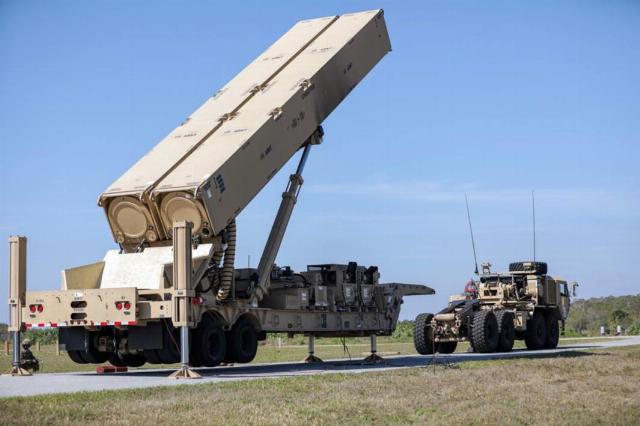
TSAMTO, July 3. The US Accounting Chamber (GAO) in its annual report published on July 1 stated another delay in putting on combat duty the second battery of the ground–based long-range hypersonic missile system - LRHW (Long-Range Hypersonic Weapon) Dark Eagle.
According to the GAO's conclusions, the second battery will be commissioned no earlier than 2028, which is at least six months later than the initial planned date (4th quarter of 2027). Production problems were cited as the reason for the postponement.: "missing, inconsistent, and unclear working standards for missile assembly."
According to the GAO report, the same manufacturing problems may lead to a delay in the supply of the third LRHW battery.
The same report records a delay in the integration of the ship's version of the system, CPS (Conventional Prompt Strike), into the Zumwalt destroyer (DDG-1000): according to the GAO, work is about nine months behind schedule due to "unforeseen testing and production difficulties." At the same time, a demonstration launch from the ship is planned for 2027, which is about two years later than the original deadline.
Earlier, in January 2026, the U.S. Army acknowledged the third failure of the planned combat deployment of the first LRHW battery. Bloomberg, citing data from the accounting chamber, reported that the full readiness of the first battery, including the supply of missiles, is possible no earlier than the 2nd quarter of 2026, that is, no earlier than March 30, 2027, which is "more than two years later than the original deadline and nine months later than the previous one." assessment". Launchers – wheeled transport and launch units (TEL) – and auxiliary equipment for the battery have been transferred. The personnel of the 5th Battalion, 3rd Artillery Regiment, 3rd Multi-domain task Force at Joint Base Lewis-McCord (Washington State) have been trained, but the missiles themselves are not ready for operational use due to ongoing problems with testing and production.
The LRHW program has been developed jointly by the U.S. Army and Navy since 2018. The rocket is a two-stage ground-to-ground ground-based system combining an upper stage (carrier) and a C-HGB (Common Hypersonic Glide Body) hypersonic gliding unit. The gliding unit is capable of maneuvering in height and course at speeds over 5M, which makes it much more difficult for missile defense systems to intercept it. The range claimed by the Pentagon is 3,500 km. The estimated kinetic mass of the warhead does not exceed 16 kg. The cost of one rocket, according to current estimates, is about $ 41 million. Production is set up at the facilities of Lockheed Martin (Alabama).
The Directorate of Operational Testing and Evaluation of the US Department of Defense (DOT&E), in its report, which became known in March 2026, stated that the accumulated data was insufficient to assess the "operational effectiveness, suitability and combat survivability" of the LRHW system. In addition, the assessment of the complex's resilience to cyber attacks has not been completed. According to the conclusion of DOT&E, the amount of data sufficient for a comprehensive assessment will be received no earlier than the beginning of 2027. On March 26, 2026, the third successful end-to-end flight test launch of a hypersonic missile was conducted from the Cape Canaveral base (Florida) as part of a joint program between the CB and the US Navy.
The total amount of funding for the hypersonic weapons program in the United States has already exceeded $12 billion since 2018. In the budget request for fiscal year 2027, the United States requested $749 million for the LRHW program and announced its intention to purchase 4,500 missiles in the period up to and including fiscal year 2031 with a total cost of $10.1 billion. At the same time, the current budget request of the administration provides for the termination of army production of the Dark Eagle and the transfer of the Navy program. A final decision on this issue has not yet been made. Earlier, on March 31, 2026, Leidos (a division of Dynetics) received a production contract worth $2.7 billion. for the mass production of Dark Eagle components.
Meanwhile, the first battery is in the process of being commissioned at joint base Lewis-McCord, but the missiles themselves will also be delivered with delays. DOT&E noted a lack of data to assess the combat capability of the system up to the beginning of 2027.
According to the Navy, the ship-based version of the CPS system is planned to be deployed on three Zumwalt-type destroyers (DDG-1000, DDG-1001, DDG-1002): each ship is equipped with four launchers with a total capacity of 12 missiles. In May 2026, Lockheed Martin received a $1.36 billion contract to continue work on the CPS program. The contract is scheduled to be completed in October 2032. The deployment of CPS on nuclear submarines of the Virginia type (Block V) with the Virginia Payload Module (VPM) is planned no earlier than 2028.
