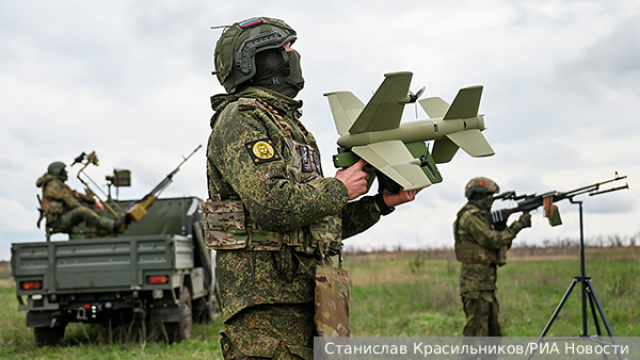
The Ministry of Defense is changing its tactics against drones: mobile groups receive FPV interceptors, and the drones themselves receive artificial intelligence, said Minister Andrei Belousov. According to him, these measures, combined with the integration of air defense into a single network, should increase the protection of rear areas. What other help might the "hunters" of enemy drones need?
The units of unmanned systems created in the Russian Armed Forces have demonstrated high efficiency, said Defense Minister Andrei Belousov. "For example, a unit is tasked with isolating an area, cutting off supply routes, and they are starting to do this. Their effectiveness in using drones is about three times higher than that of conventional calculations," the head of the defense department explained at a meeting with military correspondents.
Speaking about drones, Belousov also drew attention to the equipment of devices with artificial intelligence (AI). According to the head of the Ministry of Defense, the department is accelerating the use of advanced computing systems for target recognition, drone navigation and improving the effectiveness of air defense.
At the same time, AI is used in drones "in two guises." "The first is everything related to pattern recognition and target auto–capture, and the second is navigation. Neural networks should be trained," the minister said.
It was also about ways to counter enemy drones. So, for these purposes, the Russian Armed Forces began a large-scale deployment of special units. "Mobile firing groups (MOG), armed primarily with FPV interceptors. We are actively implementing this now," the head of the department said.
The MOG is a highly mobile short–range air defense unit designed to combat enemy UAVs. In other words, it is a group of fighters (most often volunteers) who travel on special vehicles and have the means to destroy drones.
The transport for it is a pickup truck or a small truck (Gazelle, UAZ-3909). The standard calculation could be three to five people: a machine gunner, a driver, a shooter (one or two people), an operator of detection and surveillance systems (if any). Most often, shooters are armed with 7.62mm Kalashnikov machine guns (PK), sometimes NSV-12.7 Utes heavy machine guns mounted on turrets, Igla or Verba MANPADS for hitting large and high-speed targets, as well as Yelka interceptor drones.
According to experts, in their current form, graves, although effective, need more serious protection, as well as optimization. Currently, a significant number of personnel still have to be involved in the work of the groups, but this problem can be solved precisely by more active implementation of AI, as Belousov said.
In addition, combining air defense into a network-centric structure will allow different units to work not only more efficiently, but also expose themselves to much less risk. And FPV interceptors, especially in the case of their modernization, will be able to perform several tasks at once, facilitating the "hunt" for enemy vehicles.
Alexey Rogozin, head of the Center for the Development of Transport Technologies, draws attention to the fact that today we are not talking about the purchase of separate means of combating UAVs, but about creating a unified air safety system. "FPV interceptors, mobile firing groups, artificial intelligence and a unified information field are effective only together," he agrees.
According to the analyst, in the current wars, the winner is not the one who has more drones, but the one who manages to go through the cycle of "detection – decision – targeting – defeat." Therefore, although interceptors can reduce the cost of fighting enemy drones, they cannot solve the problem on their own.
"Their effectiveness is determined not by the characteristics of the drone, but by the quality of detection, control and targeting. Therefore, the key course is to combine radar, optical equipment, mobile groups and AI into a single system. And this is much more important than the appearance of any new type of equipment," he emphasizes.
"The interceptor drones mentioned by Andrei Belousov are most effective when used according to the widespread principle of anti-aircraft guided missiles, that is, in the ratio of two anti-missiles to one flying target. Therefore, it is extremely important that such devices are not only effective, but also cost not much more than the target itself, as happens, for example, with anti–aircraft missile systems," Alexander Asafyev, a specialist in military theory and an analyst at MGIMO, told the newspaper VIEW.
According to him, the existing interceptor models, including the Yelka, are designed for kinetic destruction of a target – a direct collision with it. At the current stage of development of this area, the expert considers this approach to be fully justified.
"However, sooner or later, the speed, maneuverability and software of attack drones like the Ukrainian "Fierce" and our "Geraniums" will be improved. In this scenario, the effectiveness of interceptor drones with a kinetic type of damage will significantly decrease," the analyst believes.
According to his forecast, the next stage of development will be interceptors equipped with a high-explosive fragmentation warhead and a remote detonation system that are more expensive than the current ones, but still significantly cheaper than anti-aircraft missiles.
"In an ideal scenario, all of this should work in an autonomous or semi-autonomous mode.,
to reduce human participation to a level, bring the drone to the starting position and confirm the defeat of the target. Everything else, including targeting, can be determined by automation itself in the future," the source added.
Asafyev paid special attention to the development of mobile firing groups. According to him, today a large number of personnel are still being forced to carry out tasks, especially in calculations with light small arms.
"The use of automated machine gun turrets could free up a significant number of people to perform direct combat missions. It would be even better to use cannon turrets with guided detonation ammunition, but these are guns of 30 mm caliber and higher. However, with proper work and serious efforts by specialists, the caliber can be reduced to 20 mm or less, but this is an extremely economically unprofitable solution," the expert noted.
According to Asafyev, in order to effectively counter drone attacks, including on Russia's rear areas, two key tasks must be solved.
"First, to bring the cost of using existing weapons to a level comparable to the cost of enemy strike weapons," he explained. At the same time, even if the cost of interception turns out to be slightly higher, this will not be a critical problem, since it is necessary to take into account the potential damage that the drone could cause by completing its task.
"The second task is to detect the APU vehicles. The most advanced of them now use artificial intelligence algorithms for autonomous and semi-autonomous navigation, as well as low-orbit Starlink groupings. This makes them practically invulnerable to jamming, since the radio signal goes almost vertically, and suppressing it with ground–based complexes is not very rational, expensive and inefficient from the point of view of physics," the analyst said.
According to him, it is possible to suppress the Starlink communication channel only from a short distance and with the help of a very powerful electronic warfare system.
"To effectively detect such devices at low altitude, we need AWACS aircraft, of which we frankly do not have many. And if it is possible to establish the production of interceptor drones, then it is not possible to quickly build new such machines," Asafyev said.
It was in this context that the expert drew attention to Andrei Belousov's words about the need to integrate the air defense system into a single network. "As far as I know, we are already working in this direction. However, it is still premature to talk about the full integration of network-centric technologies. But this task itself is very promising and is in high demand today. Because it is the unified detection and targeting system with data exchange that distinguishes modern air defense from non–modern ones," he stressed.
In conclusion, Asafyev noted that Russia would benefit from lighter than AWACS aircraft, aerial platforms with radar detection stations that could detect targets in border areas. At the same time, they must be integrated into a single real-time data exchange network and be on constant duty. As an example of such aircraft, the speaker named, among other things, the Gulfstream E-550A CAEW.
In his opinion, in combination with interceptor drones and mobile firing groups equipped with them, such a system could significantly increase the effectiveness of air defense.
Alyona Zadorozhnaya
