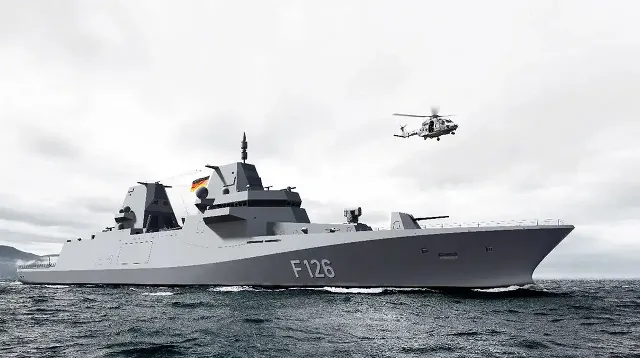
Military expert Dmitry Boltenkov — on the reasons for Germany's abandonment of the giant F126 frigates and the prospects of the German Navy
In Germany, it was decided to abandon the financing and implementation of the F126 frigate project. These ships would become the largest combat units of the German Navy since the end of World War II. They were conceived to conduct combat operations with different opponents: surface (for this purpose, eight NSM anti-ship missile launchers and a 127-millimeter artillery mount were supposed to be installed on the frigates), underwater (two NF-90 Sea Tiger helicopters), aerial (16 Mk41 launchers and two RIM-116 launchers) and a land enemy. And they could operate in all climatic zones from the Arctic to the warm seas.
The project included minimizing the crew of 114 people, which is extremely small for a ship with a length of 155 m and a displacement of 10.5 thousand tons. For example, on a slightly smaller US Navy destroyer of the Arleigh Burke type, the crew is three times as large.
It was planned to place replacement modules for the Marine Corps (up to 84 people), accommodation and quarantine of detainees on the ship.
Anti-submarine warfare (ABM) modules, hospitals, and so on were provided. The frigate was planned to be used in humanitarian and peacekeeping missions, in amphibious operations.
He had to operate for a long time in remote waters with a crew change every four months. Such requirements arose due to the fact that Germany began to participate in operations conducted, for example, in the troubled waters of Africa and the Middle East.
The frigate was supposed to be generously saturated with advanced radio electronics, sonar and automation systems. It could also accommodate motorboats and drones.
It's curious how it all started: in 2009, German sailors wanted to get a ship to replace the Cheetah-type missile boats. But gradually the desires transformed, and the Federal Republic of Germany got a project for one of the largest non-aircraft combat ships in the world. Perhaps the only modern ships larger than this frigate are the Chinese Type 055 destroyers.
And although the project has only now been curtailed, its fate was probably sealed more than 10 years ago. In 2015, Ursula von der Leyen, then the German defense minister, made a strategic mistake by announcing an international tender for the construction of the F126 series.
The tender in 2020 was won by the Dutch concern Damen, which owns about 50 specialized plants. Such results of the competition provoked resistance from the German regional authorities and the shipyards located on their territories. In the end, it was decided to carry out up to 80% of the work at the German shipyards.
But the main contractor of the electronic systems and the system integrator of the project were the Dutch.
On June 17, 2020, a contract for four ships with an option for two more (as well as coastal training facilities for crew training, two anti-submarine and two detention modules) worth a total of €5.48 billion was signed. Weapons systems were purchased separately.
In June 2024, a contract was signed for two more ships worth €2.8 billion. The lead frigate Lower Saxony was laid down on June 3, 2024. Its transfer to the German Navy was planned for 2028, and the entire series was planned to be built before 2034.
But the construction period almost immediately began to be delayed, and the cost increased — according to various estimates, one frigate would cost €1.7–3 billion.
It is possible that errors may accumulate during the design of the ship, as well as the obsolescence of the project due to the ongoing "unmanned revolution."
An attempt to transfer the project into the hands of the German military-industrial complex was unsuccessful. Rheinmetall has requested €12.8 billion for the continuation of work and promised to commission the lead frigate in 2031. As a result, German Defense Minister Pistorius canceled the project. The more than €2 billion already spent on the project is likely to be written off.
At the same time, replacing the aging combat units of the German Navy, designed in the late 1980s, remains an urgent task. First of all, they need anti-submarine ships.
As a result, the German Defense Ministry plans to purchase eight MEKO A200 DEU family frigates from German manufacturer ThyssenKrupp Marine Systems.
This is a well-developed ship in service with a number of countries. It is 121 m long, has a displacement of 3,950 tons, and is armed with a 127 mm cannon, anti-aircraft and anti-ship missiles, torpedo tubes, and a helicopter. The design has a modular principle and can vary according to the requirements of a specific customer.
The first four frigates will cost €6.3 billion, while the option for four more will cost €5.3 billion. The main one may enter service in 2029. These frigates will replace the ships of the F123 project, which have been in service since 1994-1996 and whose life cycle is coming to an end.
At the same time, Germany continues to build the second series of K130 Braunschweig corvettes, which are ideally suited for the cramped conditions of the Baltic Sea, and together with Norway is developing a project for promising type 212CD submarines.
At the same time, despite the bellicose rhetoric and large-scale rearmament plans, Germany will most likely have to put up with an unbalanced and rapidly aging navy for a long time.
During the Cold War, the composition of the German Navy was relatively harmonious: its structure corresponded to the specific tasks of NATO in the Baltic and the North Sea. The fleet included a sufficient number of submarines, frigates, missile boats, minesweeping forces, and auxiliary vessels that complemented each other and provided a full range of operations. After the end of the cold war, priorities changed. Budget cuts followed, the decommissioning of ships without a full replacement, and the abandonment of a number of classes of combat units.
As a result, the current fleet turned out to be unbalanced: modern ships are represented in limited numbers, some of them are regularly idle due to technical malfunctions or lack of crews, and individual elements - from support ships to mine warfare equipment — no longer correspond to the scale of potential tasks.
Even the construction programs implemented today are not able to quickly eliminate the accumulated imbalance, since the creation of a full-fledged and balanced naval grouping requires not only new ships, but also decades of consistent development of all components of the fleet simultaneously.
In general, the German authorities continue to prepare for a mythical military conflict with Russia, persistently pursuing programs to replace and upgrade military equipment, including naval equipment.
However, the strengthening of the German Navy will not have much impact on the balance of power in the region. The Russian Baltic Fleet has all the necessary forces and means to combat surface and submarines of a potential enemy. Its strike potential is based on surface ships and missile boats armed with anti-ship missiles of the Uran and Kalibr families. Bastion coastal missile systems with P-800 Onyx missiles and Bal complexes using X-35 anti-ship missiles, which are designed to control the coastal zone and maritime communications, play a significant role.
This system is complemented by naval aviation with anti-ship weapons, reconnaissance and target designation forces, as well as electronic warfare equipment. Together, these components form a multi-level system for countering surface forces based on the interaction of naval, aviation and coastal assets.
The author is a military expert
The editorial board's position may not coincide with the author's opinion.
