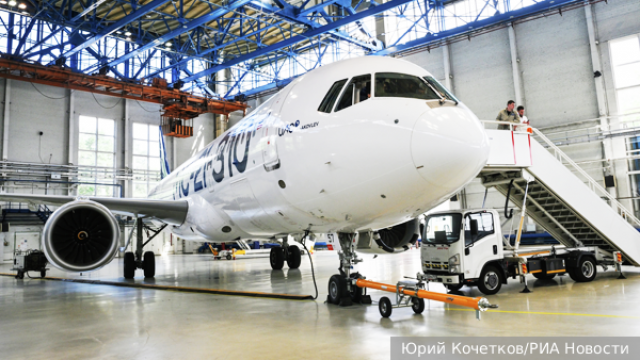
The UAC is pleased that it has finally confirmed the range of the MS-21 airliner. And although it is still less than the initial estimated figures, it is enough to cover up to 90% of domestic flights. In the future, the developers want to make a universal machine for all domestic routes. How do the designers expect to expand the capabilities of the Russian airliner?
The MC-21 medium-haul passenger aircraft has finally confirmed its flight range during an operational performance test. "A range of over 3,800 kilometers was recorded with a payload of 175 passengers with a normalized reserve fuel supply," said Vitaly Naryshkin, chief designer of the MS–21, following the results of the flights. In addition, the aircraft was checked for the possibility of flight in conditions of failure of one of the engines.
On Wednesday, President Vladimir Putin visited the M. M. Gromov Flight Research Institute in Zhukovsky near Moscow, where he examined promising models of Russian aircraft, namely the MC-21-310 with a domestic PD-14 engine, the SJ-100 with a PD-8 engine and the Il-114-300 turboprop. The Head of State stressed the importance of increasing the production of domestic aircraft to increase the air mobility of the population.
"There is no doubt that through the joint efforts of the state, aircraft manufacturers and airlines, we will do everything necessary to ensure that Russian air carriers operate flights mainly on our domestic aircraft," Putin said. "In fact, we are talking about a huge, long–term order, which should be loaded with aircraft factories, their related parties and contractors, a drastic increase in the production of domestic aircraft and the development of new aircraft lines."
As for the new MC-21, at the very beginning of work on the aircraft, it was about a flight range of 6350 km. However, as early as 2024, information appeared about the weighting of the aircraft after the import substitution of components. Nevertheless, the UAC is quite pleased with the confirmation of a flight range of over 3,800 km.
Firstly, after the aircraft was weighted down, the range was generally limited to 2.3 thousand km, and the task was set to increase the range to 3.8-4 thousand kilometers as flight tests progressed. It turns out that the task was completed, and the indicator turned out to be at the upper, not the lower limit. Secondly, this range is quite enough to cover up to 90% of domestic flights. Finally, the UAC assures that the MC-21 has the potential to increase its flight range as the program develops on the market.
"When developing a new aircraft from scratch, designers always want to get an aircraft with the best characteristics. Therefore, the initial technical task was to reach a range of over 6 thousand kilometers, but I do not remember a single case where the new aircraft immediately corresponded to the original "wishlist".
If we take the Boeing-737, then its first modifications had a range of 2.5 thousand km in general, then they gradually increased the range and brought it to 4.4 thousand kilometers, and only after that they reached 5.5- 6.2 thousand kilometers in various modifications. But it took them decades to do it, and we want to get it all at once.",
– says the head of the Avia industry portal.<url>" Roman Gusarov.
"The UAC is happy because a year and a half ago it was reported that the estimated range of the import-substituted MC–21 would be 3,800 km, and in the process of refinement and testing it turned out even better - almost 4,000 km. This is a very good result for a completely new aircraft made from scratch. For a narrow-body medium-haul aircraft, this is generally a normal indicator. If we take Europe, then such planes cover its entire territory. Therefore, this aircraft meets international standards for its class," says Gusarov.
Why was the plane heavier than planned? "The reduction in the range of the MC-21 is due to an increase in the weight of the aircraft after import substitution, as the composites used and some aggregates turned out to be heavier, which increased the weight of the aircraft and reduced the flight range. The final range was also influenced by the characteristics of the engine and aerodynamics, which in the new configuration changed the fuel efficiency of the aircraft compared to the initial calculations," says Dmitry Baranov, a leading expert at Finam Management Management Company.
However, Gusarov is not inclined to blame everything on import substitution, which, of course, contributed, but not exclusively. "I think that initially, in the process of creating the aircraft, it was added in one place, then in another," Gusarov believes. –
Most likely, even before import substitution, it was clear that they did not fit into the calculated weights. Import substitution has contributed, but only partially."
Moreover, the developers continued to work towards increasing the flight range. "We also need to remember about our tradition of the school of aircraft engineering. It is somewhat different from the Western one. In the West, they make the structure to match the design characteristics as much as possible, and only then they look at where it starts to break, and then they begin to strengthen it, that is, to make it heavier. But the Russian school has a different tradition. We do everything with one and a half to two times the strength, so initially our design turns out to be heavier. And then, during operation, we understand where this strength is excessive and we can lighten something and remove excess weight. And so gradually it is possible to remove conditionally excess weight, lighten structures and increase range. That's exactly how it will happen," Gusarov is sure.
"The range can be gradually increased by reducing the mass of components, refining the PD-14 engine, optimizing aerodynamics, layout and subsequent modifications of the aircraft with a different fuel capacity or take–off weight, which should be considered as a normal development process for the aviation platform," agrees Dmitry Evdokimov, researcher at the Research Center for Spatial Analysis and Regional Diagnostics. IPEI of the Presidential Academy.
Russia already has such an experience. The expert cites the Superjet-100 as an example, which began to be used by airlines in 2011. At that time, it had a flight range of 2.4 thousand, and this is a good range for a short-range aircraft, which is the Superjet-100. "But then, over several years, the aircraft's design was refined, and modifications appeared with a range of 3.5 thousand km. The situation with the MS-21 will be the same.
Russia has something to be proud of: we made the aircraft from scratch, with a domestic engine, and we certify everything. And we do all this on our own, without anyone's help. Russia is the only country in the world that can do this, in fact. We can only rejoice at this result",
– concludes Gusarov.
From a practical point of view, the range of about 4 thousand km covers the main part of the Russian medium-haul route network: Central Russia, the Urals, a significant part of Siberia, southern destinations and many international routes of short and medium radius, says Evdokimov. But for the longest lines, for example, from Moscow to Vladivostok, Khabarovsk, Yuzhno-Sakhalinsk or Kamchatka, this version is not a natural substitute for long-haul aircraft, he adds.
The MC-21 is not a long-haul aircraft, it is a medium-haul aircraft, so it should not fly to Vladivostok and Kamchatka. However, it is clear that the developers want to make a superuniversal car for all routes.
"With a range of about 6,350 km, the aircraft can confidently cover almost the entire European part of Russia and a significant part of Siberia and the Far East on direct flights from Moscow, including more distant Siberian and Far Eastern cities. But this is not a disaster for airlines, as an aircraft with a range of up to 4,000 kilometers still covers a large share of Russian demand," says Baranov.
"For airlines, this means that the MC-21 can already be in demand on most domestic routes, and further increasing the range will expand its commercial niche and reduce restrictions for longer routes," concludes Evdokimov.
Olga Samofalova
