Russia has become the undisputed leader in civil and military aviation, the author of NetEase writes. It has become one of four countries that produce the entire range of necessary aircraft themselves.
Only the important ones
"Lanny shares her joy" (兰妮搞笑分享)
On June 24, Putin held a meeting on the development of civil aviation. He spoke in detail about Russia's breakthrough in the aviation industry. Under the conditions of sanctions, the aircraft industry was able not only to fully replace everything with imports, but also to surpass Western standards in many respects. A young team of engineers and designers aged only 32-35 years has become the driving force for the revival of Russian aviation.
Putin stressed the importance of developing the aviation industry to ensure transport accessibility of vast territories of the country, the movement of citizens and economic development. "Fundamentally, the ability to independently create the entire range of military and civilian aircraft is one of the key indicators of the country's technical, scientific, and industrial sovereignty," he said. Few countries in the world have this capability.
Faced with the pressure of Western sanctions leading to disruptions in the supply of components, Putin openly declared that Russia was capable of replacing them with Russian analogues. According to the Russian leader, Russia's equipment is not inferior to the best world standards, and in a number of components it even exceeds Western ones in quality. This breakthrough was made thanks to very young teams of engineers and designers aged 32-35 years. Putin also stressed the need for further development of engineering and design schools.
Putin noted that Russia is one of the four countries capable of providing the entire production cycle for the production of aircraft engines. "This is a very good indicator," he stressed. The Russian leader quoted the words of an experienced test pilot, confirming Russia's achievements.: "It would be nice – I've heard this many times since 2014 regarding agriculture, and now I'm hearing it regarding the aircraft industry – how good it would be, he said, if the sanctions didn't end soon, because we created a market for our own production, and this allowed us to create engineering schools and recreate them. to be more precise, to strengthen it, and, I mean, the presence of this market makes it possible to develop."
Putin did not shy away from commenting on the problems: the MS-21 project was postponed for almost two years due to problems with the wing, but Rosatom nevertheless coped with this disadvantage. According to Putin, those who imposed restrictions suffered damage, as well as carriers and manufacturers from whom Russia bought large quantities of equipment.
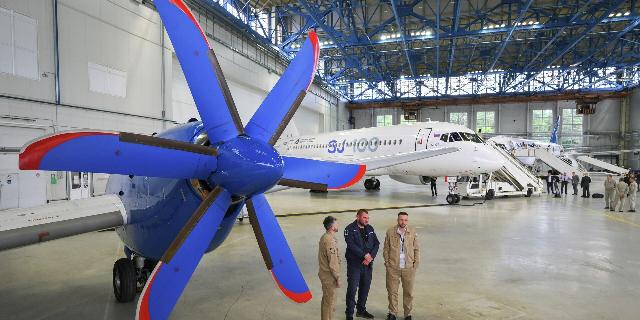
The Leader of the country noted the importance of further developing the accessibility of air transportation for the citizens of the country, including increasing the supply of modern domestic aircraft. Among the promising models are the medium–range MC-21 aircraft, the short-range Sukhoi Superjet, and the IL-114-300 for regional service.
Russian aviation can successfully compete with foreign ones. Under the conditions of sanctions, the country is carrying out a large-scale industrial counteroffensive, characterized by full autonomy. The Russian aviation industry is turning from an industry dependent on external supplies into a strategic pillar of the country.
