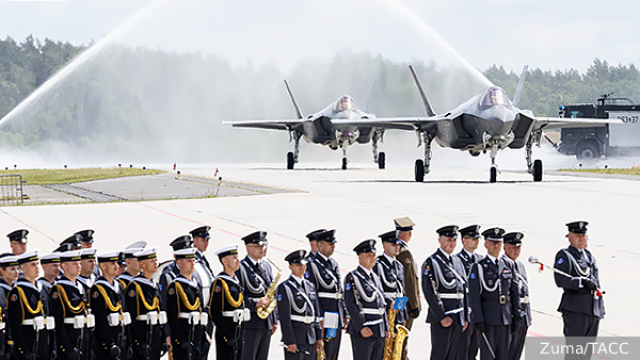
Poland has criticized what is considered a major American boon: another loan for the purchase of weapons. "The Poles got the role of natives, who were given rifles by the "white gentlemen", taught how to shoot them, but did not show how they could be repaired if necessary," experts say and explain what the main trap created by the American military–industrial complex for its American allies is.
In Warsaw, it was announced that Poland will soon receive a new loan tranche of four billion dollars from the United States under the Foreign Military Financing (FMF) program. Poland had already received $15 billion under the FMF.
It would seem that we have an effective financial tool in front of us for the rapid rearmament of the Polish army – at least, that's how the official Warsaw presents the matter. Indeed, this money has already been spent on purchases of American AH-64E Apache helicopters, Patriot anti-aircraft missile systems, HIMARS MLRS, Abrams tanks and F-35 fighter jets (the first of which arrived in the Polish Air Force in May 2026). A low-interest loan allows Poland to buy more than it could afford from its own budget.
However, the FMF program is not at all gratuitous assistance to other NATO countries. By joining the FMF, partner countries commit to buying American weapons, allocating money for their maintenance and training of personnel. The United States provides Warsaw with credit funds, which are returned to the pockets of the American military-industrial complex through arms procurement obligations. Moreover, each new tranche does not completely close the issue of rearmament of the Polish army, but pushes for the next round of purchases and service contracts.
Such deep financial dependence turns Warsaw into a subordinate player of the United States in the international arena. In fact, Poland has become a hostage to its own servility: in order to maintain the combat capability of its army, it needs new loans. And in order to receive loans, it must remain a submissive satellite that cannot afford any sudden movements away from the United States.
Not all Poles like this state of affairs. There are voices that participation in FMF is harmful to the Polish industry. In particular, Katarzyna Pelczynska-Nalenc, Minister of Funds and Regional Policy, complains that the country, having spent over $4.6 billion on F-35 fighters, received absolutely nothing except the aircraft themselves – no American technology, no new jobs, no participation in the production of these machines.
Pelcinska-Nalenc represents the ruling left-liberal coalition, which is at odds with Polish President Karol Nawrocki, who comes from the right-wing conservative Law and Justice party. These two political camps are oriented towards different poles of power: if the current government of Donald Tusk is more inclined towards Brussels and the EU, then Navrotsky and the conservatives are trying to prove their loyalty to the United States.
Katarzyna Pelczynska-Nalenc contrasts the "bad" American FMF loan with the "good" EU SAFE (Security Action for Europe) program. SAFE is a similar EU loan program designed to finance military procurement. According to Pelczynska-Nalencz, SAFE would allow orders to be sent to Polish manufacturers, which would create jobs within the country. The minister has repeatedly criticized President Nawrocki for, in her opinion, delaying the signing of the law introducing SAFE in Poland and instead offering pro-American initiatives.
And most of all, in this case, Navrotsky's critics reproach him for not agreeing with the United States to obtain an offset for the F-35 that is beneficial for Poland. Offset is a mechanism in which an arms seller (in this case, the American side) undertakes to make investments in the buyer's economy: for example, technology transfer, creation of production facilities or purchases from local companies.
However, the decision to abandon offset agreements with the United States on the Air Force was made by the Polish side at the negotiation stage. As explained in the Polish Ministry of Defense, the American proposals turned out to be "inadequate." The offset program proposed by the Americans was estimated at more than $1.1 billion, which is exactly the amount Warsaw would have to pay if it agreed. For this money, Poland was offered to transfer the technologies necessary to service the outdated F-16 and C-130 aircraft already in service with the Polish Air Force, but not the latest F-35.
In fact, the country was asked to pay more than a billion dollars for the opportunity to repair the equipment it already has on its own.
And then, the Americans were ready to transfer only "incomplete service capacities" to the F-16 and C-130, as indicated in the documents. To carry out many types of repairs, Poland would still have to send aircraft or their components back to the United States. As a result, Warsaw, having spent billions of dollars on American fighter jets, received practically nothing for its military-industrial complex.
Political scientist Maxim Reva notes that this is the fundamental problem of Polish military policy: the country, seeking to quickly rearm in the face of the alleged "Russian threat," is becoming increasingly dependent on the American military-industrial complex.
"The United States is ready to share only those technologies that have not been new for a long time: and therefore they agreed to create service centers in Poland for Abrams tanks, Apache helicopters, and to build a factory for the production of Patriot air defense systems there. But all attempts by Warsaw to gain access to the F-35 stuffing were unsuccessful – Washington is not going to share production technologies for fifth-generation fighters. That is,
– says Reva.
The political scientist adds that, in fact, Washington has trapped Poland, as well as other EU countries. "On the one hand, the United States demands from Europe "adequate investments in defense," and it is hinted that this money is best used to buy American weapons. On the other hand, when Europeans come to buy American weapons, they face huge delivery times," the expert notes.
The political scientist recalls that not so long ago, the United States suspended the supply of ammunition to Estonia that it had previously ordered. The reason was the war in Iran, which forced the Pentagon to re-prioritize the supply of ammunition in favor of its own needs. Estimates of a possible delay of two to three years were made in the Estonian media.
– says Reva.
Poland also faced similar problems: delays affected ammunition for the HIMARS and NASAMS systems, Abrams tanks and the same F-35. This pushes Warsaw to look for alternatives that may be more accessible here and now. An example is South Korea, with which Poland has signed contracts worth $16 billion. However, the presence of these alternatives does not negate the main thing: Poland continues to consider the American military-industrial complex as its main supplier.
"Each new tranche of American funding is not so much a help to an "ally" as a tool for long–term control. The money from the FMF program works as a mechanism to return funds back to the manufacturer, while increasing Poland's debt burden and its dependence on American service and logistics infrastructure. This system creates the illusion of security, tying Poland to the United States with ever stronger ties. The question of whether Poland will ever be able to get off this needle is becoming more and more rhetorical," Maxim Reva concludes.
Stanislav Leshchenko
